
Pulp Fiction · page 24 of 68
Aboriginal Science Fiction, Issues 57–58 — page 24: what you’re looking at
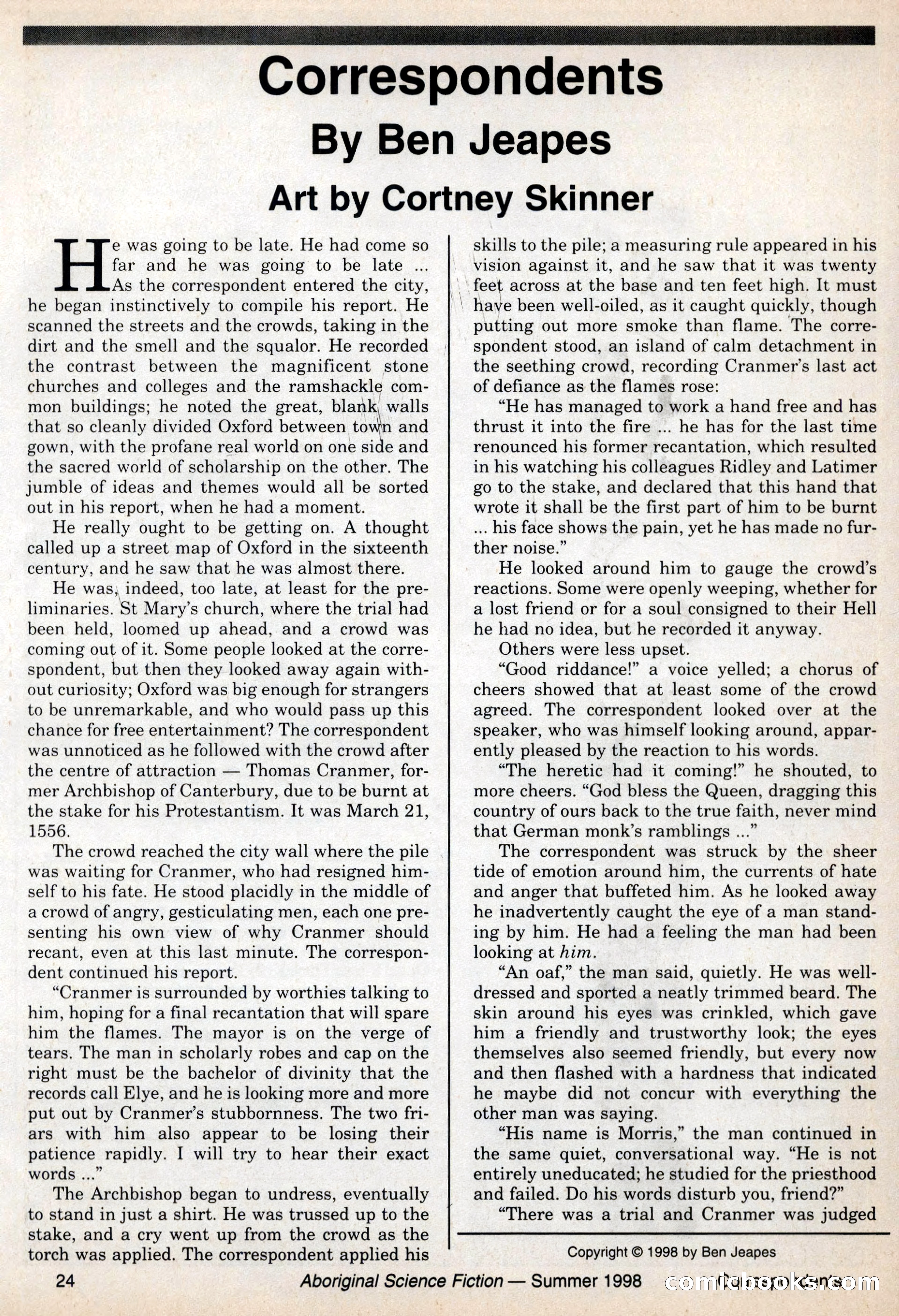
A restored page from Pulp Fiction. Page through the whole issue in the reader above.
📄 Transcribed text from this page (OCR, searchable)
Machine-transcribed from the original scan — historical spelling and the odd misread are preserved.
Correspondents By Ben Jeapes Art by Cortney Skinner e was going to be late. He had come so H: and he was going to be late ... As the correspondent entered the city, he began instinctively to compile his report. He scanned the streets and the crowds, taking in the dirt and the smell and the squalor. He recorded the contrast between the magnificent stone churches and colleges and the ramshackle com- mon buildings; he noted the great, blank, walls that so cleanly divided Oxford between town and gown, with the profane real world on one side and the sacred world of scholarship on the other. The jumble of ideas and themes would all be sorted out in his report, when he had a moment. He really ought to be getting on. A thought called up a street map of Oxford in the sixteenth century, and he saw that he was almost there. He was, indeed, too late, at least for the pre- liminaries. St Mary’s church, where the trial had been held, loomed up ahead, and a crowd was coming out of it. Some people looked at the corre- spondent, but then they looked away again with- out curiosity; Oxford was big enough for strangers to be unremarkable, and who would pass up this chance for free entertainment? The correspondent was unnoticed as he followed with the crowd after the centre of attraction — Thomas Cranmer, for- mer Archbishop of Canterbury, due to be burnt at the stake for his Protestantism. It was March 21, 1556. The crowd reached the city wall where the pile was waiting for Cranmer, who had resigned him- self to his fate. He stood placidly in the middle of a crowd of angry, gesticulating men, each one pre- senting his own view of why Cranmer should recant, even at this last minute. The correspon- dent continued his report. “Cranmer is surrounded by worthies talking to him, hoping for a final recantation that will spare him the flames. The mayor is on the verge of tears. The man in scholarly robes and cap on the right must be the bachelor of divinity that the records call Elye, and he is looking more and more put out by Cranmer’s stubbornness. The two fri- ars with him also appear to be losing their patience rapidly. I will try to hear their exact words ...” The Archbishop began to undress, eventually to stand in just a shirt. He was trussed up to the stake, and a cry went up from the crowd as the torch was applied. The correspondent applied his skills to the pile; a measuring rule appeared in his vision against it, and he saw that it was twenty _' feet across at the base and ten feet high. It must \ have been well-oiled, as it caught quickly, though putting out more smoke than flame. The corre- spondent stood, an island of calm detachment in the seething crowd, recording Cranmer’s last act of defiance as the flames rose: “He has managed to work a hand free and has thrust it into the fire ... he has for the last time renounced his former recantation, which resulted in his watching his colleagues Ridley and Latimer go to the stake, and declared that this hand that wrote it shall be the first part of him to be burnt ... his face shows the pain, yet he has made no fur- ther noise.” He looked around him to gauge the crowd’s reactions. Some were openly weeping, whether for a lost friend or for a soul consigned to their Hell he had no idea, but he recorded it anyway. Others were less upset. “Good riddance!” a voice yelled; a chorus of cheers showed that at least some of the crowd agreed. The correspondent looked over at the speaker, who was himself looking around, appar- ently pleased by the reaction to his words. “The heretic had it coming!” he shouted, to more cheers. “God bless the Queen, dragging this country of ours back to the true faith, never mind that German monk’s ramblings ...” The correspondent was struck by the sheer tide of emotion around him, the currents of hate and anger that buffeted him. As he looked away he inadvertently caught the eye of a man stand- ing by him. He had a feeling the man had been looking at him. “An oaf,” the man said, quietly. He was well- dressed and sported a neatly trimmed beard. The skin around his eyes was crinkled, which gave him a friendly and trustworthy look; the eyes themselves also seemed friendly, but every now and then flashed with a hardness that indicated he maybe did not concur with everything the other man was saying. “His name is Morris,” the man continued in the same quiet, conversational way. “He is not entirely uneducated; he studied for the priesthood and failed. Do his words disturb you, friend?” “There was a trial and Cranmer was judged Copyright © 1998 by Ben Jeapes 24 Aboriginal Science Fiction— Summer 1998 o)pj\Polersye) *C3m’s0)/)h)