
Pulp Fiction, 1950 · page 96 of 135
A. Merritt's Fantasy Magazine, October 1950 — page 96: what you’re looking at
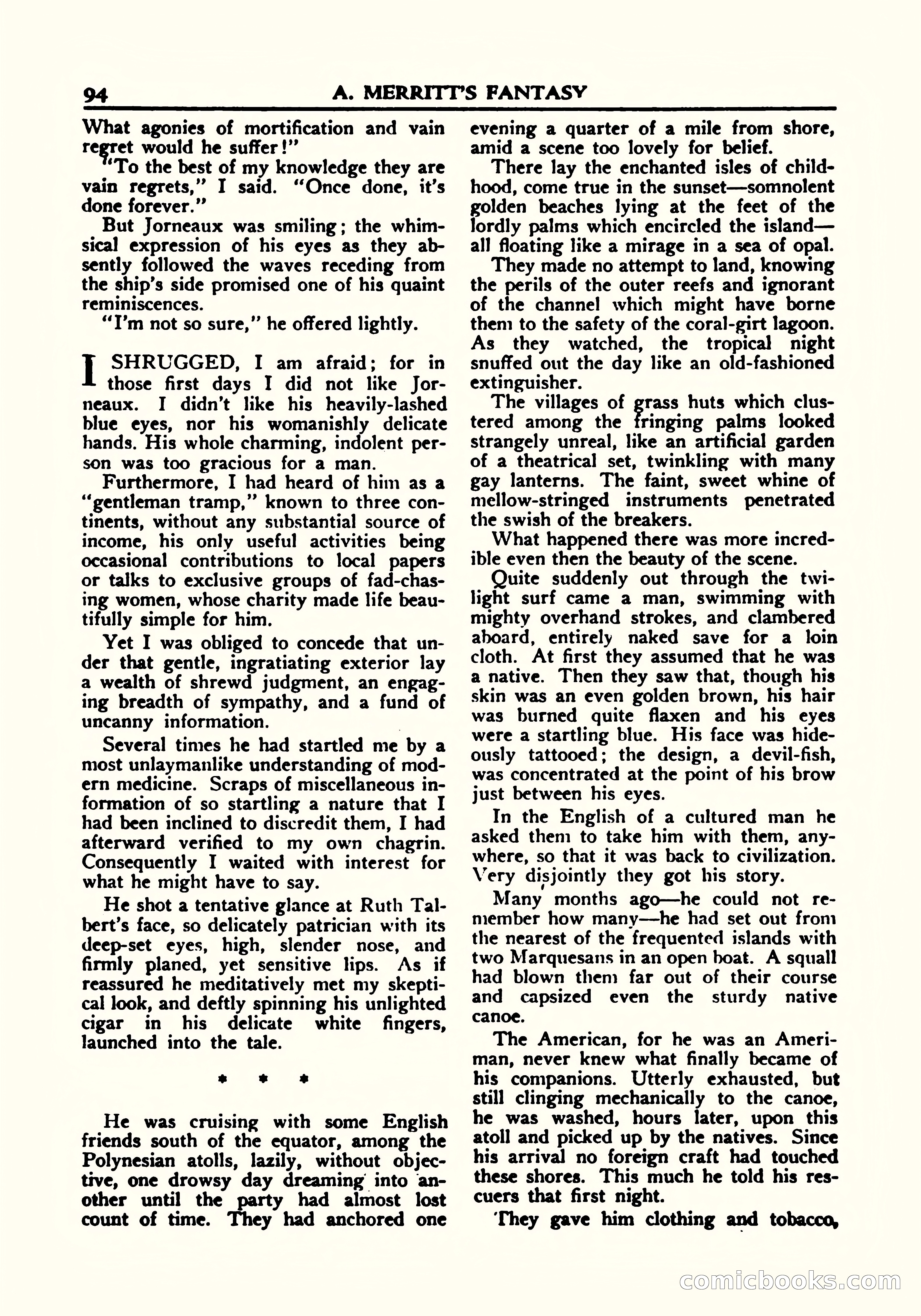
A restored page from Pulp Fiction, 1950. Page through the whole issue in the reader above.
📄 Transcribed text from this page (OCR, searchable)
Machine-transcribed from the original scan — historical spelling and the odd misread are preserved.
94 A. MERRITT’S FANTASY What agonies of mortification and vain regret would he suffer!’ “To the best of my knowledge they are vain regrets,” I said. “Once done, it’s done forever.” But Jorneaux was smiling; the whim- sical expression of his eyes as they ab- sently followed the waves receding from the ship’s side promised one of his quaint reminiscences. “I’m not so sure,” he offered lightly. SHRUGGED, I am afraid; for in those first days I did not like Jor- neaux. I didn’t like his heavily-lashed blue eyes, nor his womanishly delicate hands. His whole charming, indolent per- son was too gracious for a man. Furthermore, I had heard of him as a “gentleman tramp,” known to three con- tinents, without any substantial source of income, his only useful activities being occasional contributions to local papers or talks to exclusive groups of fad-chas- ing women, whose charity made life beau- tifully simple for him. Yet I was obliged to concede that un- der that gentle, ingratiating exterior lay a wealth of shrewd judgment, an engag- ing breadth of sympathy, and a fund of uncanny information. Several times he had startled me by a most unlaymanlike understanding of mod- ern medicine. Scraps of miscellaneous in- formation of so startling a nature that I had been inclined to discredit them, I had afterward verified to my own chagrin. Consequently I waited with interest for what he might have to say. He shot a tentative glance at Ruth Tal- bert’s face, so delicately patrician with its deep-set eyes, high, slender nose, and firmly planed, yet sensitive lips. As if reassured he meditatively met my skepti- cal look, and deftly spinning his unlighted cigar in his delicate white fingers, launched into the tale. a * x He was cruising with some English friends south of the equator, among the Polynesian atolls, lazily, without objec- tive, one drowsy day dreaming into an- other until the party had almost lost count of time. They had anchored one evening a quarter of a mile from shore, amid a scene too lovely for belief. There lay the enchanted isles of child- hood, come true in the sunset—somnolent golden beaches lying at the feet of the lordly palms which encircled the island— all floating like a mirage in a sea of opal. They made no attempt to land, knowing the perils of the outer reefs and ignorant of the channel which might have borne them to the safety of the coral-girt lagoon. As they watched, the tropical night snuffed out the day like an old-fashioned extinguisher. The villages of grass huts which clus- tered among the fringing palms looked strangely unreal, like an artificial garden of a theatrical set, twinkling with many gay lanterns. The faint, sweet whine of mellow-stringed instruments penetrated the swish of the breakers. What happened there was more incred- ible even then the beauty of the scene. Quite suddenly out through the twi- light surf came a man, swimming with mighty overhand strokes, and clambered aboard, entirely naked save for a loin cloth. At first they assumed that he was a native. Then they saw that, though his skin was an even golden brown, his hair was burned quite flaxen and his eyes were a startling blue. His face was hide- ously tattooed; the design, a devil-fish, was concentrated at the point of his brow just between his eyes. In the English of a cultured man he asked them to take him with them, any- where, so that it was back to civilization. Very disjointly they got his story. Many months ago—he could not re- member how many—he had set out from the nearest of the frequented islands with two Marquesans in an open boat. A squall had blown them far out of their course and capsized even the sturdy native canoe. The American, for he was an Ameri- man, never knew what finally became of his companions. Utterly exhausted, but still clinging mechanically to the canoe, he was washed, hours later, upon this atoll and picked up by the natives. Since his arrival no foreign craft had touched these shores. This much he told his res- cuers that first night. They gave him clothing and tobacco, (C(O) nn) (€ 6)(0)©) Ss (C(O)