
Pulp Fiction, 1950 · page 94 of 135
A. Merritt's Fantasy Magazine, October 1950 — page 94: what you’re looking at
A restored page from Pulp Fiction, 1950. Page through the whole issue in the reader above.
📄 Transcribed text from this page (OCR, searchable)
Machine-transcribed from the original scan — historical spelling and the odd misread are preserved.
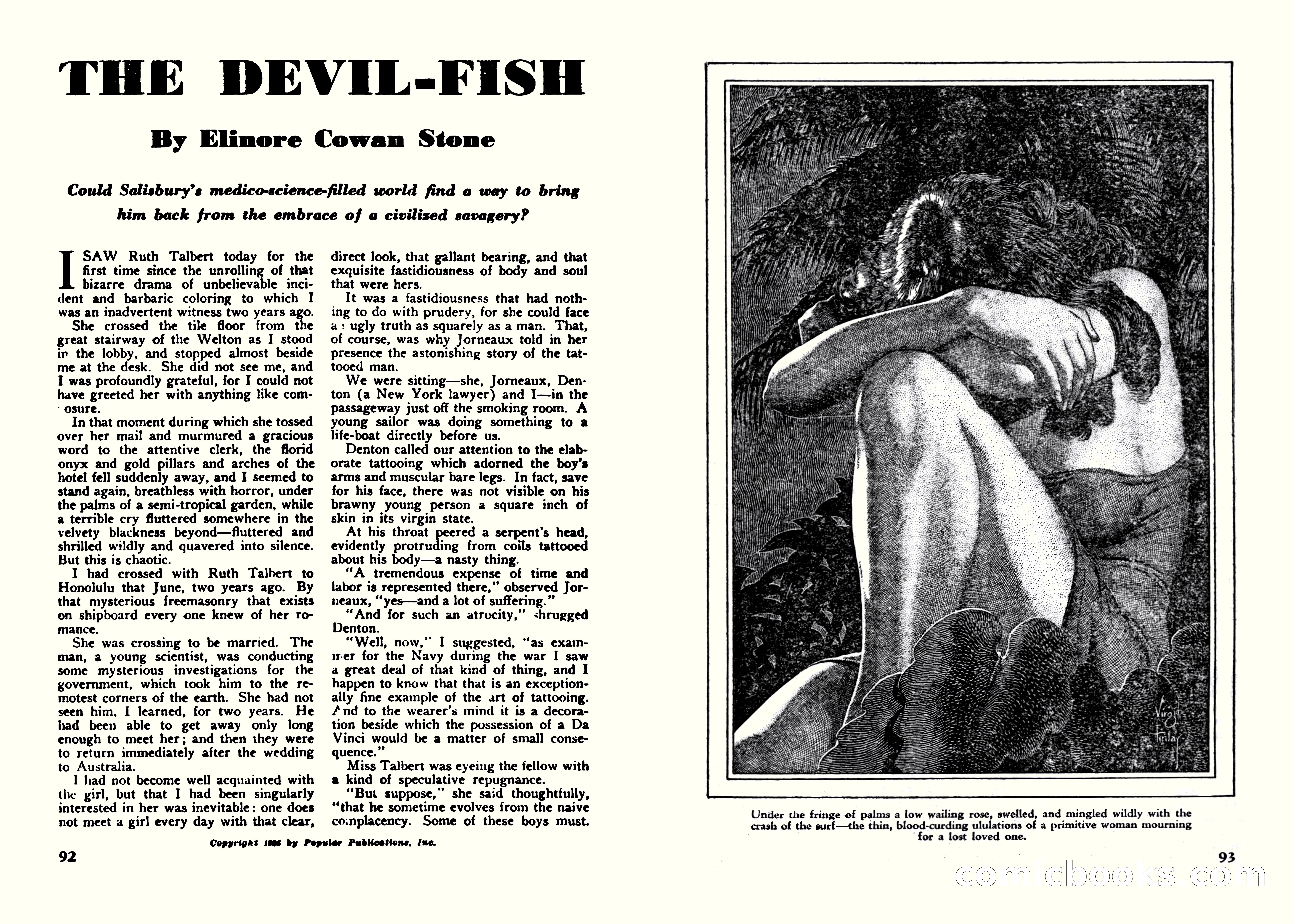
THE DEVIL-FISH By Elinore Cowan Stone Could Salisbury’s medico-science-filled world find a way to bring him back from the embrace of a civilized savagery? SAW Ruth Talbert today for the first time since the unrolling of that bizarre drama of unbelievable inci- dent and barbaric coloring to which I was an inadvertent witness two years ago. She crossed the tile floor from the great stairway of the Welton as I stood in the lobby, and stopped almost beside me at the desk. She did not see me, and I was profoundly grateful, for I could not have greeted her with anything like com- ‘ osure. In that moment during which she tossed over her mail and murmured a gracious word to the attentive clerk, the florid onyx and gold pillars and arches of the hotel fell suddenly away, and I seemed to stand again, breathless with horror, under the palms of a semi-tropical garden, while a terrible cry fluttered somewhere in the velvety blackness beyond—fiuttered and shrilled wildly and quavered into silence. But this is chaotic. I had crossed with Ruth Talbert to Honolulu that June, two years ago. By that mysterious freemasonry that exists on shipboard every one knew of her ro- mance. She was crossing to be married. The man, a young scientist, was conducting some mysterious investigations for the government, which took him to the re- motest corners of the earth. She had not seen him, I learned, for two years. He had been able to get away only long enough to meet her; and then they were to return immediately after the wedding to Australia. I had not become well acquainted with the girl, but that I had been singularly interested in her was inevitable: one does not meet a girl every day with that clear, direct look, that gallant bearing, and that exquisite fastidiousness of body and soul that were hers. It was a fastidiousness that had noth- ing to do with prudery, for she could face a: ugly truth as squarely as a man. That, of course, was why Jorneaux told in her presence the astonishing story of the tat- tooed man. We were sitting—she, Jorneaux, Den- ton (a New York lawyer) and I—in the passageway just off the smoking room. A young sailor was doing something to a life-boat directly before us. Denton called our attention to the elab- orate tattooing which adorned the boy’s arms and muscular bare legs. In fact, save for his face, there was not visible on his brawny young person a square inch of skin in its virgin state. At his throat peered a serpent’s head, evidently protruding from coils tattooed about his body—a nasty thing. “A tremendous expense of time and labor is represented there,” observed Jor- neaux, “‘yes—and a lot of suffering.” “And for such an atrocity,” shrugged Denton. “Well, now,” I suggested, “as exam- irer for the Navy during the war I saw a great deal of that kind of thing, and I happen to know that that is an exception- ally fine example of the art of tattooing. fnd to the wearer’s mind it is a decora- tion beside which the possession of a Da Vinci would be a matter of small conse- quence.” Miss Talbert was eyeing the fellow with a kind of speculative repugnance. “But suppose,”’ she said thoughtfully, “that he sometime evolves from the naive conplacency. Some of these boys must. Copyright 1986 by Pepuler Publications, Inc. 92 HK ANY Hi i i A 4 SH) \ HH j it da Wh ii Ng PANY TBH HAAN a in | Ne \ | } ‘ \\\ \ \ wie Wh i i} uy ii} ity hy f My / Mii i Hii Hi Hheas (fh il s i pH) der, ” Hutt H(t Kt IRON Under the fringe of palms a low wailing rose, swelled, and mingled wildly with the crash of the surf—the thin, blood-curding ululations of a primitive woman mourning for a lost loved one. (CO in (C DOO CS 93 (GO)