
Pulp Fiction, 1950 · page 86 of 135
A. Merritt's Fantasy Magazine, October 1950 — page 86: what you’re looking at
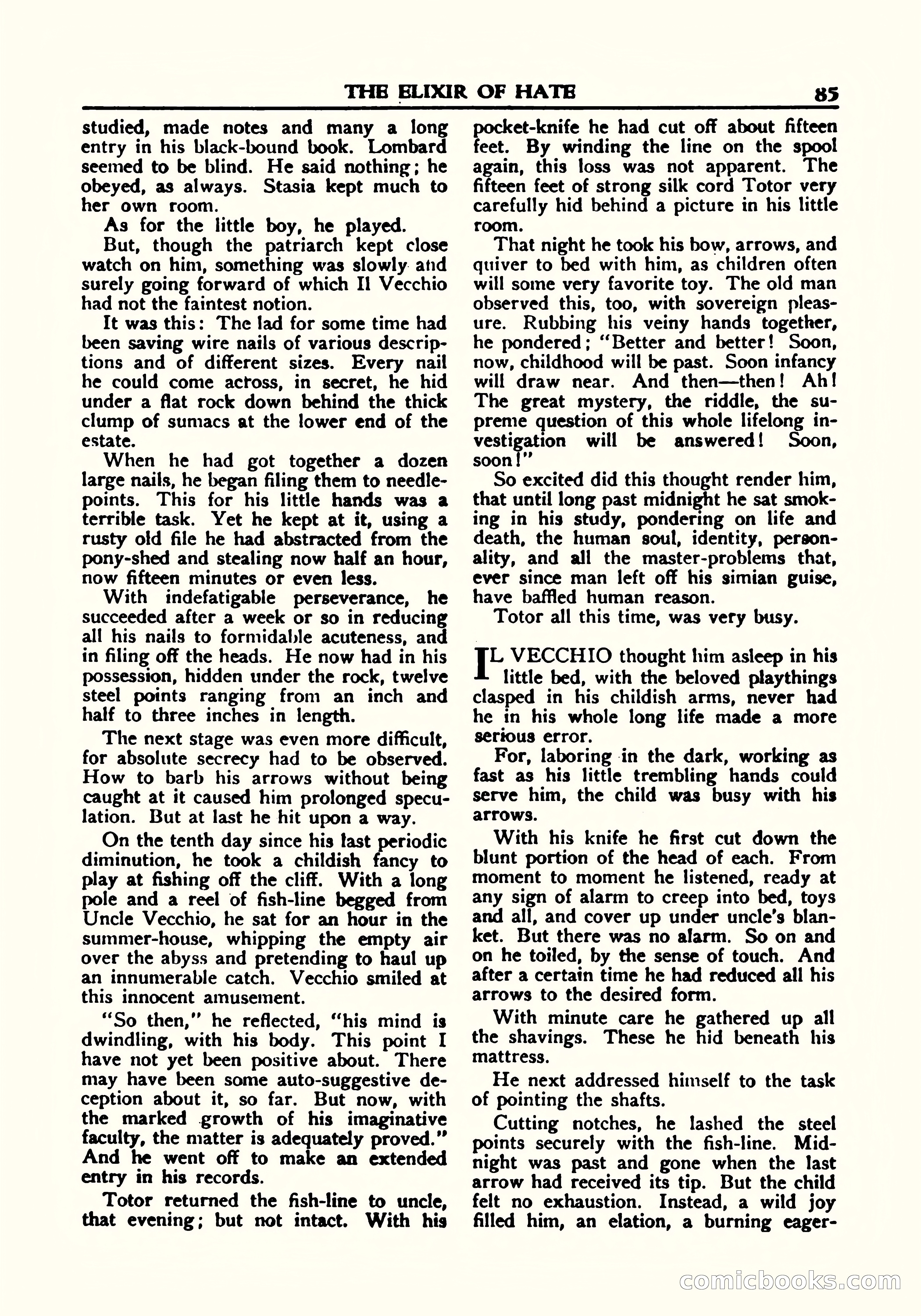
A restored page from Pulp Fiction, 1950. Page through the whole issue in the reader above.
📄 Transcribed text from this page (OCR, searchable)
Machine-transcribed from the original scan — historical spelling and the odd misread are preserved.
THE ELIXIR OF HATE 85 studied, made notes and many a long entry in his black-bound book. Lombard seemed to be blind. He said nothing; he obeyed, as always. Stasia kept much to her own room. As for the little boy, he played. But, though the patriarch kept close watch on him, something was slowly. atid surely going forward of which I! Vecchio had not the faintest notion. It was this: The lad for some time had been saving wire nails of various descrip- tions and of different sizes. Every nail he could come across, in secret, he hid under a flat rock down behind the thick clump of sumacs at the lower end of the estate. When he had got together a dozen large nails, he began filing them to needle- points. This for his little hands was a terrible task. Yet he kept at it, using a rusty old file he had abstracted from the pony-shed and stealing now half an hour, now fifteen minutes or even less. With indefatigable perseverance, he succeeded after a week or so in reducing all his nails to formidable acuteness, and in filing off the heads. He now had in his possession, hidden under the rock, twelve steel points ranging from an inch and half to three inches in length. The next stage was even more difficult, for absolute secrecy had to be observed. How to barb his arrows without being caught at it caused him prolonged specu- lation. But at last he hit upon a way. On the tenth day since his fast periodic diminution, he took a childish fancy to play at fishing off the cliff. With a long pole and a reel of fish-line begged from Uncle Vecchio, he sat for an hour in the summer-house, whipping the empty air over the abyss and pretending to haul up an innumerable catch. Vecchio smiled at this innocent amusement. “So then,” he reflected, “his mind is dwindling, with his body. This point I have not yet been positive about. There may have been some auto-suggestive de- ception about it, so far. But now, with the marked growth of his imaginative faculty, the matter is adequately proved.” And he went off to make an extended entry in his records. Totor returned the fish-line to uncle, that evening; but not intact. With his pocket-knife he had cut off about fifteen feet. By winding the line on the spool again, this loss was not apparent. The fifteen feet of strong silk cord Totor very carefully hid behind a picture in his little room. That night he took his bow, arrows, and quiver to bed with him, as children often will some very favorite toy. The old man observed this, too, with sovereign pleas- ure. Rubbing his veiny hands together, he pondered; “Better and better! Soon, now, childhood will be past. Soon infancy will draw near. And then—then! Ah! The great mystery, the riddle, the su- preme question of this whole lifelong in- vestigation will be answered! Soon, soon !”’ So excited did this thought render him, that until long past midnight he sat smok- ing in his study, pondering on life and death, the human soul, identity, person- ality, and all the master-problems that, ever since man left off his simian guise, have baffled human reason. Totor all this time, was very busy. [¢ VECCHIO thought him asleep in his little bed, with the beloved playthings clasped in his childish arms, never had he in his whole long life made a more serious error. For, laboring in the dark, working as fast as his little trembling hands could serve him, the child was busy with his arrows. With his knife he first cut down the blunt portion of the head of each. From moment to moment he listened, ready at any sign of alarm to creep into bed, toys and all, and cover up under uncle’s blan- ket. But there was no alarm. So on and on he toiled, by the sense of touch. And after a certain time he had reduced all his arrows to the desired form. With minute care he gathered up all the shavings. These he hid beneath his mattress. He next addressed himself to the task of pointing the shafts. Cutting notches, he lashed the steel points securely with the fish-line. Mid- night was past and gone when the last arrow had received its tip. But the child felt no exhaustion. Instead, a wild joy filled him, an elation, a burning eager- ECOMICLOO|S (C(O)