
Pulp Fiction, 1950 · page 76 of 135
A. Merritt's Fantasy Magazine, October 1950 — page 76: what you’re looking at
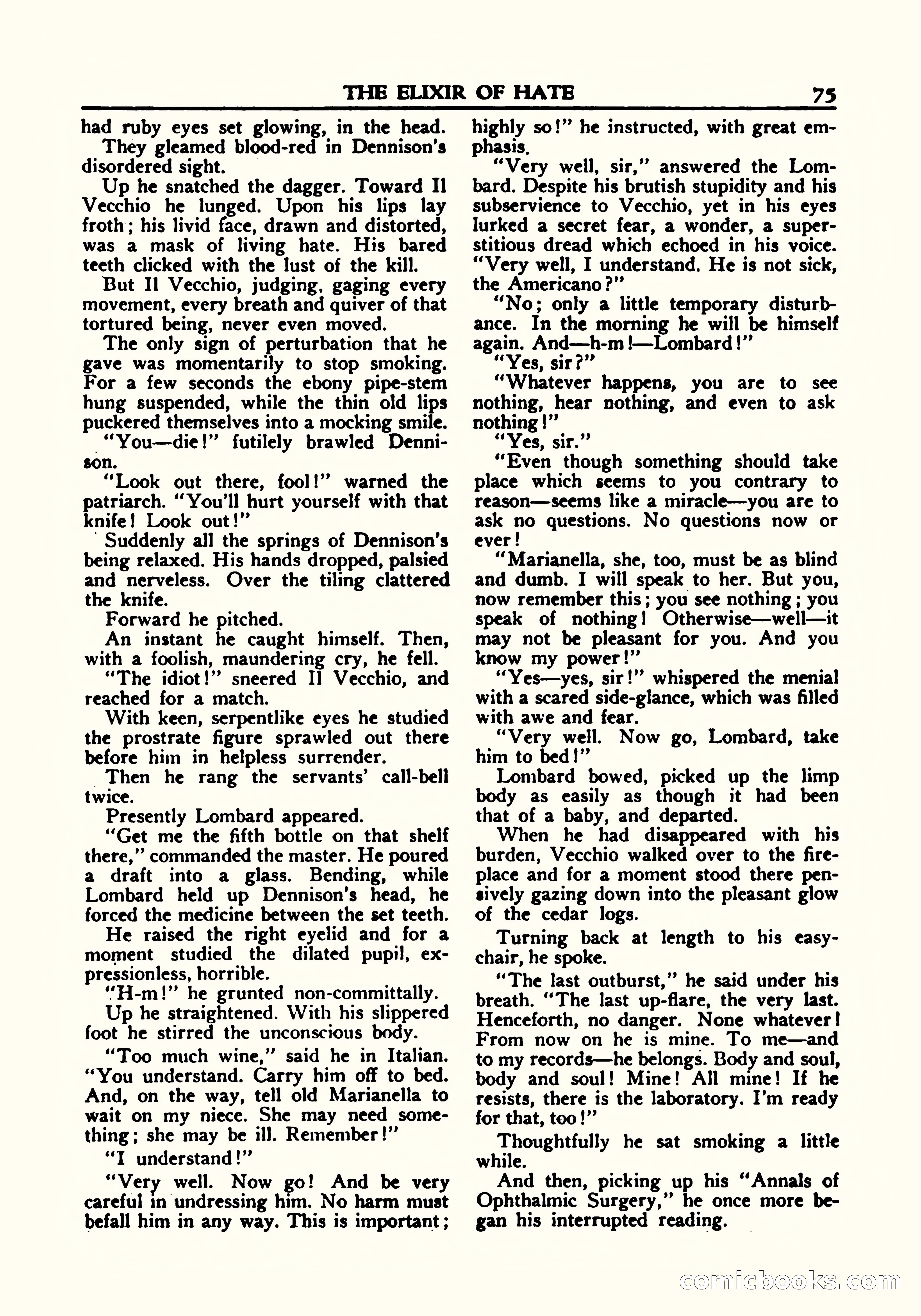
A restored page from Pulp Fiction, 1950. Page through the whole issue in the reader above.
📄 Transcribed text from this page (OCR, searchable)
Machine-transcribed from the original scan — historical spelling and the odd misread are preserved.
THE ELIXIR OF HATE 75 had ruby eyes set glowing, in the head. They gleamed blood-red in Dennison’s disordered sight. _ Up he snatched the dagger. Toward Il Vecchio he lunged. Upon his lips lay froth; his livid face, drawn and distorted, was a mask of living hate. His bared teeth clicked with the lust of the kill. But Il Vecchio, judging, gaging every movement, every breath and quiver of that tortured being, never even moved. The only sign of perturbation that he gave was momentarily to stop smoking. For a few seconds the ebony pipe-stem hung suspended, while the thin old lips puckered themselves into a mocking smile. “You—die!” futilely brawled Denni- son. “Look out there, fool!’ warned the patriarch. “You'll hurt yourself with that knife! Look out!” ' Suddenly all the springs of Dennison’s being relaxed. His hands dropped, palsied and nerveless. Over the tiling clattered the knife. Forward he pitched. An instant he caught himself. Then, with a foolish, maundering cry, he fell. “The idiot!’ sneered I] Vecchio, and reached for a match. With keen, serpentlike eyes he studied the prostrate figure sprawled out there before him in helpless surrender. Then he rang the servants’ call-bell twice. Presently Lombard appeared. “Get me the fifth bottle on that shelf there,” commanded the master. He poured a draft into a glass. Bending, while Lombard held up Dennison’s head, he forced the medicine between the set teeth. He raised the right eyelid and for a moment studied the dilated pupil, ex- pressionless, horrible. “H-m!” he grunted non-committally. Up he straightened. With his slippered foot he stirred the unconscious body. “Too much wine,” said he in Italian. “You understand. Carry him off to bed. And, on the way, tell old Marianella to wait on my niece. She may need some- thing; she may be ill. Remember !”’ “T understand !”’ “Very well. Now go! And be very careful in undressing him. No harm must befall him in any way. This is important ; highly so!” phasis. “Very well, sir,” answered the Lom- bard. Despite his brutish stupidity and his subservience to Vecchio, yet in his eyes lurked a secret fear, a wonder, a super- stitious dread which echoed in his voice. “Very well, I understand. He is not sick, the Americano ?” “No; only a little temporary disturb- ance. In the morning he will be himself again. And—h-m !—Lombard!”’ “Yes, sir?” “Whatever happens, you are to see nothing, hear nothing, and even to ask nothing!” “Yes, sir.” “Even though something should take place which seems to you contrary to reason—seems like a miracle—you are to ask no questions. No questions now or ever! ‘““Marianella, she, too, must be as blind and dumb. I will speak to her. But you, now remember this ; you see nothing ; you speak of nothing! Otherwise—well—it may not be pleasant for you. And you know my power!”’ “Yes—yes, sir!’’ whispered the menial with a scared side-glance, which was filled with awe and fear. “Very well. Now go, Lombard, take him to bed!” Lombard bowed, picked up the limp body as easily as though it had been that of a baby, and departed. When he had disappeared with his burden, Vecchio walked over to the fire- place and for a moment stood there pen- sively gazing down into the pleasant glow of the cedar logs. Turning back at length to his easy- chair, he spoke. “The last outburst,” he said under his breath. “The last up-flare, the very last. Henceforth, no danger. None whatever! From now on he is mine. To me—and to my records—he belongs. Body and soul, body and soul! Mine! All mine! If he resists, there is the laboratory. I’m ready for that, too!”’ Thoughtfully he sat smoking a little while. And then, picking up his “Annals of Ophthalmic Surgery,” he once more be- gan his interrupted reading. he instructed, with great em- (C(O) nn) (C 6)(0)©) (C(O)