
Pulp Fiction, 1950 · page 72 of 135
A. Merritt's Fantasy Magazine, October 1950 — page 72: what you’re looking at
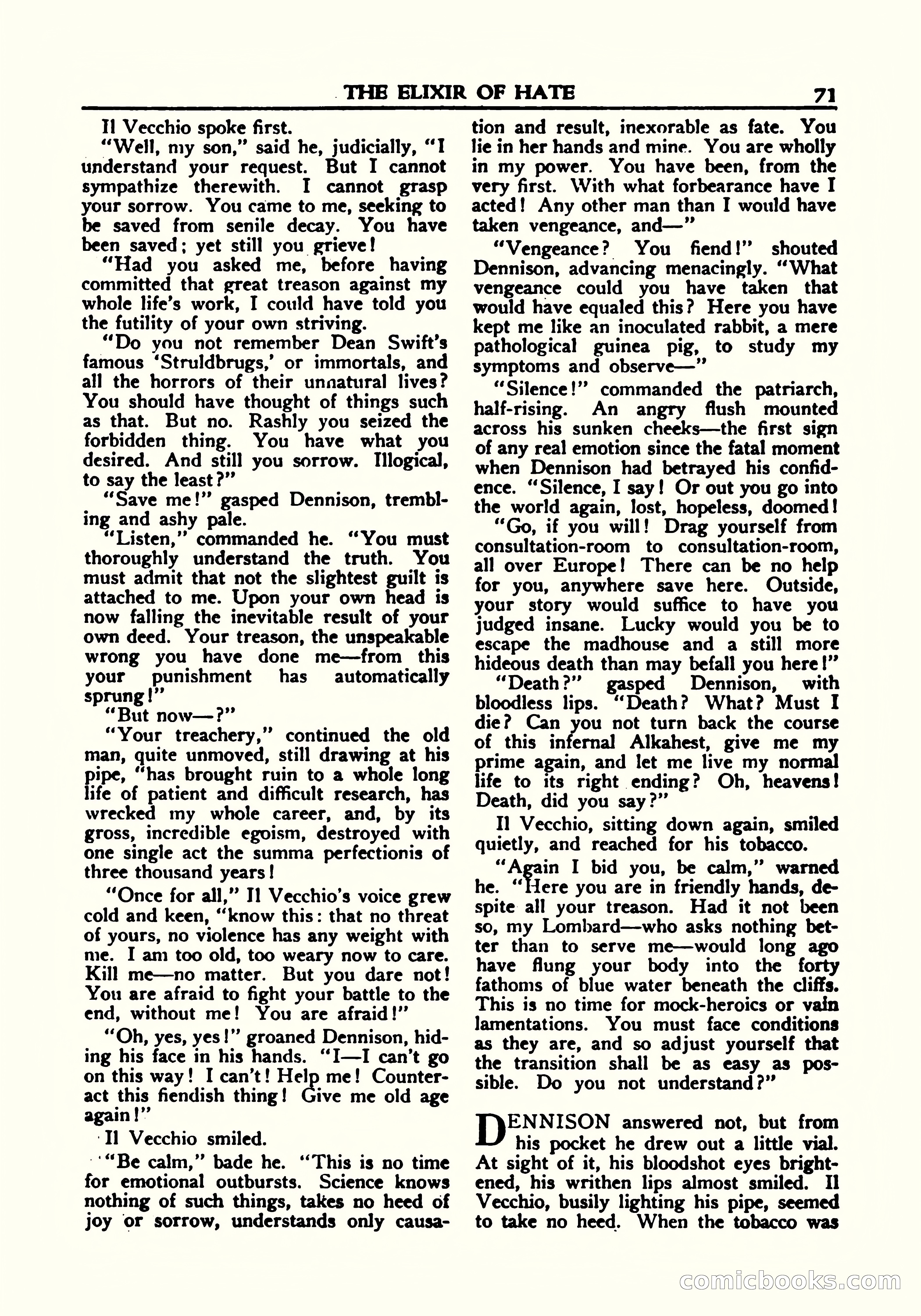
A restored page from Pulp Fiction, 1950. Page through the whole issue in the reader above.
📄 Transcribed text from this page (OCR, searchable)
Machine-transcribed from the original scan — historical spelling and the odd misread are preserved.
. THE BLIXIR OF HATE 71 Il Vecchio spoke first. _ “Well, my son,” said he, judicially, “I understand your request. But I cannot sympathize therewith. I cannot grasp your sorrow. You came to me, seeking to be saved from senile decay. You have been saved; yet still you grieve! “Had you asked me, before having committed that great treason against my whole life’s work, I could have told you the futility of your own striving. “Do you not remember Dean Swift’s famous ‘Struldbrugs,’ or immortals, and all the horrors of their unnatural lives? You should have thought of things such as that. But no. Rashly you seized the forbidden thing. You have what you desired. And still you sorrow. Illogical, to say the least?” “Save me!” gasped Dennison, trembl- ing and ashy pale. “‘Listen,’’ commanded he. “You must thoroughly understand the truth. You must admit that not the slightest guilt is attached to me. Upon your own head is now falling the inevitable result of your own deed. Your treason, the unspeakable wrong you have done me—from this your punishment has _ automatically sprung!” “But now— ?”’ “Your treachery,” continued the old man, quite unmoved, still drawing at his pipe, “has brought ruin to a whole long life of patient and difficult research, has wrecked my whole career, and, by its gross, incredible egoism, destroyed with one single act the summa perfectionis of three thousand years! “Once for all,” Il Vecchio’s voice grew cold and keen, “know this: that no threat of yours, no violence has any weight with me. I am too old, too weary now to care. Kill me—no matter. But you dare not! You are afraid to fight your battle to the end, without me! You are afraid!” “‘Oh, yes, yes!”” groaned Dennison, hid- ing his face in his hands. ‘“I—I can’t go on this way! I can’t! Help me! Counter- act this fiendish thing! Eive me old age again !”’ ‘Tl Vecchio smiled. -‘“Be calm,” bade he. ‘‘This is no time for emotional outbursts. Science knows nothing of such things, takes no heed of joy or sorrow, understands only causa- tion and result, inexorable as fate. You lie in her hands and mine. You are wholly in my power. You have been, from the very first. With what forbearance have I acted! Any other man than I would have taken vengeance, and—” “Vengeance? You fiend!” shouted Dennison, advancing menacingly. ‘What vengeance could you have taken that would have equaled this? Here you have kept me like an inoculated rabbit, a mere pathological guinea pig, to study my symptoms and observe—”’ “‘Silence!’’ commanded the patriarch, half-rising. An angry flush mounted across his sunken cheeks—the first sign of any real emotion since the fatal moment when Dennison had betrayed his confid- ence. “Silence, I say! Or out you go into the world again, lost, hopeless, doomed! “Go, if you will! Drag yourself from consultation-room to consultation-room, all over Europe! There can be no help for you, anywhere save here. Outside, your story would suffice to have you judged insane. Lucky would you be to escape the madhouse and a still more hideous death than may befall you here!” “Death ?” Dennison, with bloodless lips. ‘Death? What? Must I die? Can you not turn back the course of this infernal Alkahest, give me my prime again, and let me live my normal life to its right ending? Oh, heavens! Death, did you say?” Il Vecchio, sitting down again, smiled quietly, and reached for his tobacco. “Again I bid you, be calm,” warned he. “Here you are in friendly hands, de- spite all your treason. Had it not been so, my Lombard—who asks nothing bet- ter than to serve me—would long ago have flung your body into the forty fathoms of blue water beneath the cliffs. This is no time for mock-heroics or vain lamentations. You must face conditions as they are, and so adjust yourself that the transition shall be as easy as pos- sible. Do you not understand?” ENNISON answered not, but from his pocket he drew out a little vial. At sight of it, his bloodshot eyes bright- ened, his writhen lips almost smiled. Il Vecchio, busily lighting his pipe, seemed to take no heed. When the tobacco was an) (C 6)(0)©) Ss (C(O)