
Pulp Fiction, 1950 · page 69 of 135
A. Merritt's Fantasy Magazine, October 1950 — page 69: what you’re looking at
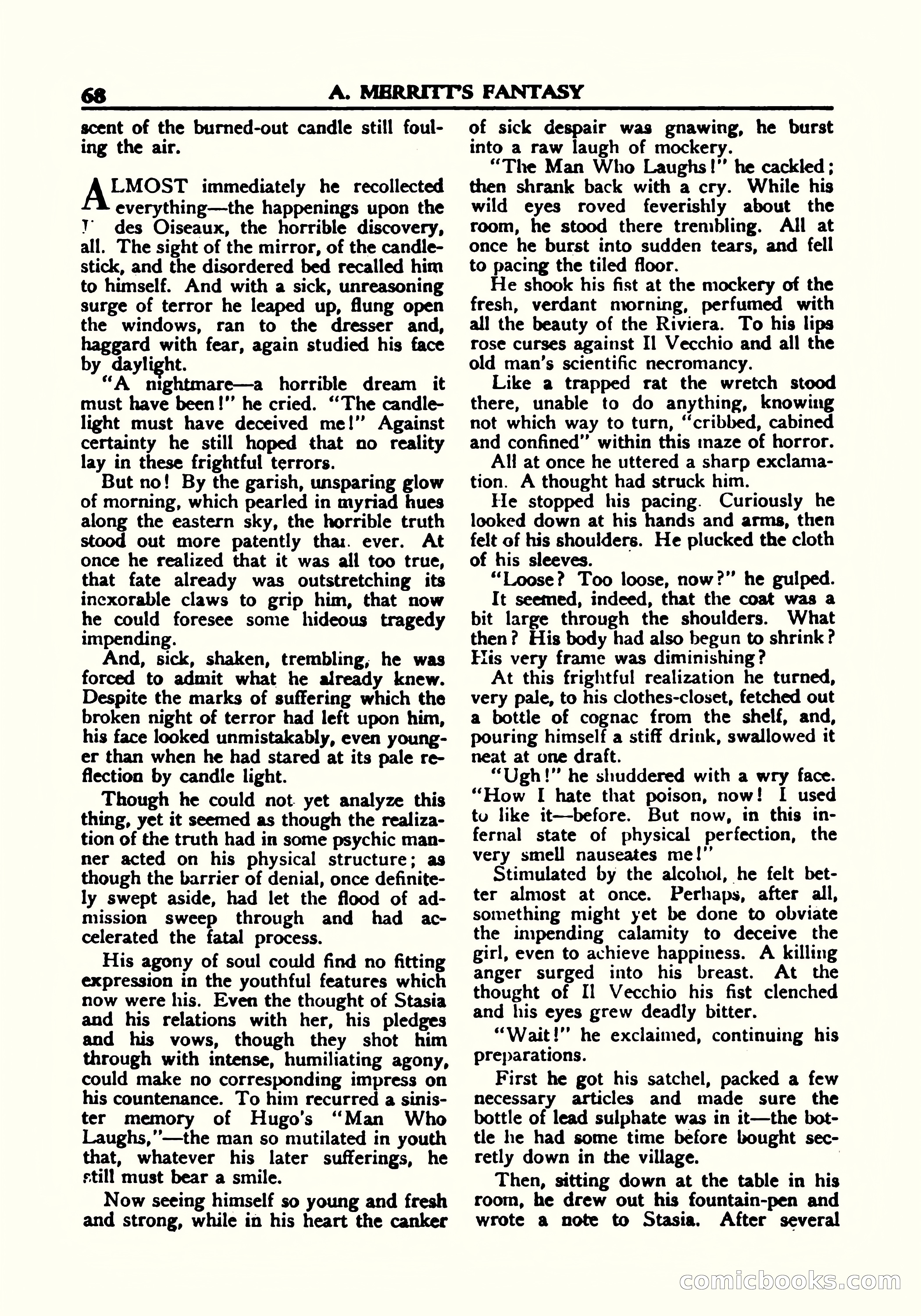
A restored page from Pulp Fiction, 1950. Page through the whole issue in the reader above.
📄 Transcribed text from this page (OCR, searchable)
Machine-transcribed from the original scan — historical spelling and the odd misread are preserved.
68 A. MERRITT’S FANTASY scent of the burned-out candle still foul- ing the air. Aver immediately he recollected everything—the happenings upon the Y’ des Oiseaux, the horrible discovery, all. The sight of the mirror, of the candle- stick, and the disordered bed recalled him to himself. And with a sick, unreasoning surge of terror he leaped up, flung open the windows, ran to the dresser and, haggard with fear, again studied his face by daylight. “A nightmare—a horrible dream it must have been!’’ he cried. “The candle- light must have deceived me!” Against certainty he still hoped that no reality lay in these frightful terrors. But no! By the garish, unsparing glow of morning, which pearled in myriad hues along the eastern sky, the horrible truth stood out more patently thar. ever. At once he realized that it was all too true, that fate already was outstretching its inexorable claws to grip him, that now he could foresee some hideous tragedy impending. And, sick, shaken, trembling, he was forced to admit what he already knew. Despite the marks of suffering which the broken night of terror had left upon him, his face looked unmistakably, even young- er than when he had stared at its pale re- flection by candle light. Though he could not. yet analyze this thing, yet it seemed as though the realiza- tion of the truth had in some psychic man- mer acted on his physical structure; as though the barrier of denial, once definite- ly swept aside, had let the flood of ad- mission sweep through and had ac- celerated the fatal process. His agony of soul could find no fitting expression in the youthful features which now were his. Even the thought of Stasia and his relations with her, his pledges and his vows, though they shot him through with intense, humiliating agony, could make no corresponding impress on his countenance. To him recurred a sinis- ter memory of Hugo’s “Man Who Laughs,”’—the man so mutilated in youth that, whatever his later sufferings, he still must bear a smile. Now seeing himself so young and fresh and strong, while in his heart the canker of sick despair was gnawing, he burst into a raw laugh of mockery. “The Man Who Laughs!” he cackled ; then shrank back with a cry. While his wild eyes roved feverishly about the room, he stood there trembling. All at once he burst into sudden tears, and fell to pacing the tiled floor. He shook his fist at the mockery of the fresh, verdant morning, perfumed with all the beauty of the Riviera. To his lips rose curses against Il Vecchio and all the old man’s scienttfic necromancy. Like a trapped rat the wretch stood there, unable to do anything, knowing not which way to turn, ‘“‘cribbed, cabined and confined” within this maze of horror. All at once he uttered a sharp exclama- tion. A thought had struck him. He stopped his pacing. Curiously he looked down at his hands and arms, then felt of his shoulders. He plucked the cloth of his sleeves. “Loose? Too loose, now?” he gulped. It seemed, indeed, that the coat was a bit large through the shoulders. What then? His body had also begun to shrink? lis very frame was diminishing ? At this frightful realization he turned, very pale, to his clothes-closet, fetched out a bottle of cognac from the shelf, and, pouring himself a stiff drink, swallowed it neat at one draft. “Ugh!” he shuddered with a wry face. “How [ hate that poison, now! I used tu like it—before. But now, tn this in- fernal state of physical perfection, the very smell nauseates me!”’ Stimulated by the alcohol, he felt bet- ter almost at once. Perhaps, after all, something might yet be done to obviate the impending calamity to deceive the girl, even to achieve happiness. A killing anger surged into his breast. At the thought of I] Vecchio his fist clenched and his eyes grew deadly bitter. “Wait!’’ he exclaimed, continuing his preparations. First he got his satchel, packed a few necessary articles and made sure the bottle of lead sulphate was in it—the bot- tle he had some time before bought sec- retly down in the village. | Then, sitting down at the table in his room, he drew out his fountain-pen and wrote a note to Stasia. After several an) (C 6)(0)©) Ss (C(O)