
Pulp Fiction, 1950 · page 66 of 135
A. Merritt's Fantasy Magazine, October 1950 — page 66: what you’re looking at
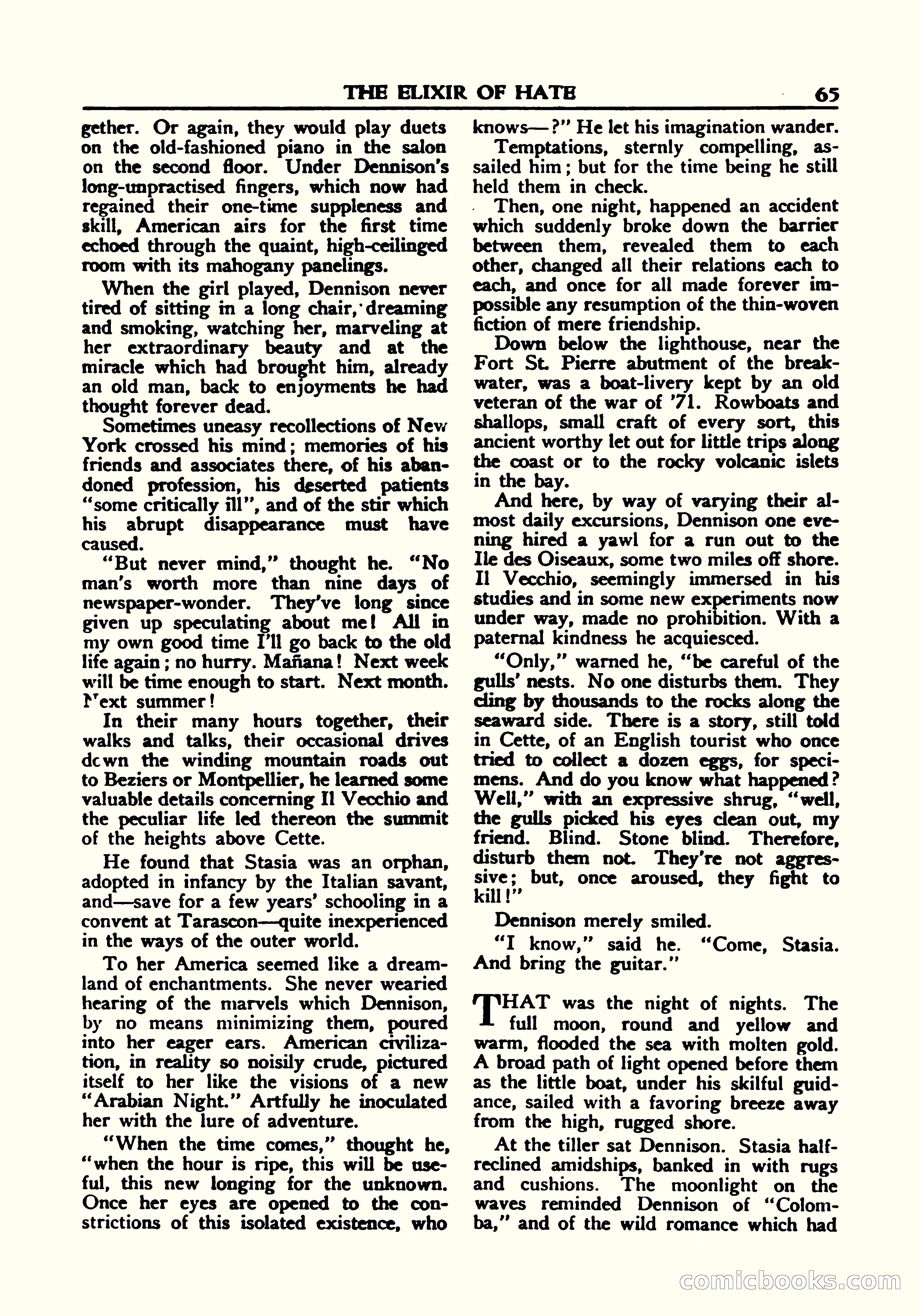
A restored page from Pulp Fiction, 1950. Page through the whole issue in the reader above.
📄 Transcribed text from this page (OCR, searchable)
Machine-transcribed from the original scan — historical spelling and the odd misread are preserved.
THE ELIXIR OF HATE 65 gether. Or again, they would play duets on the old-fashioned piano in the salon on the second floor. Under Dennison’s long-unpractised fingers, which now had regained their one-time suppleness and skill, American airs for the first time echoed through the quaint, high-ceilinged room with its mahogany panelings. When the girl played, Dennison never tired of sitting in a long chair,’ dreaming and smoking, watching her, marveling at her extraordinary beauty and at the miracle which had brought him, already an old man, back to enjoyments he had thought forever dead. Sometimes uneasy recollections of New York crossed his mind; memories of his friends and associates there, of his aban- doned profession, his deserted patients “some critically ill”, and of the stir which his abrupt disappearance must have caused. “But never mind,” thought he. “No man’s worth more than nine days of newspaper-wonder. They've long since given up speculating about me! Ali in my own good time I'll go back to the old life again ; no hurry. Mafiana! Next week will be time enough to start. Next month. hext summer! In their many hours together, their walks and talks, their occasional drives dcwn the winding mountain roads out to Beziers or Montpellier, he learned some valuable details concerning I! Vecchio and the peculiar life led thereon the summit of the heights above Cette. He found that Stasia was an orphan, adopted in infancy by the Italian savant, and—save for a few years’ schooling in a convent at Tarascon—dquite inexperienced in the ways of the outer world. To her America seemed like a dream- land of enchantments. She never wearied hearing of the marvels which Dennison, by no means minimizing them, poured into her eager ears. American civiliza- tion, in reality so noisily crude, pictured itself to her like the visions of a new “Arabian Night.” Artfully he inoculated her with the lure of adventure. “When the time comes,” thought he, “when the hour is ripe, this will be use- ful, this new longing for the unknown. Once her eyes are opened to the con- strictions of this isolated existence, who knows— ?”’ He let his imagination wander. Temptations, sternly compelling, as- sailed him; but for the time being he still held them in check. Then, one night, happened an accident which suddenly broke down the barrier between them, revealed them to each other, changed all their relations each to each, and once for all made forever im- possible any resumption of the thin-woven fiction of mere friendship. Down below the lighthouse, near the Fort St. Pierre abutment of the break- water, was a boat-livery kept by an old veteran of the war of ’71. Rowboats and shallops, small craft of every sort, this ancient worthy let out for little trips along the coast or to the rocky volcanic islets in the bay. And here, by way of varying their al- most daily excursions, Dennison one eve- ning hired a yawl for a run out to the Ile des Oiseaux, some two miles off shore. Il Vecchio, seemingly immersed in his Studies and in some new experiments now under way, made no prohibition. With a paternal kindness he acquiesced. “Only,”’ warned he, “be careful of the gulls’ nests. No one disturbs them. They cling by thousands to the rocks along the seaward side. There is a story, still told in Cette, of an English tourist who once tried to collect a dozen eggs, for speci- mens. And do you know what happened ? Well,” with an expressive shrug, “well, the gulls picked his eyes clean out, my friend. Blind. Stone blind. Therefore, disturb them not. They’re not aggres- ae but, once aroused, they fight to i 1”? Dennison merely smiled. “I know,” said he. “Come, Stasia. And bring the guitar.” d hier) was the night of nights. The full moon, round and yellow and warm, flooded the sea with molten gold. A broad path of light opened before them as the little boat, under his skilful guid- ance, sailed with a favoring breeze away from the high, rugged shore. At the tiller sat Dennison. Stasia half- reclined amidships, banked in with rugs and cushions. The moonlight on the waves reminded Dennison of ‘Colom- ba,” and of the wild romance which had an) (C 6)(0)©) <S (C(O)