
Pulp Fiction, 1950 · page 64 of 135
A. Merritt's Fantasy Magazine, October 1950 — page 64: what you’re looking at
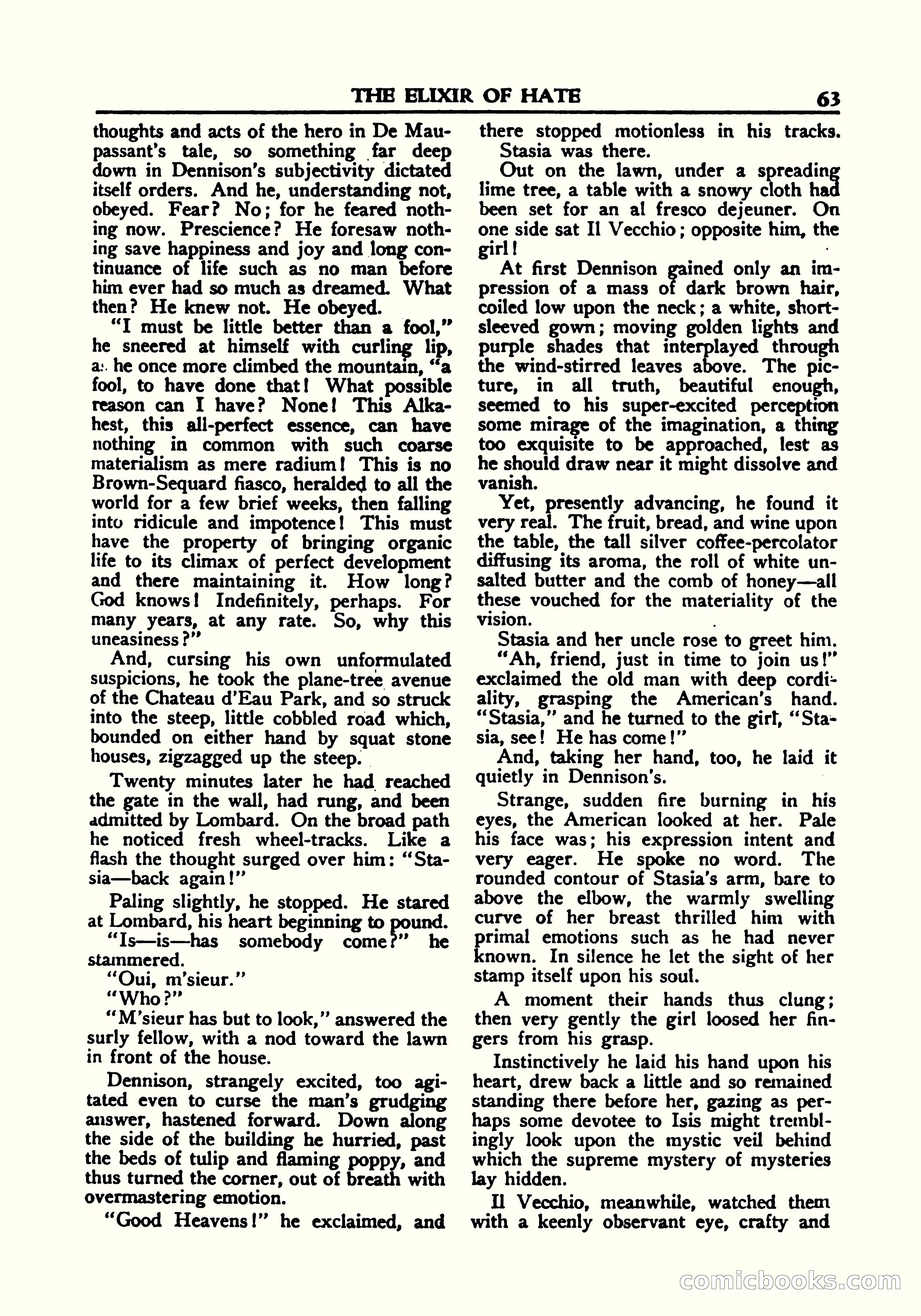
A restored page from Pulp Fiction, 1950. Page through the whole issue in the reader above.
📄 Transcribed text from this page (OCR, searchable)
Machine-transcribed from the original scan — historical spelling and the odd misread are preserved.
THE ELIXIR OF HATE 63 thoughts and acts of the hero in De Mau- passant’s tale, so something far deep down in Dennison’s subjectivity dictated itself orders. And he, understanding not, obeyed. Fear? No; for he feared noth- ing now. Prescience? He foresaw noth- ing save happiness and joy and long con- tinuance of life such as no man before him ever had so much as dreamed. What then? He knew not. He obeyed. _ “I must be little better than a fool,” he sneered at himself with curling lip, a:. he once more climbed the mountain, “a fool, to have done that! What possible reason can I have? None! This Alka- hest, this ali-perfect essence, can have nothing in common with such coarse materialism as mere radium! This is no Brown-Sequard fiasco, heralded to all the world for a few brief weeks, then falling into ridicule and impotence! This must have the property of bringing organic life to its climax of perfect development and there maintaining it. How long? God knows! Indefinitely, perhaps. For many years, at any rate. So, why this uneasiness ?”” And, cursing his own unformulated suspicions, he took the plane-tree avenue of the Chateau d’Eau Park, and so struck into the steep, little cobbled road which, bounded on either hand by squat stone houses, zigzagged up the steep. | Twenty minutes later he had reached the gate in the wall, had rung, and been admitted by Lombard. On the broad path he noticed fresh wheel-tracks. Like a flash the thought surged over him: ‘‘Sta- sia—back again!” Paling slightly, he stopped. He stared at Lombard, his heart beginning to pound. “Is—is—has somebody come?” he stammered. “Qui, m’sieur.”’ 6e Wh re) le “‘M’sieur has but to look,” answered the surly fellow, with a nod toward the lawn in front of the house. Dennison, strangely excited, too agi- tated even to curse the man’s grudging answer, hastened forward. Down along the side of the building he hurried, past the beds of tulip and flaming poppy, and thus turned the corner, out of breath with overmastering emotion. “Good Heavens!” he exclaimed, and there stopped motionless in his tracks. Stasia was there. Out on the lawn, under a spreadin lime tree, a table with a snowy cloth ha been set for an al fresco dejeuner. On one side sat Il Vecchio; opposite him, the irl! : At first Dennison gained only an im- pression of a mass of dark brown hair, coiled low upon the neck; a white, short- sleeved gown; moving golden lights and purple shades that interplayed through the wind-stirred leaves above. The pic- ture, in all truth, beautiful enough, seemed to his super-excited perception some mirage of the imagination, a thing too exquisite to be approached, lest as he should draw near it might dissolve and vanish. Yet, presently advancing, he found it very real. The fruit, bread, and wine upon the table, the tall silver coffee-percolator diffusing its aroma, the roll of white un- salted butter and the comb of honey—all these vouched for the materiality of the vision. . Stasia and her uncle rose to greet him. “‘Ah, friend, just in time to join us!” exclaimed the old man with deep cordi- ality, grasping the American’s hand. “‘Stasia,” and he turned to the girf, “Sta- sia, see! He has come!” And, taking her hand, too, he laid it quietly in Dennison’s. | Strange, sudden fire burning in_ his eyes, the American looked at her. Pale his face was; his expression intent and very eager. He spoke no word. The rounded contour of Stasia’s arm, bare to above the elbow, the warmly swelling curve of her breast thrilled him with primal emotions such as he had never known. In silence he let the sight of her stamp itself upon his soul. A moment their hands thus clung; then very gently the girl loosed her fin- gers from his grasp. Instinctively he laid his hand upon his heart, drew back a little and so remained standing there before her, gazing as per- haps some devotee to Isis might trembl- ingly look upon the mystic veil behind which the supreme mystery of mysteries lay hidden. Il Vecchio, meanwhile, watched them with a keenly observant eye, crafty and (C(O)