
Pulp Fiction, 1950 · page 62 of 135
A. Merritt's Fantasy Magazine, October 1950 — page 62: what you’re looking at
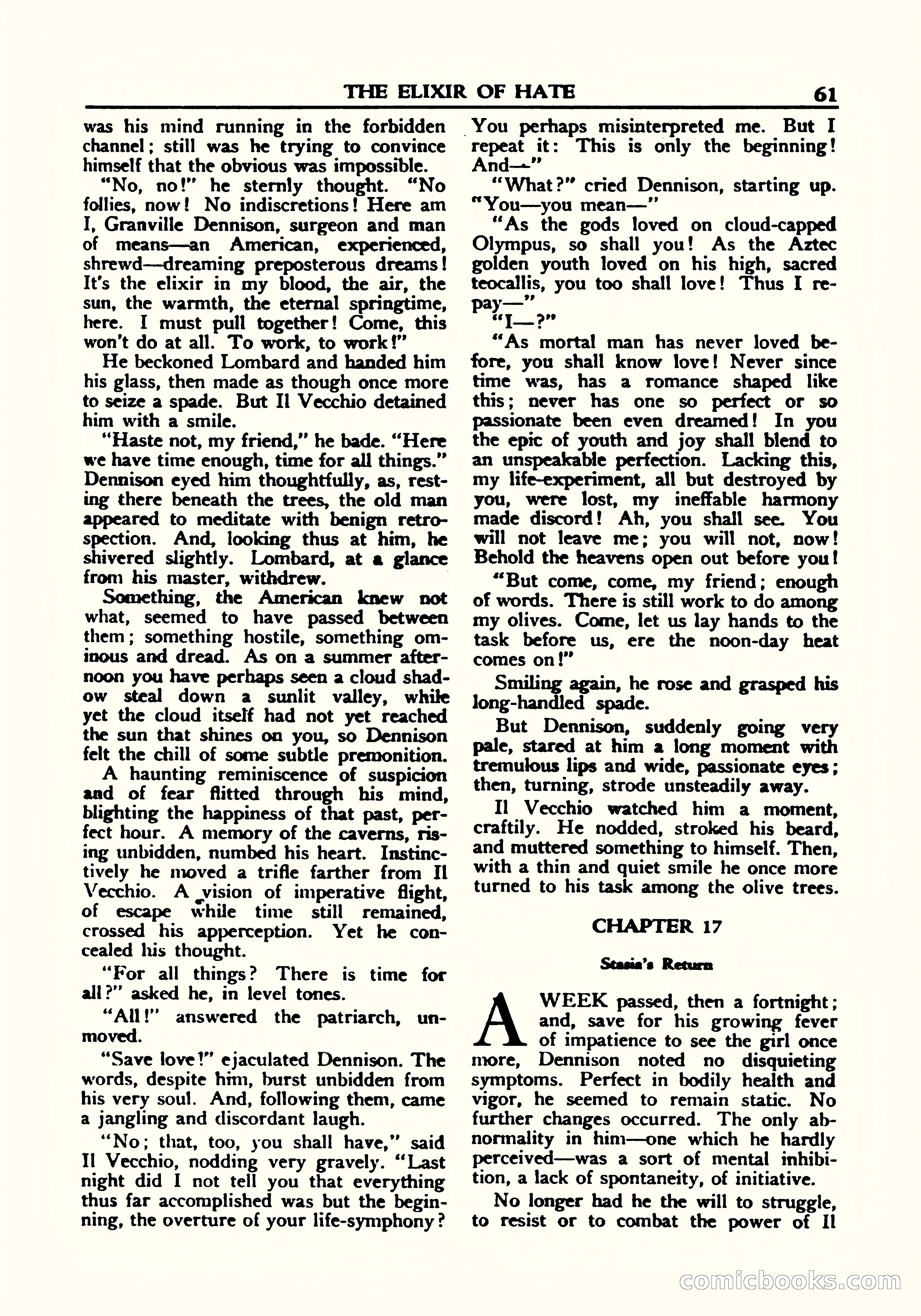
A restored page from Pulp Fiction, 1950. Page through the whole issue in the reader above.
📄 Transcribed text from this page (OCR, searchable)
Machine-transcribed from the original scan — historical spelling and the odd misread are preserved.
THE ELIXIR OF HATE You perhaps misinterpreted me. But I was his mind running in the forbidden channel; still was he trying to convince himself that the obvious was impossible. “No, no!” he sternly thought. “No follies, now! No indiscretions! Here am I, Granville Dennison, surgeon and man of means—an American, experienced, shrewd—dreaming preposterous dreams! It’s the elixir in my blood, the air, the sun, the warmth, the eternal springtime, here. I must pull together! Come, this won't do at all. To work, to work!’ He beckoned Lombard and handed him his glass, then made as though once more to seize a spade. But II Vecchio detained him with a smile. “Haste not, my friend,” he bade. “Here we have time enough, time for all things.” Dennison eyed him thoughtfully, as, rest- ing there beneath the trees, the old man appeared to meditate with benign retro- spection. And, looking thus at him, he shivered slightly. Lombard, at a glance from his master, withdrew. | Something, the American knew not what, seemed to have passed between them; something hostile, something om- inous and dread. As on a summer after- noon you have perhaps seen a cloud shad- ow steal down a sunlit valley, while yet the cloud itself had not yet reached the sun that shines on you, so Dennison felt the chill of some subtle premonition. A haunting reminiscence of suspicion and of fear flitted through his mind, blighting the happiness of that past, per- fect hour. A memory of the caverns, ris- ing unbidden, numbed his heart. Instinc- tively he moved a trifle farther from II Vecchio. A vision of imperative flight, of escape while time still remained, crossed his apperception. Yet he con- cealed his thought. “For all things? There is time for all’’’ asked he, in level tones. “All!” answered the patriarch, un- moved. “Save love!” ejaculated Dennison. The words, despite hrm, burst unbidden from his very soul. And, following them, came a jangling and discordant laugh. ‘““No; that, too, you shall have,” said Il Vecchio, nodding very gravely. “‘Last night did I not tell you that everything thus far accomplished was but the begin- ning, the overture of your life-symphony ? 9 61 repeat it: This is only the beginning! And—” “What?” cried Dennison, starting up. “You—you mean—”’ “As the gods loved on cloud-capped Olympus, so shall you! As the Aztec golden youth loved on his high, sacred teocallis, you too shall love! Thus I re- pay—”’ ik PR “As mortal man has never loved be- fore, you shall know love! Never since time was, has a romance shaped like this; never has one so perfect or so passionate been even dreamed! In you the epic of youth and joy shall blend to an unspeakable perfection. Lacking this, my life-experiment, all but destroyed by you, were lost, my ineffable harmony made discord! Ah, you shall see. You will not leave me; you will not, now! Behold the heavens open out before you! “But come, come, my friend; enough of words. There is still work to do among my olives. Come, let us lay hands to the task before us, ere the noon-day heat comes on!” Smiling again, he rose and grasped his long-handled_ spade. But Dennison, suddenly going very pale, stared at him a long moment with tremulous lips and wide, passionate eyes; then, turning, strode unsteadily away. Il Vecchio watched him a moment, craftily. He nodded, stroked his beard, and muttered something to himself. Then, with a thin and quiet smile he once more turned to his task among the olive trees. CHAPTER 17 Stasia’s Return WEEK passed, then a fortnight; and, save for his growing fever of impatience to see the girl once more, Dennison noted no disquieting symptoms. Perfect in bodily health and vigor, he seemed to remain static. No further changes occurred. The only ab- normality in him—one which he hardly perceived—was a sort of mental inhibi- tion, a lack of spontaneity, of initiative. No longer had he the will to struggle, to resist or to combat the power of Il nn) (C 6)(0)©) S (C(O)