
Pulp Fiction, 1950 · page 49 of 135
A. Merritt's Fantasy Magazine, October 1950 — page 49: what you’re looking at
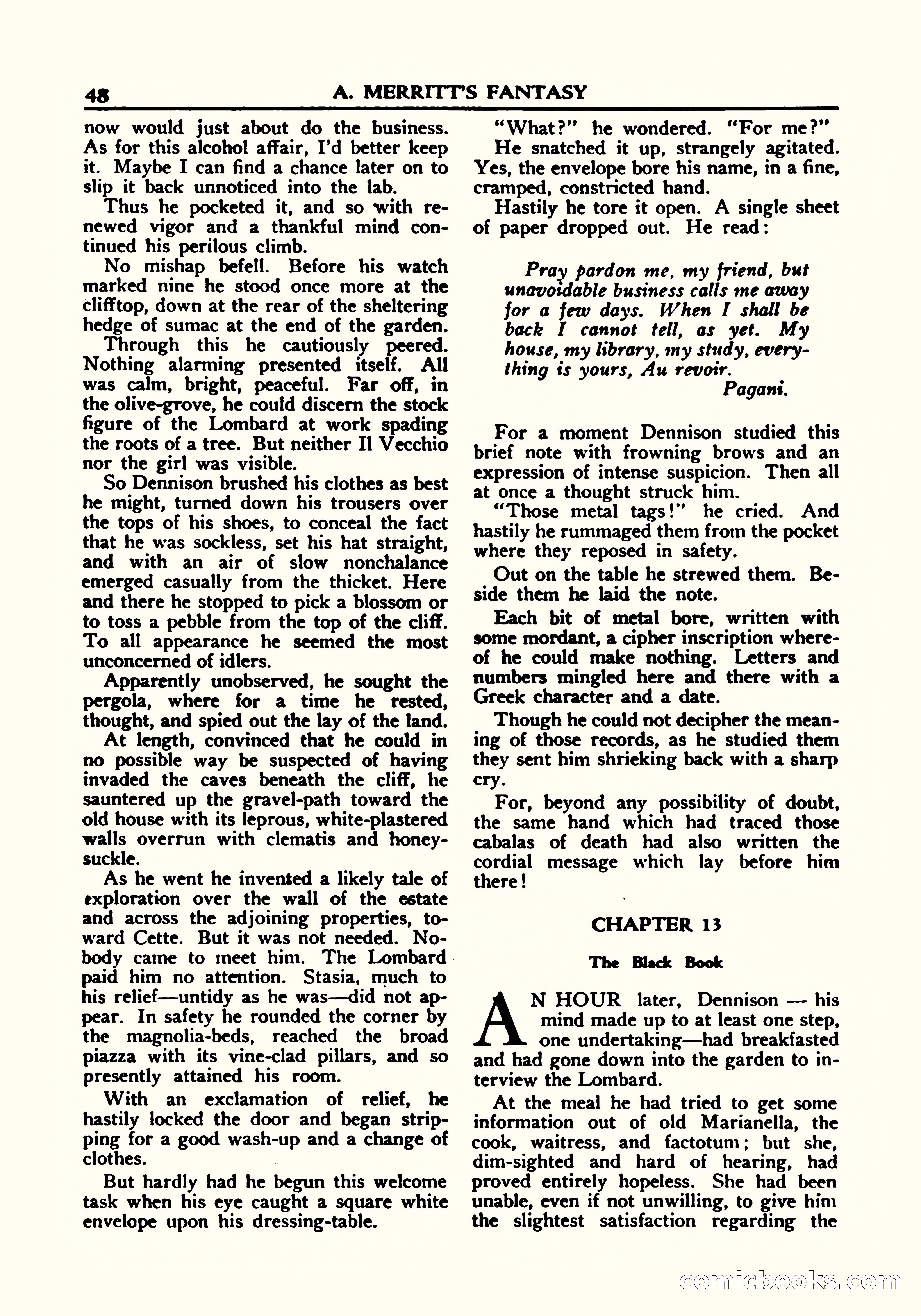
A restored page from Pulp Fiction, 1950. Page through the whole issue in the reader above.
📄 Transcribed text from this page (OCR, searchable)
Machine-transcribed from the original scan — historical spelling and the odd misread are preserved.
48 A. MERRITT’S FANTASY now would just about do the business. As for this alcohol affair, I’d better keep it. Maybe I can find a chance later on to slip it back unnoticed into the lab. Thus he pocketed it, and so with re- newed vigor and a thankful mind con- tinued his perilous climb. No mishap befell. Before his watch marked nine he stood once more at the clifftop, down at the rear of the sheltering hedge of sumac at the end of the garden. Through this he cautiously peered. Nothing alarming presented itself. All was calm, bright, peaceful. Far off, in the olive-grove, he could discern the stock figure of the Lombard at work spading the roots of a tree. But neither I] Vecchio nor the girl was visible. So Dennison brushed his clothes as best he might, turned down his trousers over the tops of his shoes, to conceal the fact that he was sockless, set his hat straight, and with an air of slow nonchalance emerged casually from the thicket. Here and there he stopped to pick a blossom or to toss a pebble from the top of the cliff. To all appearance he seemed the most unconcerned of idlers. Apparently unobserved, he sought the pergola, where for a time he rested, thought, and spied out the lay of the land. At length, convinced that he could in no possible way be suspected of having invaded the caves beneath the cliff, he sauntered up the gravel-path toward the old house with its leprous, white-plastered walls overrun with clematis and honey- suckle. As he went he invented a likely tale of exploration over the wall of the estate and across the adjoining properties, to- ward Cette. But it was not needed. No- body came to meet him. The Lombard. paid him no attention. Stasia, much to his relief—untidy as he was—did not ap- pear. In safety he rounded the corner by the magnolia-beds, reached the broad piazza with its vine-clad pillars, and so presently attained his room. With an exclamation of relief, he hastily locked the door and began strip- ping for a good wash-up and a change of clothes. | But hardly had he begun this welcome task when his eye caught a square white envelope upon his dressing-table. “What?” he wondered. ‘For me?” He snatched it up, strangely agitated. Yes, the envelope bore his name, in a fine, cramped, constricted hand. Hastily he tore it open. A single sheet of paper dropped out. He read: Pray pardon me, my friend, but unavotdable business calls me away for a few days. When I shall be back I cannot tell, as yet. My house, my library, my study, every- thing ts yours, Au revoir. Pagans. For a moment Dennison studied this brief note with frowning brows and an expression of intense suspicion. Then all at once a thought struck him. “Those metal tags!’’ he cried. And hastily he ruammaged them from the pocket where they reposed in safety. Out on the table he strewed them. Be- side them he laid the note. Each bit of metal bore, written with some mordant, a cipher inscription where- of he could make nothing. Letters and numbers mingled here and there with a Greek character and a date. Though he could not decipher the mean- ing of those records, as he studied them they sent him shrieking back with a sharp cry. For, beyond any possibility of doubt, the same hand which had traced those cabalas of death had also written the cordial message which lay before him there ! CHAPTER 13 The Black Book N HOUR later, Dennison — his mind made up to at least one step, one undertaking—had breakfasted and had gone down into the garden to in- terview the Lombard. At the meal he had tried to get some information out of old Marianella, the cook, waitress, and factotum; but she, dim-sighted and hard of hearing, had proved entirely hopeless. She had been unable, even if not unwilling, to give him the slightest satisfaction regarding the COMICLOO|S (C(O)