
Pulp Fiction, 1950 · page 45 of 135
A. Merritt's Fantasy Magazine, October 1950 — page 45: what you’re looking at
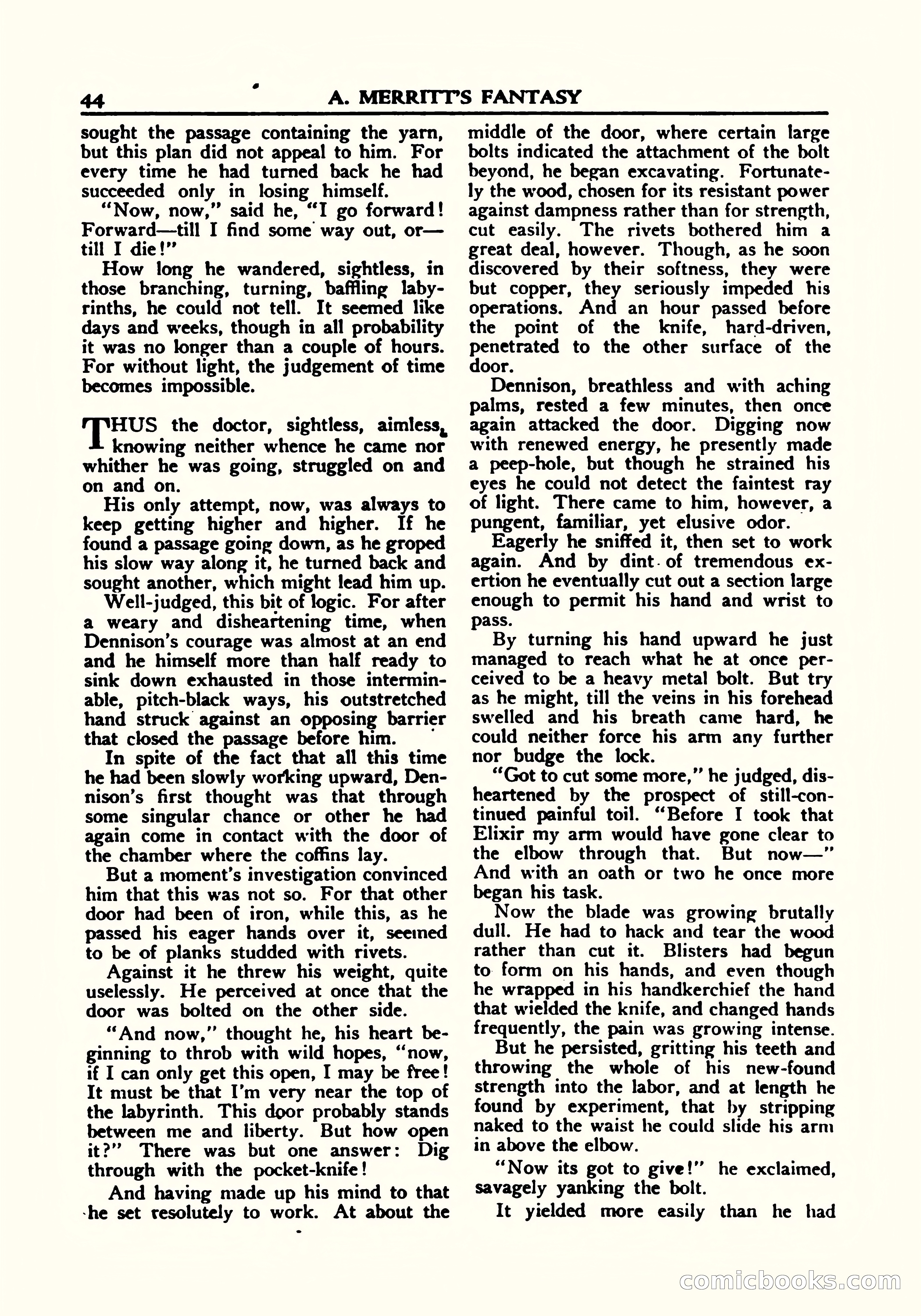
A restored page from Pulp Fiction, 1950. Page through the whole issue in the reader above.
📄 Transcribed text from this page (OCR, searchable)
Machine-transcribed from the original scan — historical spelling and the odd misread are preserved.
44 A. MERRITT’S FANTASY sought the passage containing the yarn, but this plan did not appeal to him. For every time he had turned back he had succeeded only in losing himself. “Now, now,” said he, “I go forward! Forward—till I find some way out, or— till I die!” How long he wandered, sightless, in those branching, turning, baffling laby- rinths, he could not tell. It seemed like days and weeks, though in all probability it was no longer than a couple of hours. For without light, the judgement of time becomes impossible. HUS the doctor, sightless, aimless, knowing neither whence he came nor whither he was going, struggled on and on and on. His only attempt, now, was always to keep getting higher and higher. If he found a passage going down, as he groped his slow way along it, he turned back and sought another, which might lead him up. Well-judged, this bit of logic. For after a weary and disheartening time, when Dennison’s courage was almost at an end and he himself more than half ready to sink down exhausted in those intermin- able, pitch-black ways, his outstretched hand struck against an opposing barrier that closed the passage before him. In spite of the fact that all this time he had been slowly working upward, Den- nison’s first thought was that through some singular chance or other he had again come in contact with the door of the chamber where the coffins lay. But a moment’s investigation convinced him that this was not so. For that other door had been of iron, while this, as he passed his eager hands over it, seemed to be of planks studded with rivets. Against it he threw his weight, quite uselessly. He perceived at once that the door was bolted on the other side. “And now,” thought he, his heart be- ginning to throb with wild hopes, “now, if I can only get this open, I may be free! It must be that I’m very near the top of the labyrinth. This door probably stands between me and liberty. But how open it?’”’ There was but one answer: Dig through with the pocket-knife! And having made up his mind to that -he set vesolutely to work. At about the middle of the door, where certain large bolts indicated the attachment of the bolt beyond, he began excavating. Fortunate- ly the wood, chosen for its resistant power against dampness rather than for strength, cut easily. The rivets bothered him a great deal, however. Though, as he soon discovered by their softness, they were but copper, they seriously impeded his operations. And an hour passed before the point of the knife, hard-driven, penetrated to the other surface of the door. Dennison, breathless and with aching palms, rested a few minutes, then once again attacked the door. Digging now with renewed energy, he presently made a peep-hole, but though he strained his eyes he could not detect the faintest ray of light. There came to him, however, a pungent, familiar, yet elusive odor. Eagerly he sniffed it, then set to work again. And by dint. of tremendous ex- ertion he eventually cut out a section large enough to permit his hand and wrist to pass. By turning his hand upward he just managed to reach what he at once per- ceived to be a heavy metal bolt. But try as he might, till the veins in his forehead swelled and his breath came hard, he could neither force his arm any further nor budge the lock. “‘Got to cut some more,” he judged, dis- heartened by the prospect of still-con- tinued painful toil. “‘Before I took that Elixir my arm would have gone clear to the elbow through that. But now—” And with an oath or two he once more began his task. Now the blade was growing brutally dull. He had to hack and tear the wood rather than cut it. Blisters had begun to form on his hands, and even though he wrapped in his handkerchief the hand that wielded the knife, and changed hands frequently, the pain was growing intense. But he persisted, gritting his teeth and throwing the whole of his new-found strength into the labor, and at length he found by experiment, that by stripping naked to the waist he could slide his arm in above the elbow. “Now its got to give!”” he exclaimed, savagely yanking the bolt. It yielded more easily than he had an) (C 6)(0)©) S (C(O)