
Pulp Fiction, 1950 · page 110 of 135
A. Merritt's Fantasy Magazine, October 1950 — page 110: what you’re looking at
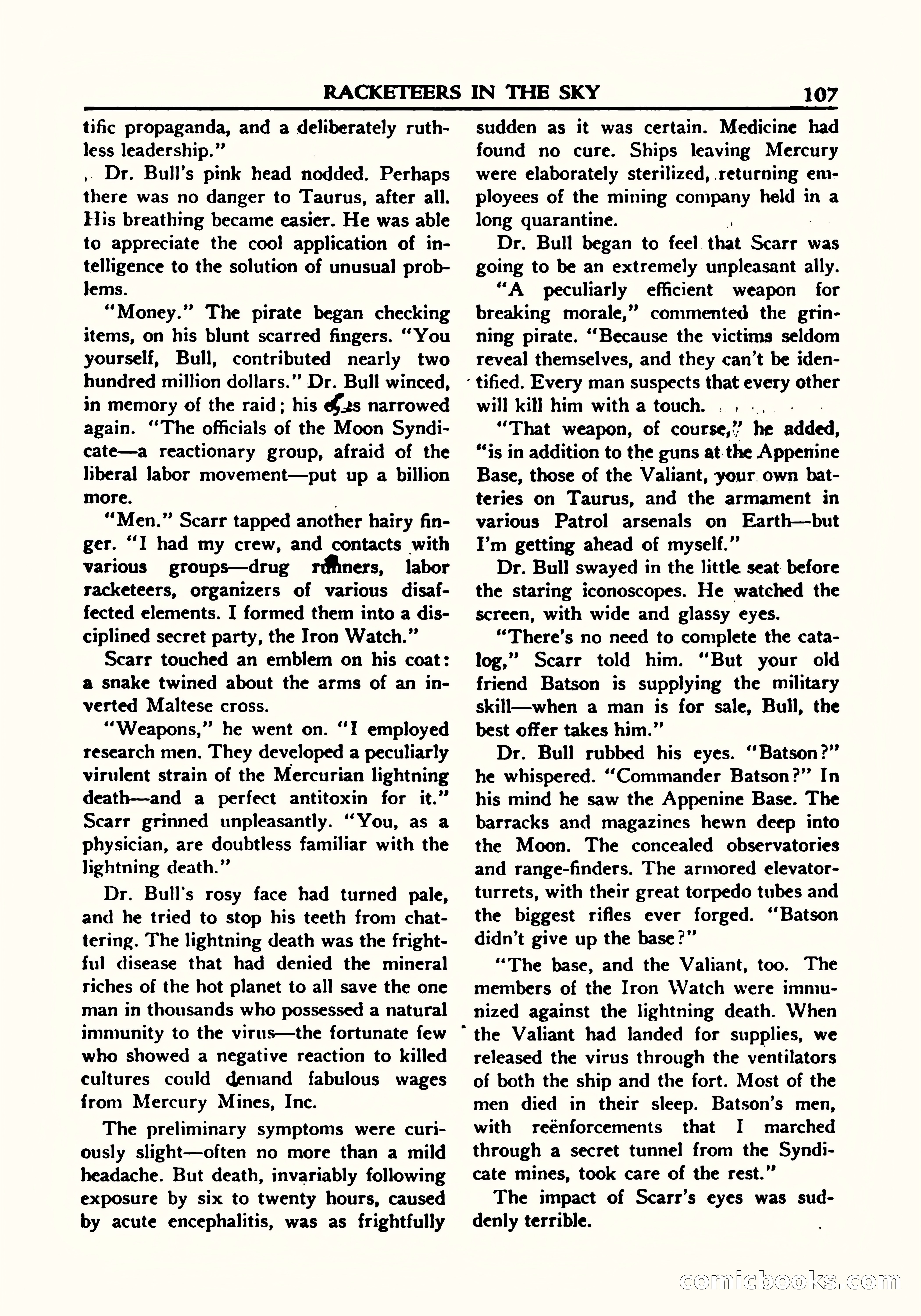
A restored page from Pulp Fiction, 1950. Page through the whole issue in the reader above.
📄 Transcribed text from this page (OCR, searchable)
Machine-transcribed from the original scan — historical spelling and the odd misread are preserved.
RACKETEERS IN THE SKY 107 tific propaganda, and a deliberately ruth- less leadership.” Dr. Bull’s pink head nodded. Perhaps inere was no danger to Taurus, after all. His breathing became easier. He was able to appreciate the cool application of in- telligence to the solution of unusual prob- lems. “Money.” The pirate began checking items, on his blunt scarred fingers. “You yourself, Bull, contributed nearly two hundred million dollars.”” Dr. Bull winced, in memory of the raid; his &2s narrowed again. “The officials of the Moon Syndi- cate—a reactionary group, afraid of the liberal Jabor movement—put up a billion more. ““Men.” Scarr tapped another hairy fin- ger. “I had my crew, and contacts with various groups—drug rffiners, labor racketeers, organizers of various disaf- fected elements. I formed them into a dis- ciplined secret party, the Iron Watch.” Scarr touched an emblem on his coat: a snake twined about the arms of an in- verted Maltese cross. “Weapons,” he went on. “I employed research men. They developed a peculiarly virulent strain of the Mercurian lightning death—and a perfect antitoxin for it.” Scarr grinned unpleasantly. ‘“You, as a physician, are doubtless familiar with the lightning death.” Dr. Bull's rosy face had turned pale, and he tried to stop his teeth from chat- tering. The lightning death was the fright- ful disease that had denied the mineral riches of the hot planet to all save the one man in thousands who possessed a natural immunity to the virus—the fortunate few who showed a negative reaction to killed cultures could demand fabulous wages from Mercury Mines, Inc. The preliminary symptoms were curi- ously slight—often no more than a mild headache. But death, invariably following exposure by six to twenty hours, caused by acute encephalitis, was as frightfully sudden as it was certain. Medicine had found no cure. Ships leaving Mercury were elaborately sterilized, returning em- ployees of the mining company held in a long quarantine. Dr. Bull began to feel. that Scare 4 was going to be an extremely unpleasant ally. “A peculiarly efficient weapon for breaking morale,’”’ commented the grin- ning pirate. “Because the victims seldom reveal themselves, and they can’t be iden- ‘ tified. Every man suspects that every other will kill him with a touch. .. . “That weapon, of course,:’ he added, “is in addition to the guns at.the Appenine Base, those of the Valiant, ‘your own bat- teries on Taurus, and the armament in various Patrol arsenals on Earth—but I’m getting ahead of myself.”’ Dr. Bull swayed in the little seat: before the staring iconoscopes. He watched the screen, with wide and glassy eyes. “‘There’s no need to complete the cata- log,” Scarr told him. “But your old friend Batson is supplying the military skill—when a man is for sale, Bull, the best offer takes him.” Dr. Bull rubbed his eyes. ‘“‘Batson?” he whispered. ‘““Commander Batson?” In his mind he saw the Appenine Base. The barracks and magazines hewn deep into the Moon. The concealed observatories and range-finders. The armored elevator- turrets, with their great torpedo tubes and the biggest rifles ever forged. “Batson didn’t give up the base?” ‘“‘The base, and the Valiant, too. The members of the Iron Watch were immu- nized against the lightning death. When the Valiant had landed for supplies, we released the virus through the ventilators of both the ship and the fort. Most of the men died in their sleep. Batson’s men, with reénforcements that I marched through a secret tunnel from the Syndi- cate mines, took care of the rest.” The impact of Scarr’s eyes was sud- denly terrible. nn) (C 6)(0)©) (C(O)