
Pulp Fiction, 1950 · page 101 of 135
A. Merritt's Fantasy Magazine, October 1950 — page 101: what you’re looking at
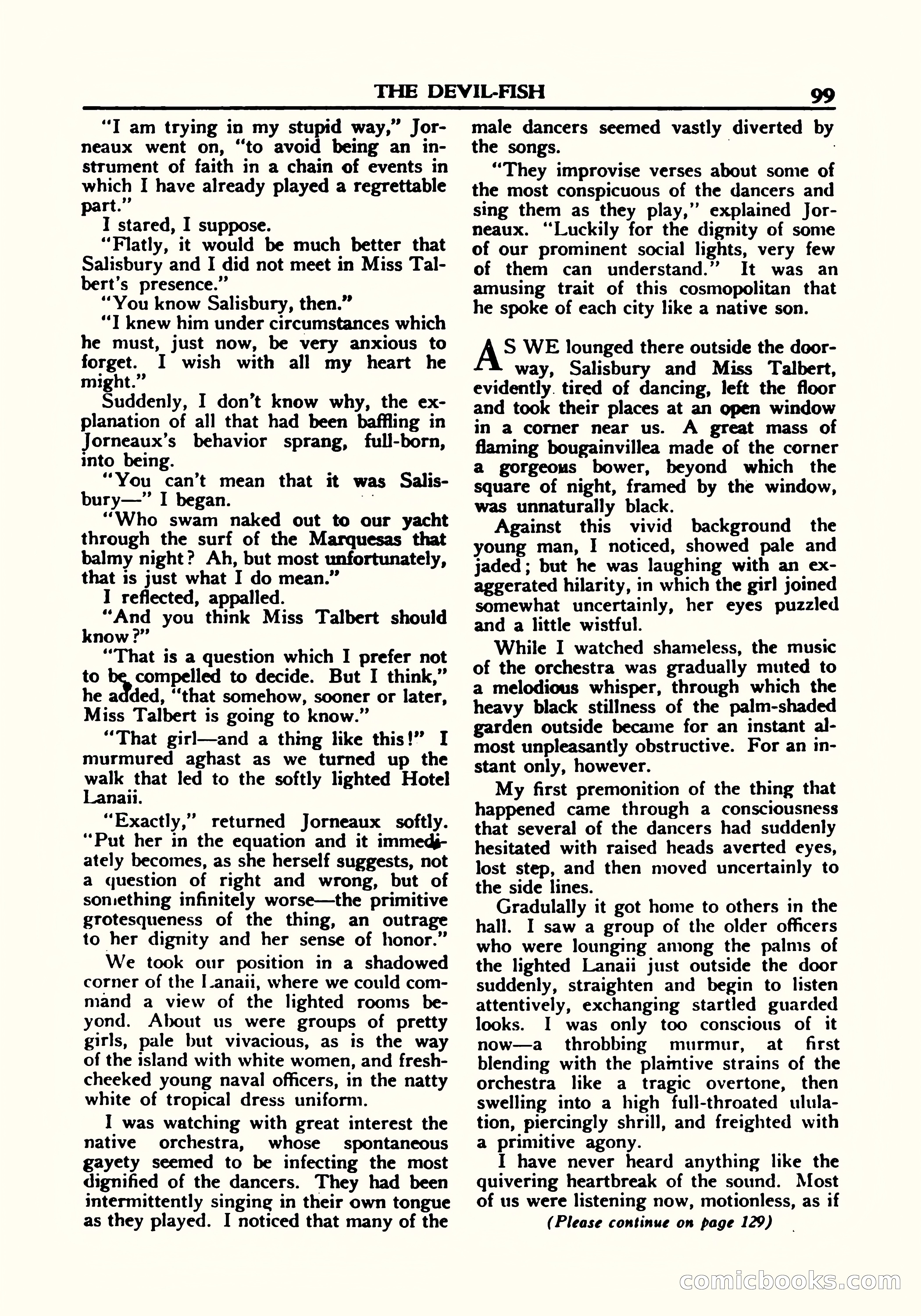
A restored page from Pulp Fiction, 1950. Page through the whole issue in the reader above.
📄 Transcribed text from this page (OCR, searchable)
Machine-transcribed from the original scan — historical spelling and the odd misread are preserved.
THE DEVIL-FISH 99 “I am trying in my stupid way,” Jor- neaux went on, “to avoid being an in- strument of faith in a chain of events in which I have already played a regrettable rt.” I stared, I suppose. “Flatly, it would be much better that Salisbury and I did not meet in Miss Tal- bert’s presence.” “You know Salisbury, then.” “IT knew him under circumstances which he must, just now, be very anxious to forget. I wish with all my heart he might.” Suddenly, I don’t know why, the ex- planation of all that had been baffling in Jorneaux’s behavior sprang, full-born, into being. “You can’t mean that it was Salis- bury—” I began. ~ “‘Who swam naked out to our yacht through the surf of the Marquesas that balmy night? Ah, but most unfortunately, that is just what I do mean.” I reflected, appalled. “And you think Miss Talbert should know ?” “That is a question which I prefer not to be compelled to decide. But I think,” he added, ‘‘that somehow, sooner or later, Miss Talbert is going to know.” “That girl—and a thing hike this!” I murmured aghast as we turned up the walk that led to the softly lighted Hotel Lanaii. “Exactly,” returned Jorneaux softly. “Put her in the equation and it immed- ately becomes, as she herself suggests, not a question of right and wrong, but of soniething infinitely worse—the primitive grotesqueness of the thing, an outrage to her dignity and her sense of honor.” We took our position in a shadowed corner of the l_anai, where we could com- mand a view of the lighted rooms be- yond. About us were groups of pretty girls, pale but vivacious, as is the way of the island with white women, and fresh- cheeked young naval officers, in the natty white of tropical dress uniform. I was watching with great interest the native orchestra, whose spontaneous gayety seemed to be infecting the most dignified of the dancers. They had been intermittently singing in their own tongue as they played. I noticed that many of the male dancers seemed vastly diverted by the songs. | : “They improvise verses about some of the most conspicuous of the dancers and sing them as they play,” explained Jor- neaux. “Luckily for the dignity of some of our prominent social lights, very few of them can understand.” It was an amusing trait of this cosmopolitan that he spoke of each city like a native son. A> WE lounged there outside the door- way, Salisbury and Miss Talbert, evidently. tired of dancing, left the floor and took their places at an open window in a corner near us. A great mass of flaming bougainvillea made of the corner a gorgeous bower, beyond which the square of night, framed by the window, was unnaturally black. Against this vivid background the young man, I noticed, showed pale and jaded ; but he was laughing with an ex- aggerated hilarity, in which the girl joined somewhat uncertainly, her eyes puzzled and a little wistful. While I watched shameless, the music of the orchestra was gradually muted to a melodious whisper, through which the heavy black stillness of the palm-shaded garden outside became for an instant al- most unpleasantly obstructive. For an in- stant only, however. My first premonition of the thing that happened came through a consciousness that several of the dancers had suddenly hesitated with raised heads averted eyes, lost step, and then moved uncertainly to the side lines. Gradulally it got home to others in the hall. I saw a group of the older officers who were lounging among the palms of the lighted Lanaii just outside the door suddenly, straighten and begin to listen attentively, exchanging startled guarded looks. I was only too conscious of itt now—a _ throbbing murmur, at first blending with the plamtive strains of the orchestra like a tragic overtone, then swelling into a high full-throated ulula- tion, piercingly shrill, and freighted with a primitive agony. I have never heard anything like the quivering heartbreak of the sound. Most of us were listening now, motionless, as if (Please continue on page 129) (C(O) nn) (C 6)(0)©) (C(O)