
Pulp Fiction, 1950 · page 16 of 133
A. Merritt's Fantasy Magazine, July 1950 — page 16: what you’re looking at
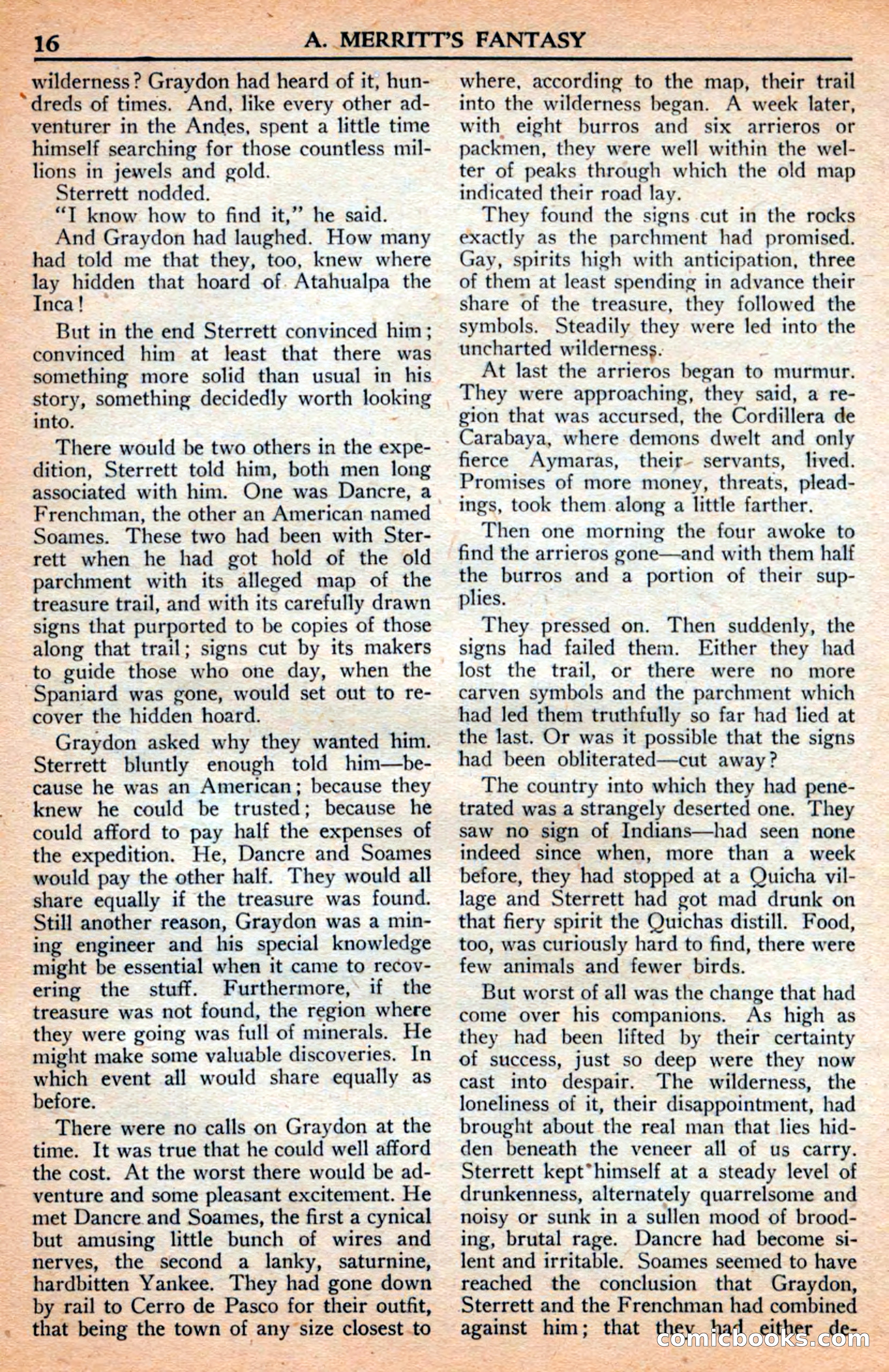
A restored page from Pulp Fiction, 1950. Page through the whole issue in the reader above.
📄 Transcribed text from this page (OCR, searchable)
Machine-transcribed from the original scan — historical spelling and the odd misread are preserved.
ya i —-F =" oe ~ "S FANTASY _ > ars —— a </ — 2 = > Wee * ’ « - . s _ wilderness? Graydon had heard of it, hun- ‘dreds of times. And, like every other ad- venturer in the Andes, spent a little time himself searching for those countless mil- lions in jewels and gold. Sterrett nodded. “T know how to find it,” he said. _ And Graydon had laughed. How many had told me that they, too, knew where S lay hidden that hoard of. Atahualpa the Inca! But in the end Sterrett convinced him; convinced him at least that there was something more solid than usual in his story, something decidedly worth looking into. There would be two others in the expe- dition, Sterrett told him, both men long associated with him. One was Dancre, a Frenchman, the other an American named Soames. These two had been with Ster- rett when he had got hold of the old parchment with its alleged map of the treasure trail, and with its carefully drawn signs that purported to be copies of those along that trail; signs cut by its makers to guide those who one day, when the Spaniard was gone, would set out to re- cover the hidden hoard. Graydon asked why they wanted him. Sterrett bluntly enough told him—be- cause he was an American; because they _ knew he could be trusted; because he could afford to pay half the expenses of the expedition. He, Dancre and Soames would pay the other half. They would all share equally if the treasure was found. Still another reason, Graydon was a min- ing engineer and his special knowledge might be essential when it came to recov- ering the stuff. Furthermore, if the treasure was not found, the region where they were going was full of minerals. He might make some valuable discoveries. In which event all would share equally as before. There were no calls on Graydon at the time. It was true that he could well afford the cost. At the worst there would be ad- venture and some pleasant excitement. He met Dancre and Soames, the first a cynical but amusing little bunch of wires and nerves, the second a lanky, saturnine, - hardbitten Yankee. They had gone down _ by rail to Cerro de Pasco for their outfit, that being the town of any size closest to where, according to the map, their trail into the wilderness began. A week later, with eight burros and six arrieros or packmen, they were well within the wel- ter of peaks through which the old map indicated their road lay. They found the signs cut in the rocks exactly as the parchment had promised. Gay, spirits high with anticipation, three of them at least spending in advance their share of the treasure, they followed the symbols. Steadily they were led into the uncharted wilderness. At last the arrieros began to murmur. They were approaching, they said, a re- gion that was accursed, the Cordillera de . Carabaya, where demons dwelt and only fierce Aymaras, their- servants, lived. Promises of more money, threats, plead- ings, took them. along a little farther, Then one morning the four awoke to find the arrieros gone—and with them half the burros and a portion of their sup- plies. They pressed on. Then suddenly, the signs had failed them. Either they had lost the trail, or there were no more carven symbols and the parchment which had led them truthfully so far had lied at the last. Or was it possible that the signs had been obliterated—cut away? The country into which they had pene- trated was a strangely deserted one. They saw no sign of Indians—had seen none indeed since when, more than a week before, they had stopped at a Quicha vil- lage and Sterrett had got mad drunk on that fiery spirit the Quichas distill. Food, too, was curiously hard to find, there were few animals and fewer birds. But worst of all was the change that had come over his companions. As high as they had been lifted by their certainty of success, just so deep were they now cast into despair. The wilderness, the loneliness of it, their disappointment, had brought about the real man that lies hid- den beneath the veneer all of us carry. Sterrett kept* himself at a steady level of drunkenness, alternately quarrelsome and noisy or sunk in a sullen mood of brood- ing, brutal rage. Dancre had become si- lent and irritable. Soames seemed to have reached the conclusion that Graydon, Sterrett and the Frenchman had combined against him; that cormich ofither com =