
Pulp Fiction, 1950 · page 14 of 133
A. Merritt's Fantasy Magazine, July 1950 — page 14: what you’re looking at
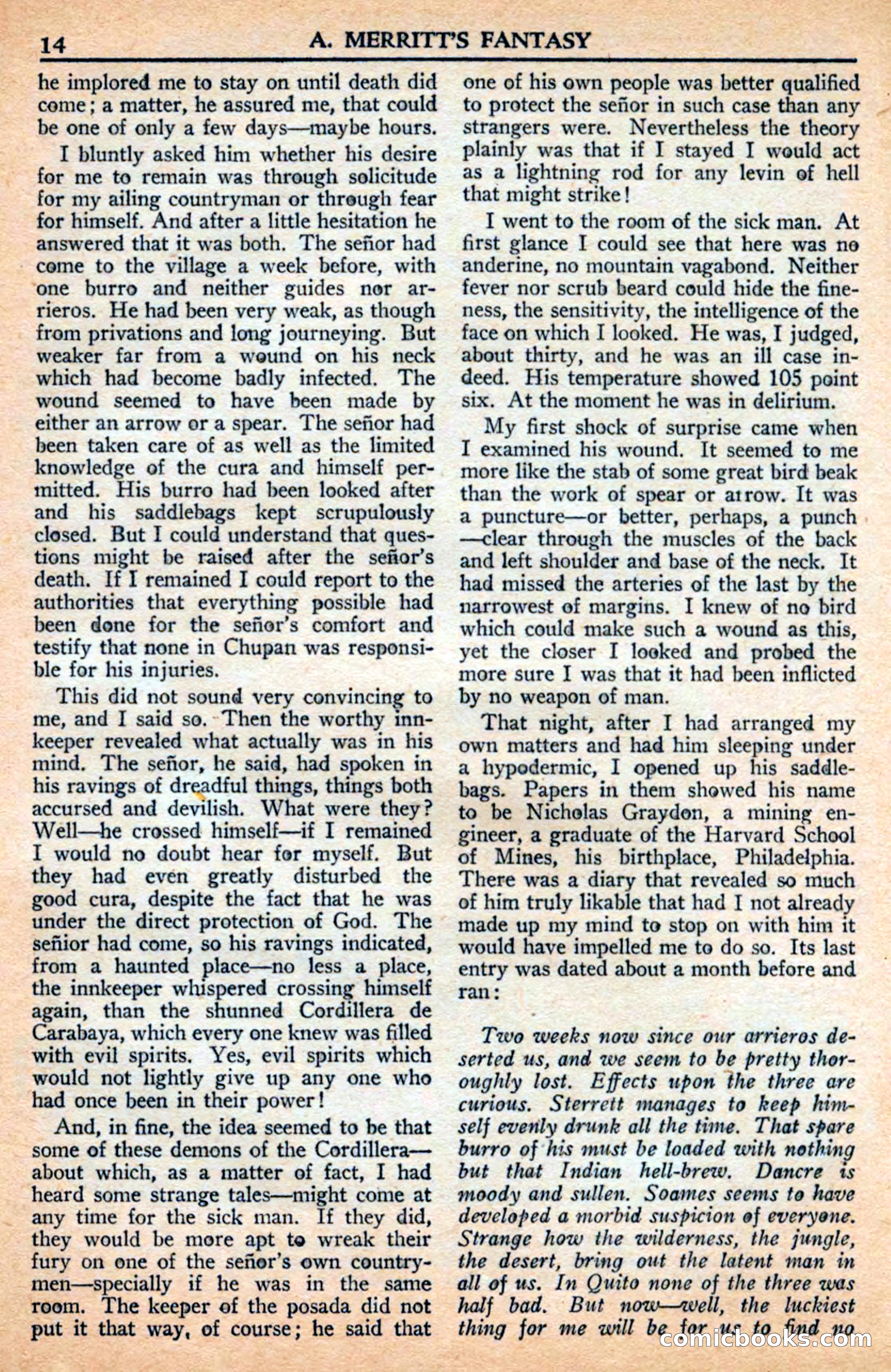
A restored page from Pulp Fiction, 1950. Page through the whole issue in the reader above.
📄 Transcribed text from this page (OCR, searchable)
Machine-transcribed from the original scan — historical spelling and the odd misread are preserved.
pa ant ed 4 ei 14 A. MERRITT’S FANTASY he implored me to stay on until death did come; a matter, he assured me, that could be one of only a few days—maybe hours. I bluntly asked him whether his desire for me to remain was through solicitude for my ailing countryman or threugh fear for himself. And after a little hesitation he answered that it was both. The sefior had - come to the village a week before, with ‘one burro and neither guides nor ar- rieros. He had been very weak, as though from privations and long journeying. But weaker far from a weund on his neck which had become badly infected. The wound seemed to have been made by either an arrow or a spear. The sefior had been taken care of as well as the limited knowledge of the cura and himself per- mitted. His burro had been looked after and his saddlebags kept scrupulously closed. But I could understand that ques- tions might be raised after the sefior’s death. If I remained I could report to the authorities that everything possible had been done for the sefier’s comfort and testify that none in Chupan was responsi- ble for his injuries. This did not sound very convincing to me, and I said so.- Then the worthy inn- keeper revealed what actually was in his mind, The sefior, he said, had spoken in his ravings of dreadful things, things both accursed and devilish. What were they? Well—he crossed himself—if I remained I would no doubt hear for myself. But they had even greatly disturbed the good cura, despite the fact that he was under the direct protection of God. The sehior had come, so his ravings indicated, from a haunted place—no less a place, the innkeeper whispered crossing himself again, than the shunned Cordillera de Carabaya, which every one knew was filled with evil spirits. Yes, evil spirits which would not lightly give up any one who had once been in their power! And, in fine, the idea seemed to be that some of these demons of the Cordillera— about which, as a matter of fact, I had heard some strange tales—might come at any time for the sick man. If they did, they would be more apt to wreak their fury on one of the sefior’s own country- men—specially if he was in the same room. The keeper of the posada did not 7 hag u put it that way, of course; he said that thing for me will be for us to..find one of his own people was better qualified to protect the sefior in such case than any strangers were. Nevertheless the theory plainly was that if I stayed I would act as a lightning rod for any levin of hell that might strike! I went to the room of the sick man. At first glance I could see that here was no anderine, no mountain vagabond. Neither fever nor scrub beard could hide the fine- ness, the sensitivity, the intelligence of the face on which I looked. He was, I judged, about thirty, and he was an ill case in- deed. His temperature showed 105 point six. At the moment he was in delirium. My first shock of surprise came when I examined his wound. It seemed to me more like the stab of some great bird beak than the work of spear or atrow. It was a puncture—or better, perhaps, a punch —clear through the muscles of the back and left shoulder and base of the neck, It had missed the arteries of the last by the narrowest of margins. I knew of no bird which could make such a wound as this, yet the closer I looked and probed the more sure I was that it had been inflicted by no weapon of man. That night, after I had arranged my own matters and had him sleeping under a hypodermic, I opened up his saddle- bags. Papers in them showed his name to be Nichelas Graydon, a mining en- gineer, a graduate of the Harvard School of Mines, his birthplace, Philadelphia. There was a diary that revealed so much of him truly likable that had I not already made up my mind te stop on with him it would have impelled me to do so. Its last entry was dated about a month before and ran: Two weeks now since our arrieros de- serted us, and we seem to be pretty thor- oughly lost. Effects upon the three are curious. Sterrett manages to keep him- self evenly drunk all the time. That spare burro of his must be loaded with nothing but that Indian hell-brew. Dancre is moody and sullen. Soames seems to have developed a morbid suspicion of everyene. Strange how the wilderness, the jungle, the desert, bring out the latent man in all of us. In Quito none of the three was half bad. But now—well, the luckiest Gomen _a * —~p