
Pulp Fiction, 1950 · page 69 of 132
A. Merritt's Fantasy Magazine, April 1950 — page 69: what you’re looking at
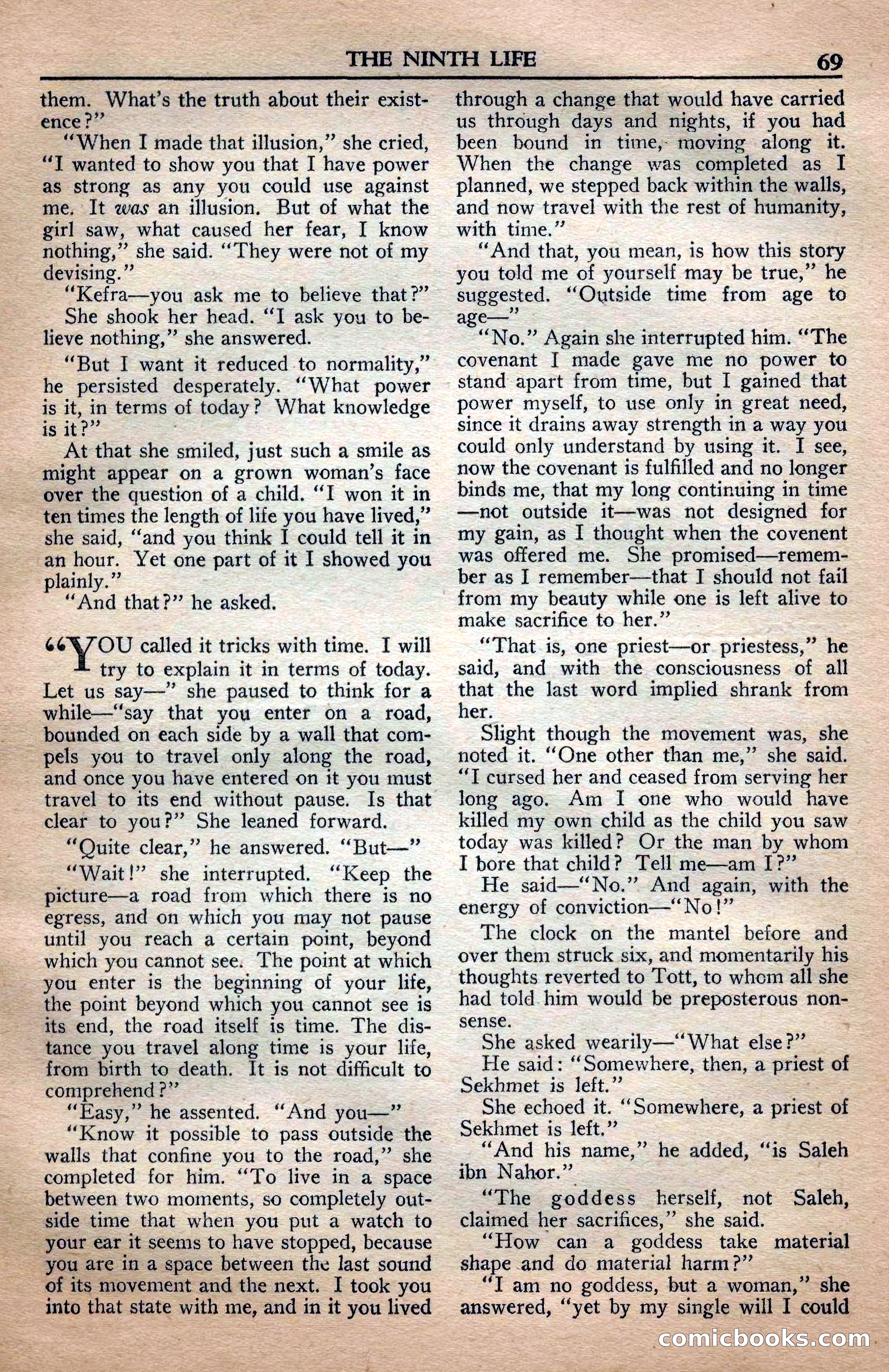
A restored page from Pulp Fiction, 1950. Page through the whole issue in the reader above.
📄 Transcribed text from this page (OCR, searchable)
Machine-transcribed from the original scan — historical spelling and the odd misread are preserved.
THE NINTH LIFE 69 them. What’s the truth about their exist- ence?” “When I made that illusion,” she cried, “I wanted to show you that I have power as strong as any you could use against me, It was an illusion. But of what the girl saw, what caused her fear, J know nothing,” she said. ‘‘They were not of my devising.” “Kefra—you ask me to believe that?” She shook her head. “I ask you to be- lieve nothing,” she answered. “But I want it reduced to normality,” he persisted desperately. “What power is it, in terms of today? What knowledge is it?” At that she smiled, just such a smile as might appear on a grown woman’s face over the question of a child. “I won it in ten times the length of life you have lived,” she said, “and you think I could tell it in an hour. Yet one part of it I showed you plainly.” “And that?” he asked. 6¢470U called it tricks with time. I will try to explain it in terms of today. Let us say—” she paused to think for a while—“say that you enter on a road, bounded on each side by a wall that com- pels you to travel only along the road, and once you have entered on it you must travel to its end without pause. Is that clear to you?” She leaned forward. “Quite clear,” he answered. “But—” “Wait!” she interrupted. ‘‘Keep the picture—a road from which there is no egress, and on which you may not pause until you reach a certain point, beyond which you cannot see. The point at which you enter is the beginning of your lite, the point beyond which you cannot see is its end, the road itself is time. The dis- tance you travel along time is your life, from birth to death. It is not difficult to comprehend ?”’ “Easy,” he assented. “And you—” “Know it possible to pass outside the walls that confine you to the road,” she completed for him. “To live in a space between two moments, so completely out- side time that when you put a watch to your ear it seems to have stopped, because ae you are in a space between the last sound Bt i 4 of its movement and the next. I took you into that state with me, and in it you lived through a change that would have carried us through days and nights, if you had been bound in time,- moving along it. When the change was completed as I planned, we stepped back within the walls, and now travel with the rest of humanity, with time.” “And that, you mean, is how this story you told me of yourself may be true,” he suggested. “Outside time from age to age—”” “No.” Again she interrupted him. “The covenant I made gave me no power to stand apart from time, but I gained that power myself, to use only in great need, since it drains away strength in a way you could only understand by using it. I see, now the covenant is fulfilled and no longer binds me, that my long continuing in time —not outside it—was not designed for my gain, as I thought when the covenent was offered me. She promised—remem- ber as J remember—that I should not fail from my beauty while one is left alive to make sacrifice to her.” “That is, one priest—or priestess,” he said, and with the consciousness of all that the last word implied shrank from her. Slight though the movement was, she noted it. ‘One other than me,” she said. “T cursed her and ceased from serving her long ago. Am I one who would have killed my own child as the child you saw today was killed? Or the man by whom I bore that child? Tell me—am I?” He said—“No.” And again, with the energy of conviction—“No!”’ The clock on the mantel before and over them struck six, and momentarily his thoughts reverted to Tott, to whem all she had told. him would be preposterous non- sense. = She asked wearily—‘What else?” He said: “Somewhere, then, a priest of Sekhmet is left.” She echoed it. “Somewhere, a priest of Sekhmet is left.” “And his name,” he added, ‘‘is Saleh ibn Nahor.”” “The goddess herself, not Saleh, claimed her sacrifices,” she said. “How can a goddess take material shape and do material harm?” “T am no goddess, but a woman,” she answered, “‘yet by my single will I could “comicbooks.co