
Pulp Fiction, 1950 · page 24 of 132
A. Merritt's Fantasy Magazine, April 1950 — page 24: what you’re looking at
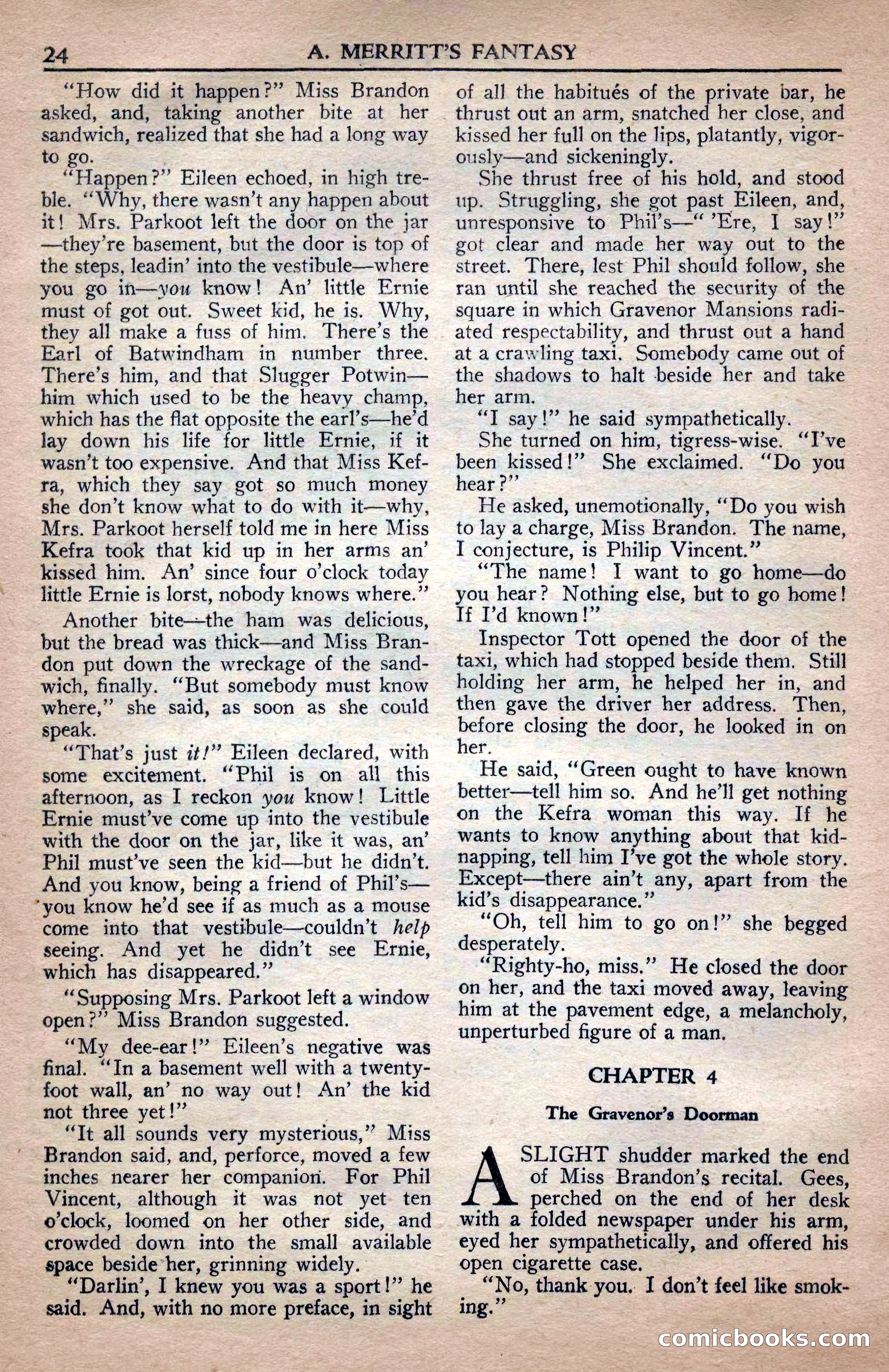
A restored page from Pulp Fiction, 1950. Page through the whole issue in the reader above.
📄 Transcribed text from this page (OCR, searchable)
Machine-transcribed from the original scan — historical spelling and the odd misread are preserved.
24 A. MERRITT’S FANTASY “How did it happen?” Miss Brandon asked, and, taking another bite at her sandwich, realized that she had a long way to go. 3 “Happen?” Eileen echoed, in high tre- ble. “Why, there wasn’t any happen about it! Mrs. Parkoot left the door on the jar —they’re basement, but the door is top of the steps, leadin’ into the vestibule—where you go in—you know! An’ little Ernie must of got out. Sweet kid, he is. Why, they all make a fuss of him. There’s the Earl of Batwindham in number three. There’s him, and that Slugger Potwin— him which used to be the heavy champ, which has the flat opposite the earl’s—he’d lay down his life for little Ernie, if it wasn’t too expensive. And that Miss Kef- ra, which they say got so much money she don’t know what to do with it—why, Mrs. Parkoot herself told me in here Miss Kefra took that kid up in her arms an’ kissed him. An’ since four o’clock today little Ernie is lorst, nobody knows where.”’ Another bite—the ham was delicious, but the bread was thick—and Miss Bran- don put down the wreckage of the sand- wich, finally. “But somebody must know where,” she said, as soon as she could speak. “That’s just it/” Eileen declared, with some excitement. “Phil is on all this afternoon, as I reckon you know! Little Ernie must’ve come up into the vestibule with the door on the jar, like it was, an’ Phil must’ve seen the kid—but he didn’t. And you know, being a friend of Phil’s— "you know he'd see if as much as a mouse come into that vestibule—couldn’t help seeing. And yet he didn’t see Ernie, which has disappeared.” “Supposing Mrs. Parkoot left a window open?” Miss Brandon suggested. “My dee-ear!’” Eileen’s negative was final. “In a basement well with a twenty- foot wall, an’ no way out! An’ the kid not three yet!” 3 “Tt all sounds very mysterious,” Miss Brandon said, and, perforce, moved a few inches nearer her companion. For Phil Vincent, although it was not yet ten o'clock, loomed on her other side, and crowded down into the small available space beside her, grinning widely. “Darlin’, I knew you was a sport!” he said. And, with no more preface, in sight of all the habitués of the private bar, he thrust out an arm, snatched her close, and kissed her full on the lips, platantly, vigor- ously—and sickeningly. She thrust free of his hold, and stood up. Struggling, she got past Eileen, and, unresponsive to Phil’s—“ ’Ere, I say!” got clear and made her way out to the street. There, lest Phil should follow, she ran until she reached the security of the square in which Gravenor Mansions radi- ated respectability, and thrust out a hand at a crawling taxi. Somebody came out of the shadows to halt beside her and take her arm. “T say!” he said sympathetically. She turned on him, tigress-wise. “I’ve been kissed!’” She exclaimed. “Do you hear ?”’ He asked, unemotionally, ““Do you wish to lay a charge, Miss Brandon. The name, I conjecture, is Philip Vincent.” “The name! I want to go home—do you hear? Nothing else, but to go home! If I’d known!” Inspector Tott opened the door of the taxi, which had stopped beside them. Still holding her arm, he helped her in, and then gave the driver her address. Then, a closing the door, he looked in on er. He said, “Green ought to have known better—tell him so. And he’ll get nothing on the Kefra woman this way. If he wants to know anything about that kid- napping, tell him I’ve got the whole story. Except—there ain’t any, apart from the kid’s disappearance.” “Oh, tell him to go on!” she begged desperately. “Righty-ho, miss.” He closed the door on her, and the taxi moved away, leaving him at the pavement edge, a melancholy, unperturbed figure of a man. CHAPTER 4 The Gravenor’s Doorman SLIGHT shudder marked the end of Miss Brandon’s recital. Gees, perched on the end of her desk with a folded newspaper under his arm, eyed her sympathetically, and offered his open cigarette case. _ “No, thank you. I don’t feel like smok- ing.” com cbooks.col