
Pulp Fiction, 1950 · page 52 of 133
A. Merritt's Fantasy Magazine, February 1950 — page 52: what you’re looking at
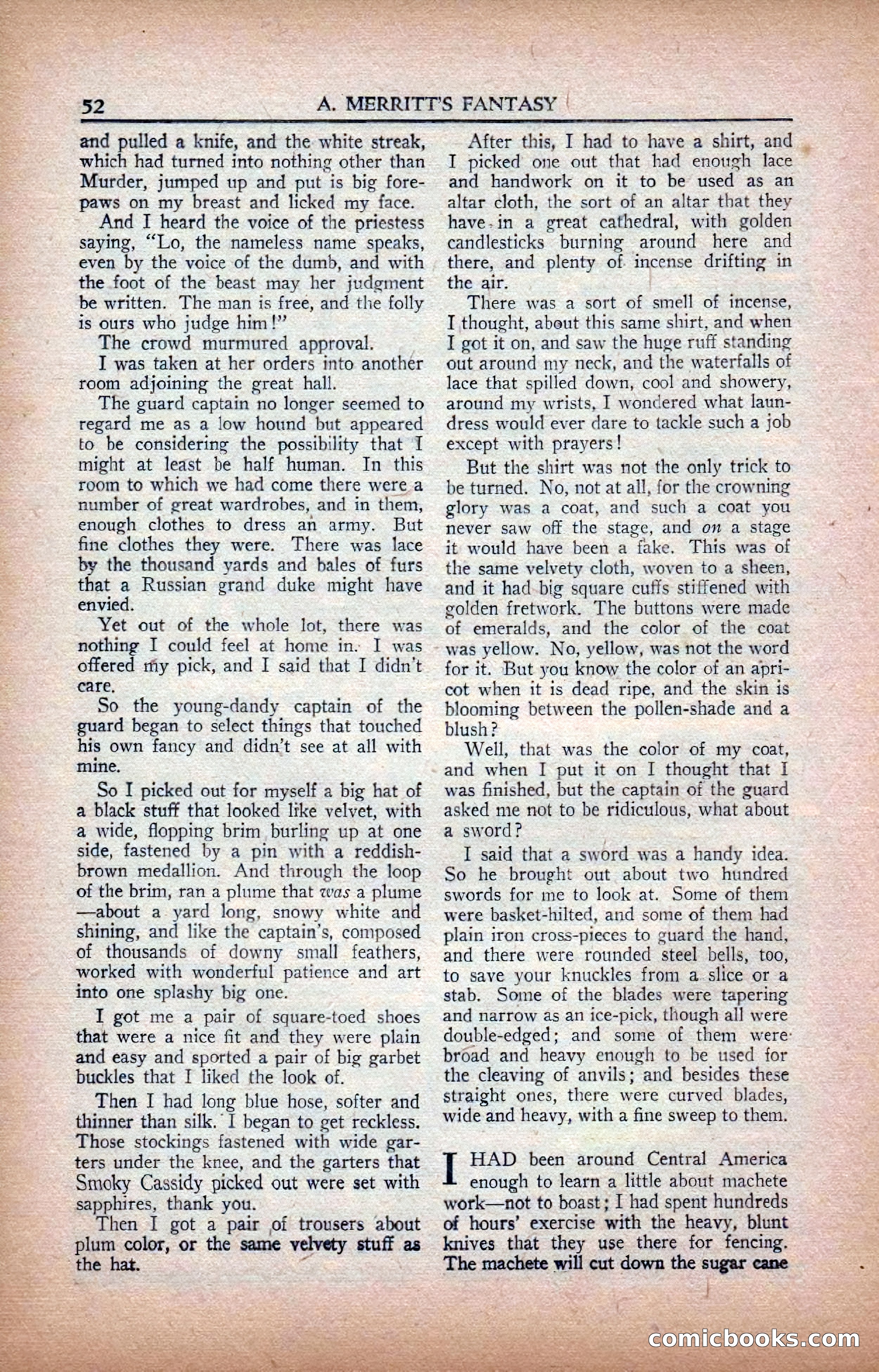
A restored page from Pulp Fiction, 1950. Page through the whole issue in the reader above.
📄 Transcribed text from this page (OCR, searchable)
Machine-transcribed from the original scan — historical spelling and the odd misread are preserved.
Sea =e — ee t CLT Abe? TAA AN Vs 4 5 , iM 52 A. MERRITT’S FANTASY | and pulled a knife, and the white streak, which had turned into nothing other than Murder, jumped up and put is big fore- paws on my breast and licked my face. And I heard the voice of the priestess saying, “Lo, the nameless name speaks, even by the voice of the dumb, and with the foot of the beast may her judgment be written. The man is free, and the folly is ours who judge him!” The crowd murmured approval. I was taken at her orders into another room adjoining the great hall. The guard captain no longer seemed to regard me as a low hound but appeared to be considering the possibility that I might at least be half human. In this room to which we had come there were a number of great wardrobes, and in them, enough clothes to dress an army. But fine clothes they were. There was lace by the thousand yards and bales of furs that a Russian grand duke might have envied. Yet out of the whole lot, there was nothing I could feel at home in. I was offered rfiy pick, and I said that I didn’t care, So the young-dandy captain of the guard began to select things that touched his own fancy and didn’t see at all with mine. So I picked out for myself a big hat of a black stuff that looked Itke velvet, with a wide, flopping brim burling up at one side, fastened by a pin with a reddish- brown medallion. And through the loop of the brim, ran a plume that was a plume —about a yard long, snowy white and shining, and like the captain’s, composed of thousands of downy small feathers, worked with wonderful patience and art into one splashy big one. I got me a pair of square-toed shoes that were a nice fit and they were plain and easy and sported a pair of big garbet buckles that I liked the look of. Then I had long blue hose, softer and thinner than silk. I began to get reckless. Those stockings fastened with wide gar- ters under the knee, and the garters that Smoky Cassidy picked out were set with sapphires, thank you. Then I got a pair of trousers about plum color, or the same velvety stuff as After this, I had to have a shirt, and I picked one out that had enough lace and handwork on it to be used as an altar cloth, the sort of an altar that they have-in a great cathedral, with golden candlesticks burning around here and there, and plenty of. incense drifting in the air. There was a sort of smell of incense, I thought, abeut this same shirt, and when I got it on, and saw the huge ruff standing out around my neck, and the waterfalls of lace that spilled down, cool and showery, around my wrists, I wondered what laun- dress would ever dare to tackle such a job except with prayers! But the shirt was not the only trick to be turned. No, not at all, for the crowning glory was a coat, and such a coat you never saw off the stage, and om a stage it would have been a fake, This was of the same velvety cloth, woven to a sheen, and it had-big square cuffs stiffened with golden fretwork. The buttons were made of emeralds, and the color of the coat - was yellow. No, yellow, was not the word for it. But you know the color of an apri- cot when it is dead ripe, and the skin is blooming between the pollen-shade and a blush? Well, that was the color of my coat, and when I put it on I thought that I was finished, but the captain of the guard asked me not to be ridiculous, what about a sword? I said that a sword was a handy idea. So he brought out about two hundred swords for me to look at. Some of them were basket-hilted, and some of them had plain iron cross-pieces to guard the hand, and there were rounded steel bells, too, to save your knuckles from a-slice or a stab. Some of the blades were tapering and narrow as an ice-pick, though all were double-edged; and some of them were: broad and heavy enough to be used for the cleaving of anvils; and besides these straight ones, there were curved blades, wide and heavy, with a fine sweep to them. HAD been around Central America enough to learn a little about machete work—not to boast; I had spent hundreds of hours’ exercise with the heavy, blunt knives that they use there for fencing. The machete will cut down the sugar cane