
Pulp Fiction, 1950 · page 106 of 133
A. Merritt's Fantasy Magazine, February 1950 — page 106: what you’re looking at
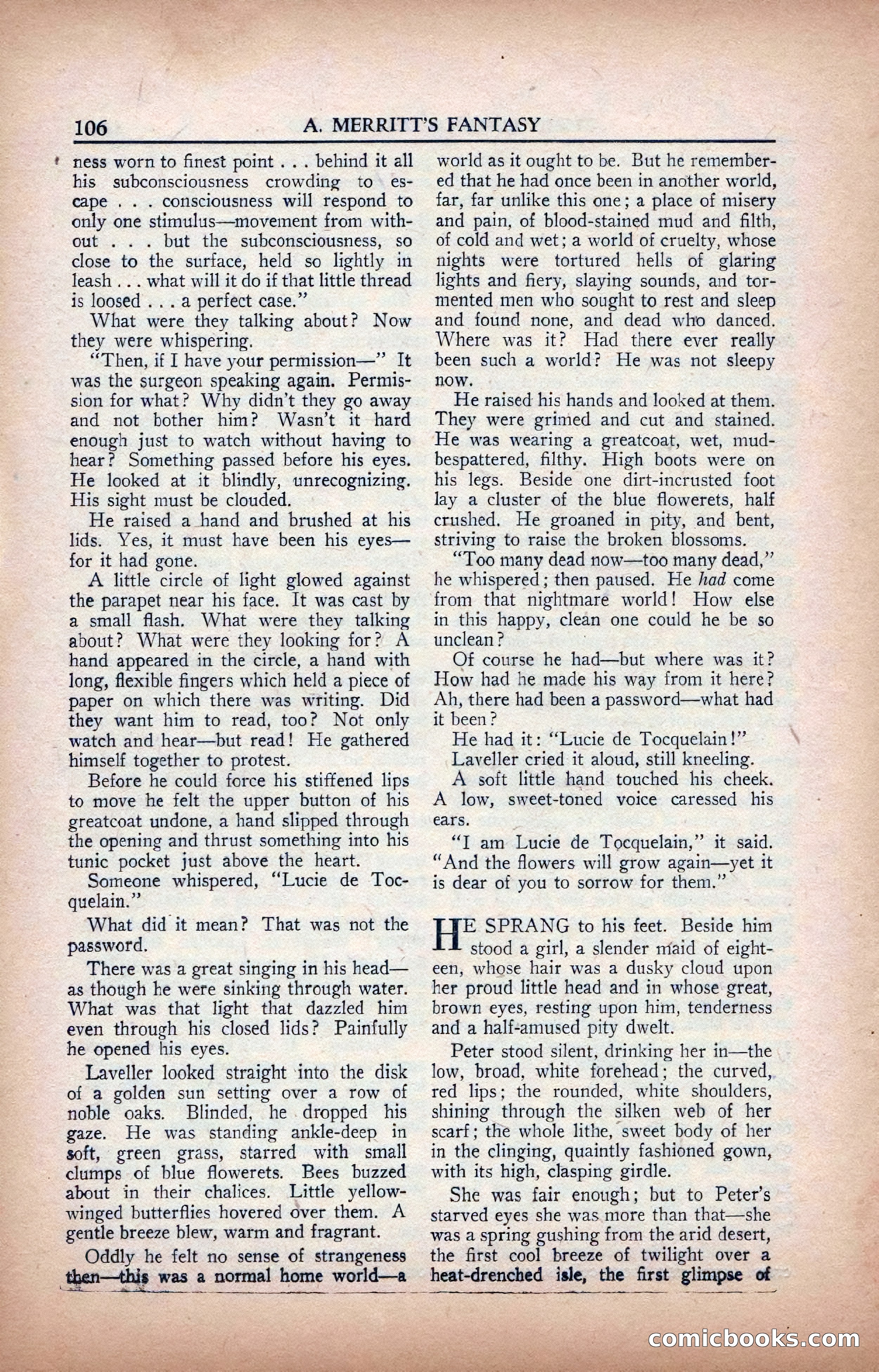
A restored page from Pulp Fiction, 1950. Page through the whole issue in the reader above.
📄 Transcribed text from this page (OCR, searchable)
Machine-transcribed from the original scan — historical spelling and the odd misread are preserved.
- 106 A. MERRITT’S FANTASY ~ ness worn to finest point . . . behind it all his subconsciousness crowding to es- cape . . . consciousness will respond to only one stimulus—movement from with- out .. . but the subconsciousness, so close to the surface, held so lightly in leash... what will it do if that little thread is loosed . . . a perfect case.” What were they talking about? Now they were whispering. “Then, if I have your permission—”’ It was the sturgeon speaking again. Permis- sion for what? Why didn’t they go away and not bother him? Wasn't it hard enough just to watch without having to hear? Something passed before his eyes. He looked at it blindly, unrecognizing. His sight must be clouded. He raised a hand and brushed at his lids. Yes, it must have been his eyes— for it had gone. A little circle of light glowed against the parapet near his face. It was cast by a small flash. What were they talking about? What were they looking for? A hand appeared in the circle, a hand with long, flexible fingers which held a piece of paper on which there was writing. Did they want him to read, too? Not only watch and hear—but read! He gathered himself together to protest. Before he could force his stiffened lips to move he felt the upper button of his greatcoat undone, a hand slipped through the opening and thrust something into his tunic pocket just above the heart. Someone whispered, ‘‘Lucie de Toc- quelain.” What did it mean? That was not the password. There was a great singing in his head— as though he were sinking through water. What was that light that dazzled him even through his closed lids? Painfully he opened his eyes. Laveller looked straight ‘into the disk of a golden sun setting over a row of noble oaks. Blinded, “he dropped his gaze. He was standing ankle-deep in soft, green grass, starred with small clumps of blue flowerets. Bees buzzed about in their chalices. Little yellow- winged butterflies hovered over them. A gentle breeze blew, warm and fragrant. Oddly he felt no sense of strangeness then—this was was a normal home world—a world as it ought to be. But he remember- ed that he had once been in another world, far, far unlike this one; a place of misery and pain, of blood-stained mud and filth, of cold and wet; a world of cruelty, whose nights were tortured hells of glaring lights and fiery, slaying sounds, and tor- mented men who sought to rest and sleep and found none, and dead who danced. Where was it? Had there ever really been such a world? He was not sleepy now. He raised his hands and looked at them. They were grimed and cut and stained. He was wearing a greatcoat, wet, mud- bespattered, filthy. High boots were on his legs. Beside one dirt-incrusted foot lay a cluster of the blue flowerets, half crushed. He groaned in pity, and bent, striving to raise the broken blossoms. “Too many dead now—too many dead,” he whispered ; then paused. He had come from that nightmare world! How else in this happy, clean one could he be so unclean? Of course he had—but where was it? How had he made his way from it here? Ah, there had been a password—what had it been? He had it: “Lucie de Tocquelain!”’ Laveller cried it aloud, still kneeling. A soft little hand touched his cheek. A low, sweet-toned voice caressed his ears. “T am Lucie de Tocquelain,” it said. “And the flowers will grow again—yet it is dear of you to sorrow for them.” 33 E SPRANG to his feet. Beside him stood a girl, a slender niaid of eight- een, whose hair was a dusky cloud upon her proud little head and in whose great, brown eyes, resting upon him, tenderness and a half-amused pity dwelt. Peter stood silent, drinking her in—the low, broad, white forehead: the curved, red lips; the rounded, white shoulders, shining through the silken web of her scarf ; “the whole lithe, sweet body of her in the clinging, quaintly fashioned gown, with its high, clasping girdle. She was fair enough; but to Peter’s starved eyes she was more than that—she was a spring gushing from the arid desert, the first cool breeze of twilight over a heat-drenched isle, the first glimpse of