
Pulp Fiction, 1950 · page 98 of 134
A. Merritt's Fantasy Magazine, February 1950 — page 98: what you’re looking at
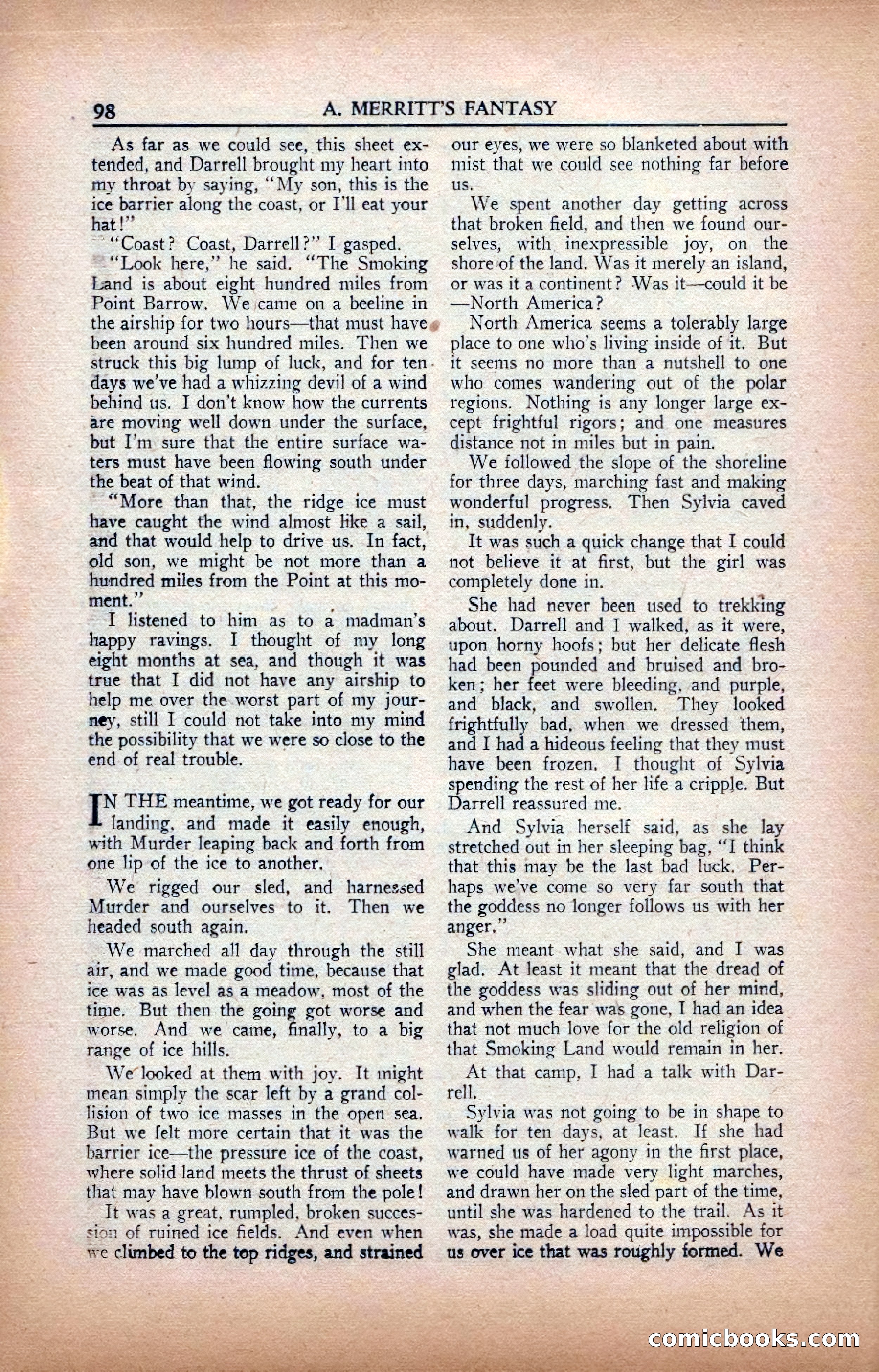
A restored page from Pulp Fiction, 1950. Page through the whole issue in the reader above.
📄 Transcribed text from this page (OCR, searchable)
Machine-transcribed from the original scan — historical spelling and the odd misread are preserved.
ee? ee) Oe eee Bee ee hk » 04 et ey pian § 98 A. MERRITT’S FANTASY As far as we could see, this sheet ex- tended, and Darrell brought my heart into my throat by saying, “My son, this is the ice barrier along the coast, or I'll eat your hat!” “Coast? Coast, Darrell?” I gasped. “Look here,” he said. “The Smoking Land is about eight hundred miles from Point Barrow. We came on a beeline in the airship for two hours—that must haves been around six hundred miles. Then we struck this big lump of luck, and for ten. days we've had a whizzing devil of a wind behind us. I don’t know how the currents are moving well down under the surface, but I’m sure that the entire surface wa- ters must have been flowing south under the beat of that wind. “More than that, the ridge ice must have caught the wind almost like a sail, and that would help to drive us. In fact, old son, we might be not more than a hundred miles from the Point at this mo- ment.” : IT listened to him as to a madman’s happy ravings. I thought of my long eight months at sea, and though it was true that I did not have any airship to help me over the worst part of my jour- ney, still I could not take into my mind the possibility that we were so close to the end of real trouble. N THE meantime, we got ready for our * landing, and made it easily enough, with Murder leaping back and forth from one lip of the ice to another. We rigged our sled, and harnessed Murder and ourselves to it. Then we headed south again. We marched all day through the still air, and we made good time, because that ice was as level as a meadow. most of the time. But then the going got worse and worse. And we came, finally, to a big range of ice hills. We looked at them with joy. It might mean simply the scar left by a grand col- lision of two ice masses in the open sea. But we felt more certain that it was the barrier ice—the pressure ice of the coast, where solid land meets the thrust of sheets that may have blown south from the pole! Tt was a great, rumpled, broken succes- ston of ruined ice fields. And even when we climbed to the top ridges, and strained our eyes, we were so blanketed about with mist that we could see nothing far before us. We spent another day getting across that broken field, and then we found our- selves, with inexpressible joy, on the shore of the land. Was it merely an island, or was it a continent? Was it—could it be —North America? North America seems a tolerably large place to one who’s living inside of it. But it seems no more than a nutshell to one who comes wandering out of the polar regions. Nothing is any longer large ex- cept frightful rigors; and one measures distance not in miles but in pain. We followed the slope of the shoreline for three days, marching fast and making wonderful progress, Then Sylvia caved in, suddenly. It was such a quick change that I could not believe it at first, but the girl was completely done in. She had never been used to trekking about. Darrell and I walked, as it were, upon horny hoofs; but her delicate flesh had been pounded and bruised and bro- ken; her feet were bleeding, and purple, and black, and swollen, They looked frightfully bad, when we dressed them, and I had a hideous feeling that they must have been frozen. [I thought of Sylvia spending the rest of her life a cripple. But Darrell reassured me. And Sylvia herself said, as she lay stretched out in her sleeping bag, “I think that this may be the last bad luck. Per- haps we've come so very far south that the goddess no longer follows us with her anger,” She meant what she said, and I was glad. At least it meant that the dread of the goddess was sliding out of her mind, and when the fear was gone, I had an idea that not much love for the old religion of that Smoking Land would remain in her. At that camp, I had a talk with Dar- rell, Sylvia was not going to be in shape to walk for ten days, at least. If she had warned us of her agony in the first place, we could have made very light marches, and drawn her on the sled part of the time, until she was hardened to the trail. As it was, she made a load quite impossible for us over ice that was roughly formed. We