
Pulp Fiction, 1950 · page 65 of 134
A. Merritt's Fantasy Magazine, February 1950 — page 65: what you’re looking at
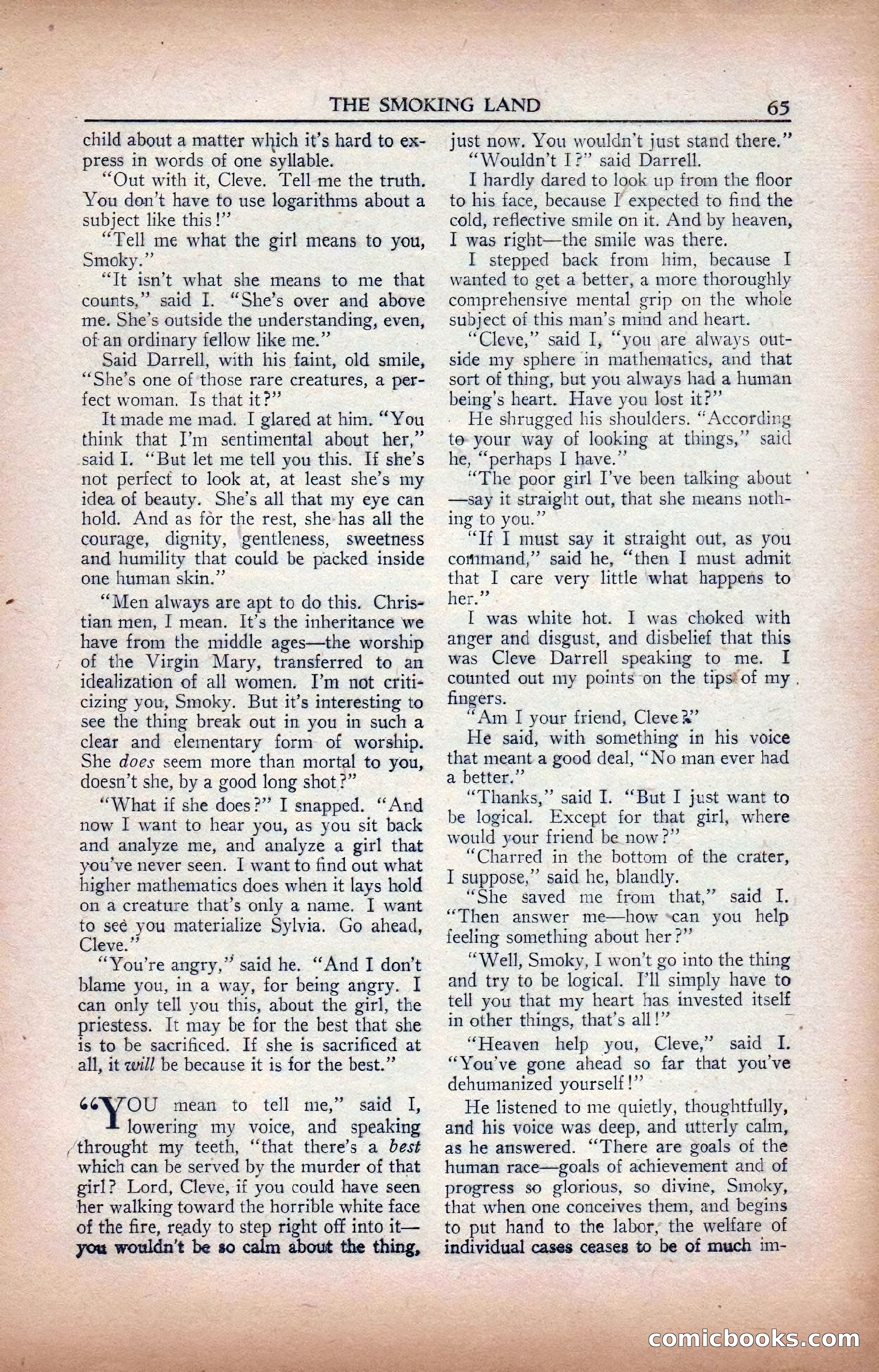
A restored page from Pulp Fiction, 1950. Page through the whole issue in the reader above.
📄 Transcribed text from this page (OCR, searchable)
Machine-transcribed from the original scan — historical spelling and the odd misread are preserved.
7 THE SMOKING LAND “child about a matter which it’s hard to ex- press in words of one syllable. “Out with it, Cleve. Tell me the truth. You don’t have to use logarithms about a subject like this!” “Tell me what the girl means to you, Smoky.” “Tt isn’t what she means to me that counts,” said I. “She’s over and above me. She’s outside the understanding, even, of an ordinary fellow like me. Said Darrell, with his faint, old suiile, “She’s one of those rare creatures, a per- fect woman. Is that it?” It made me mad. I glared at him. “You think that I’m sentimental about her,” said I. ‘But let me tell you this. Ii she’s not perfect to look at, at least she’s my idea of beauty. She’s all that my eye can hold. And as for the rest, she: has all the courage, dignity, gentleness, sweetness and humility that could be packed inside one human skin.” “Men always are apt to do this. Chris- tian men, | mean. It’s the inheritance we have from the middle ages—the worship of the Virgin Mary, transferred to an idealization of all women. I’m not criti- cizing you, Smoky. But it’s interesting to see the thing break out in you in such a clear and elementary form of worship. She does seem more than mortal to you, doesn’t she, by a good long shot ?” “What if she does?” I snapped. “And now I want to hear you, as you sit back and analyze me, and analyze a girl that you've never seen. I want to find out what higher mathematics does when it lays hold on a creature that’s only a name. I want to seé you materialize Sylvia. Go ahead, Cleve.” “You're angry,” said he. “And I don’t blame you, in a way, for being angry. I can only tell you this, about the girl, the priestess. It may be for the best that she is to be sacrificed. Ii she is sacrificed at all, it qil] be because it is for the best.” 66¥/OU mean to tell me,” said I, lowering my voice, and speaking /throught my teeth, “that there’s a best which can be served by the murder of that girl? Lord, Cleve, if you could have seen her walking toward the horrible white face of the fire, ready to step right off into it— you wouldn't be so calm about the thing, 65 just now. You wouldn't just stand there.” “Wouldn’t I?” said Darrell. I hardly dared to look up from the floor to his face, because I expected to find the cold, reflective smile on it. And by heaven, I was right—the smile was there. I stepped back from him, because I wanted to get a better, a more thoroughly comprehensive mental grip on the whole subject of this man’s mind and heart. “Cleve,” said I, “you are always out- side my sphere in mathematics, and that sort of thing, but you always had a human being’s heart. Have you lost it?”’ He shrugged his shoulders. “According te your way of looking at things,” said he, “perhaps I have.”’ “The poor girl I’ve been talking about ° —say it straight out, that she means noth- ing to you. “Tf I must say it straight out, as you command,” said he, “then I must admit that I care very little what happens to her” I was white hot. I was choked with anger and disgust, and disbelief that this was Cleve Darrell speaking to me. I counted out my points on the tipst of my . fingers. “Am I your friend, Cleve ®’ He said, with something in his voice that meant a good deal, “No man ever had a better.” “Thanks,” said I. “But I just want to be logical. Except for that girl, where would your friend be now?” “Charred in the bottom of the crater, I suppose,” said he, blandly. “She saved me from that,” said I. “Then answer me—how scan you help feeling something about her?” “Well, Smoky, I won't go into the thing and try to be logical. Ill simply have to tell you that my heart has invested itself in other things, that’s all!” ; “Heaven help you, Cleve,” said I. “You've gone ahead so far that you've dehumanized yourself!” He listened to me quietly, thoughtfully, and his voice was deep, and utterly calm, as he answered. “There are goals of the human race—goals of achievement and of progress so glorious, so divine, Smoky, that when one conceives them, and begins to put hand to the labor, the welfare of individual cases ceases to be of much im-