
Pulp Fiction, 1950 · page 107 of 134
A. Merritt's Fantasy Magazine, February 1950 — page 107: what you’re looking at
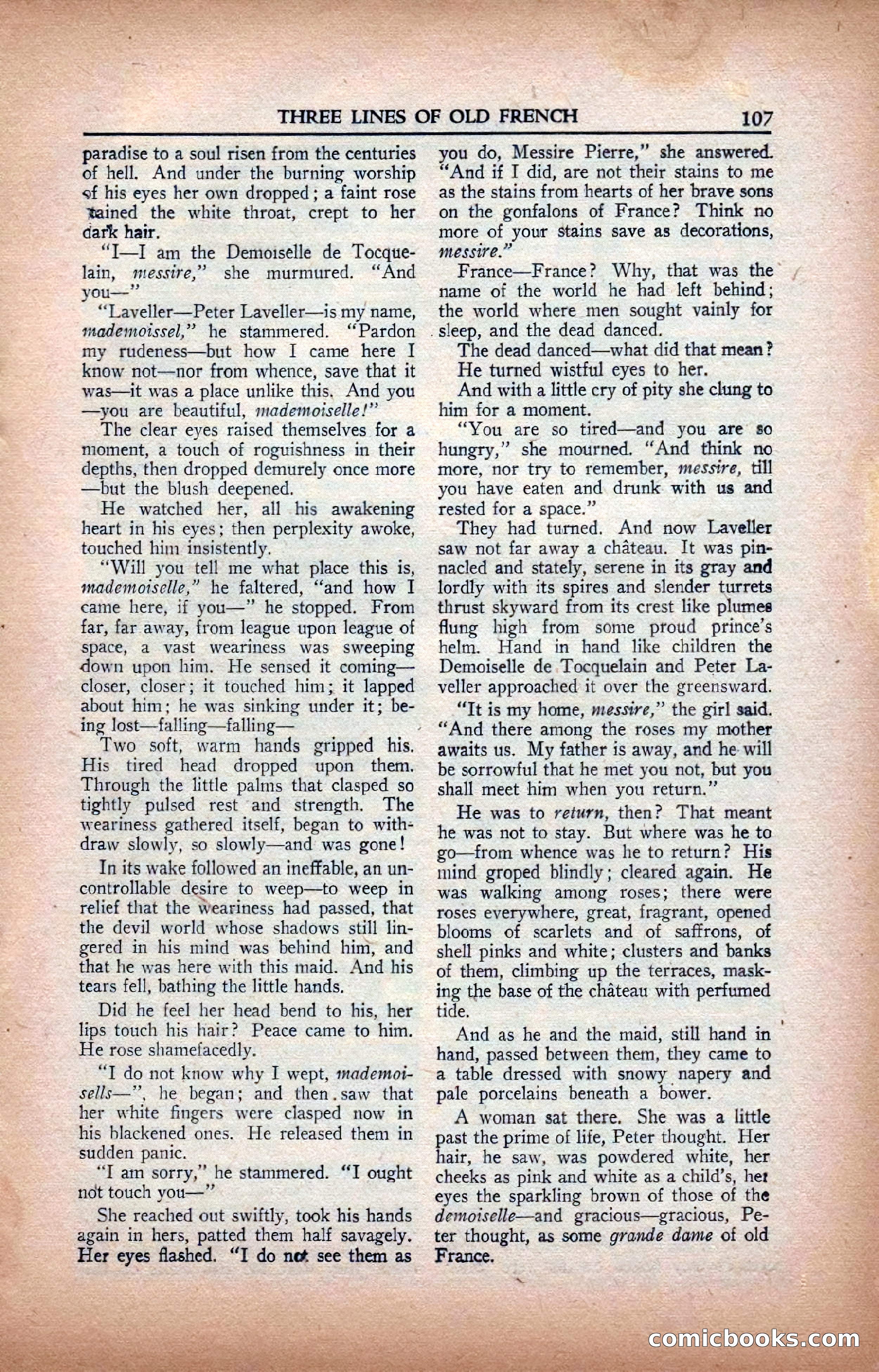
A restored page from Pulp Fiction, 1950. Page through the whole issue in the reader above.
📄 Transcribed text from this page (OCR, searchable)
Machine-transcribed from the original scan — historical spelling and the odd misread are preserved.
_ Her eyes flashed. “I do net see them as THREE LINES OF OLD FRENCH 107 paradise to a soul risen from the centuries of hell, And under the burning worship sf his eyes her own dropped; a faint rose fained the white throat, crept to her dark hair. “I—I am the Demoiselle de Tocque- lain, messire,’” she murmured. “And you—”’ “Taveller—Peter Laveller—is my name, mademotssel,” he stammered. ‘Pardon my rudeness—but how I came here I know not—nor from whence, save that it was—it was a place unlike this, And you —you are beautiful, mademoiselle!”’ The clear eyes raised themselves for a moment, a touch of roguishness in their depths, then dropped demurely once more —but the blush deepened. He watched her, all his awakening heart in his eyes; then perplexity awoke, touched him insistently. “Will you tell me what place this is, mademotselle,” he faltered, “‘and how I came here, if you—” he stopped. From far, far away, from league upon league of space, a vast weariness was sweeping down upon him. He sensed it coming— closer, closer; it touched him; it lapped about him; he was sinking under it; be- _ ing lost—falling—falling— ; Two soft, warm hands gripped his, His tired head dropped upon them. Through the little palms that clasped so tightly pulsed rest and strength. The weariness gathered itself, began to with- draw slowly, so slowly—and was gone! In its wake followed an ineffable, an un- controllable desire to weep—to weep in relief that the Weariness had passed, that the devil world whose shadows still lin- gered in his mind was behind him, and that he was here with this maid. And his tears fell, bathing the little hands, Did he feel her head bend to his, her lips touch his hair? Peace came to him. He rose shamefacedly. “T do not know why I wept, mademoi- sells—”’, he began; and then.saw that her white fingers were clasped now in his blackened ones. He released them in sudden panic. “I am sorry,” he stammered. “I ought not touch you—”’ She reached out swiftly, took his hands again in hers, patted them half savagely. you do, Messire Pierre,” she answered. “And if I did, are not their stains to me as the stains from hearts of her brave sons on the gonfalons of France? Think no more of your stains save as decorations, messire.” France—France? Why, that was the , name of the world he had left behind; the world where men sought vainly for .sleep, and the dead danced. The dead danced—what did that mean? He turned wistful eyes to her. And with a little cry of pity she clung to him for a moment. “You are so tired—and you are so hungry,” she mourned. “And think no more, nor try to remember, messire, till you have eaten and drunk with us and rested for a space.” They had turned. And now Laveller saw not far away a chateau. It was pin- nacled and stately, serene in its gray and lordly with its spires and slender turrets thrust skyward from its crest like plumes flung high from some proud prince’s helm. Hand in hand like children the Demoiselle de Tocquelain and Peter La- veller approached it over the greensward. “Tt is my home, messire,” the girl said. “And there among the roses my mother awaits us. My father is away, and he will be sorrowful that he met you not, but you shall meet him when you return.” He was to return, then? That meant he was not to stay. But where was he to go—from whence was he to return? His mind groped blindly; cleared again. He was walking among roses; there were roses everywhere, great, fragrant, opened blooms of scarlets and of saffrons, of shell pinks and white; clusters and banks of them, climbing up the terraces, mask- ing the base of the chateau with perfumed tide, And as he and the maid, still hand in hand, passed between them, they came to a table dressed with snowy napery and pale porcelains beneath a bower. A woman sat there. She was a little past the prime of life, Peter thought. Her hair, he saw, was powdered white, her cheeks as pink and white as a child’s, her eyes the sparkling brown of those of the demoiselle—and gracious—gracious, Pe- ter thought, as some grande dame of old France. pare IPS th Goch tert SERV Seer eT RE Re EL . (,2 eet 4 | Etat al tia cil