
Pulp Fiction, 1949 · page 95 of 132
A. Merritt's Fantasy Magazine, December 1949 — page 95: what you’re looking at
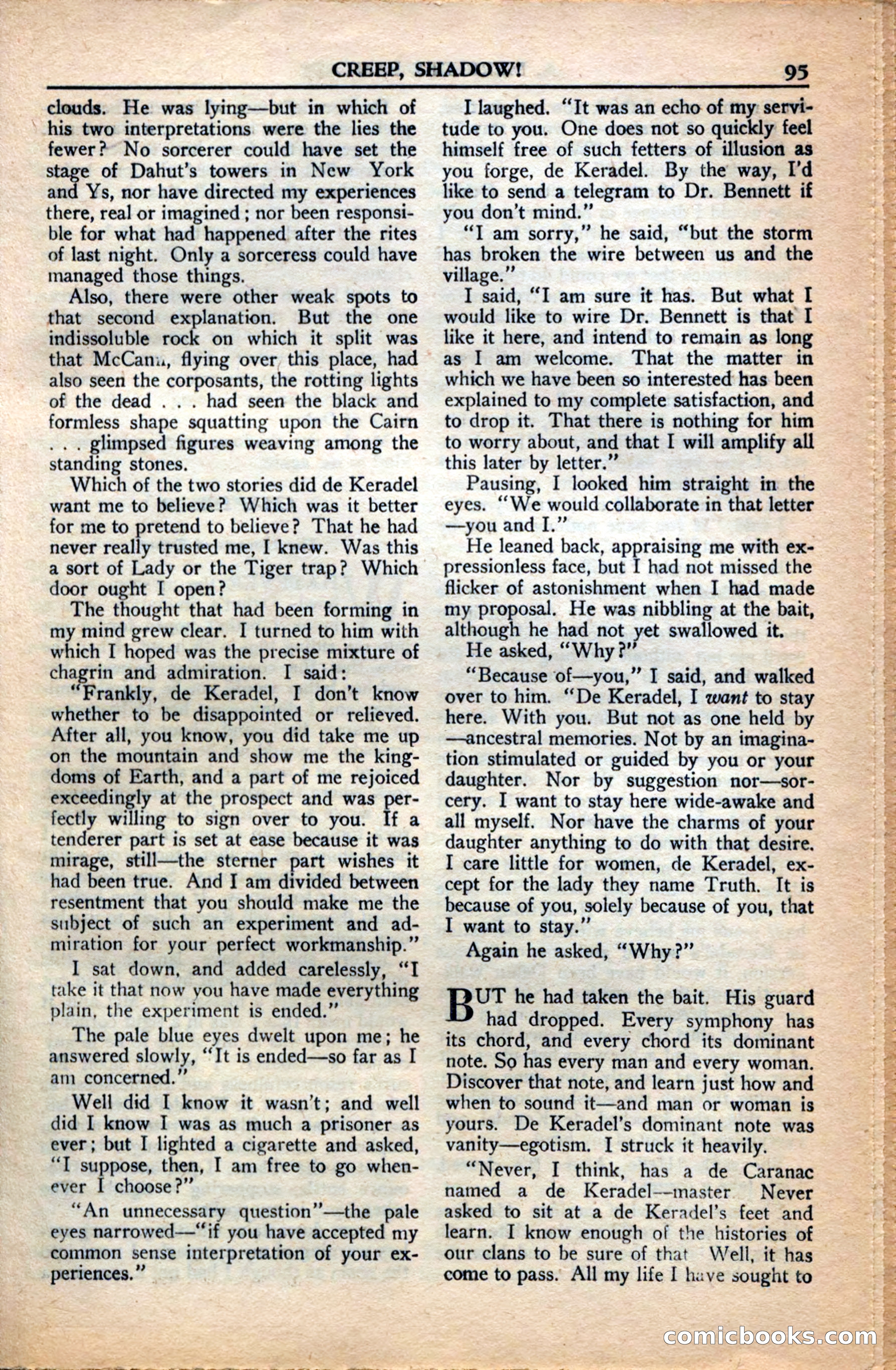
A restored page from Pulp Fiction, 1949. Page through the whole issue in the reader above.
📄 Transcribed text from this page (OCR, searchable)
Machine-transcribed from the original scan — historical spelling and the odd misread are preserved.
CREEP, SHADOW! 95 clouds. He was lying—but in which of his two interpretations. were the lies the fewer? No sorcerer could have set the e of Dahut’s towers in New York and Ys, nor have directed my experiences there, real or imagined ; nor been responsi- ble for what had happened after the rites of last night. Only a sorceress could have managed those things. Also, there were other weak spots to that second explanation. But the one indissoluble rock on which it split was that McCanu, flying over this place, had also seen the corposants, the rotting lights of the dead . . . had seen the black and formless shape squatting upon the Cairn .. . glimpsed figures weaving among the standing stones. Which of the two stories did de Keradel want me to believe? Which was it better for me to pretend to believe? That he had never really trusted me, [ knew. Was this a sort of Lady or the Tiger trap? Which door ought I open? The thought that had been forming in my mind grew clear. I turned to him with which I hoped was the precise mixture of chagrin and admiration. I said: “Frankly, de Keradel, I don’t know whether to be disappointed or relieved. After all, you know, you did take me up on the mountain and show me the king- doms of Earth, and a part of me rejoiced exceedingly at the prospect and was per- fectly willing to sign over to you. If a tenderer part is set at ease because it was mirage, still—the sterner part wishes it had been true. And I am divided between resentment that you should make me the subject of such an experiment and ad- miration for your perfect workmanship.” 1 sat down, and added carelessly, “I take it that now you have made everything plain, the experiment is ended.” The pale blue eyes dwelt upon me; he answered slowly, “‘It is ended—so far as I am concerned.” Well did I know it wasn’t; and well did I know I was as much a prisoner as ever; but I lighted a cigarette and asked, “I suppose, then, I am free to go when- ever I choose?” “An unnecessary question”—the pale eyes narrowed—“if you have accepted my common sense interpretation of your ex- periences.” I laughed. “It was an echo of my: servi- tude to you. One does not so quickly feel himself free of such fetters of illusion as you forge, de Keradel. By the way, I'd like to send a telegram to Dr. Bennett if you don’t mind.” “T am sorry,” he said, “but the storm has broken the wire between us and the village.” I said, “I am sure it has. But what I would like to wire Dr. Bennett is that I like it here, and intend to remain as long as I am welcome. That the matter in which we have been so interested has been explained to my complete satisfaction, and to drop it. That there is nothing for him to worry about, and that I will amplify all this later by letter.” Pausing, I looked him straight in the eyes. “We would collaborate in that letter —you and [.” He leaned back, appraising me with ex- pressionless face, but I had not missed the flicker of astonishment when I had made my proposal. He was nibbling at the bait, although he had not yet swallowed it. He asked, “Why ?’ “Because of—you,” I said, and walked over to him. “De Keradel, I want to stay here. With you. But not as one held by —ancestral memories. Not by an imagina- tion stimulated or guided by you or your daughter. Nor by suggestion nor—sor- cery. I want to stay here wide-awake and all myself. Nor have the charms of your daughter anything to do with that desire. I care little for women, de Keradel, ex- cept for the lady they name Truth. It is because of you, solely because of you, that I want to stay.” Again he asked, “Why?” Bu he had taken the bait. His guard had dropped. Every symphony has its chord, and every chord its dominant note. So has every man and every woman. Discover that note, and learn just how and when to sound it—and man or woman is yours. De Keradel’s dominant note was vanity—egotism. I struck it heavily. “Never, I think, has a de Caranac named a de Keradel--master Never asked to sit at a de Keradel’s feet and learn. I know enough of the histories of our clans to be sure of that come to pass. All my life | have sought to im) cS) Well, it has | Eomicboo (Eo) § we Oh het oar ee her & » SSDNA be GAS Weg PL Rae hance AP sgt RUT A NEETU EFL SMR ORSRESNT DR RI s Aareie we See ee oa ¢ ri wo : he er we +; i