
Pulp Fiction, 1949 · page 44 of 132
A. Merritt's Fantasy Magazine, December 1949 — page 44: what you’re looking at
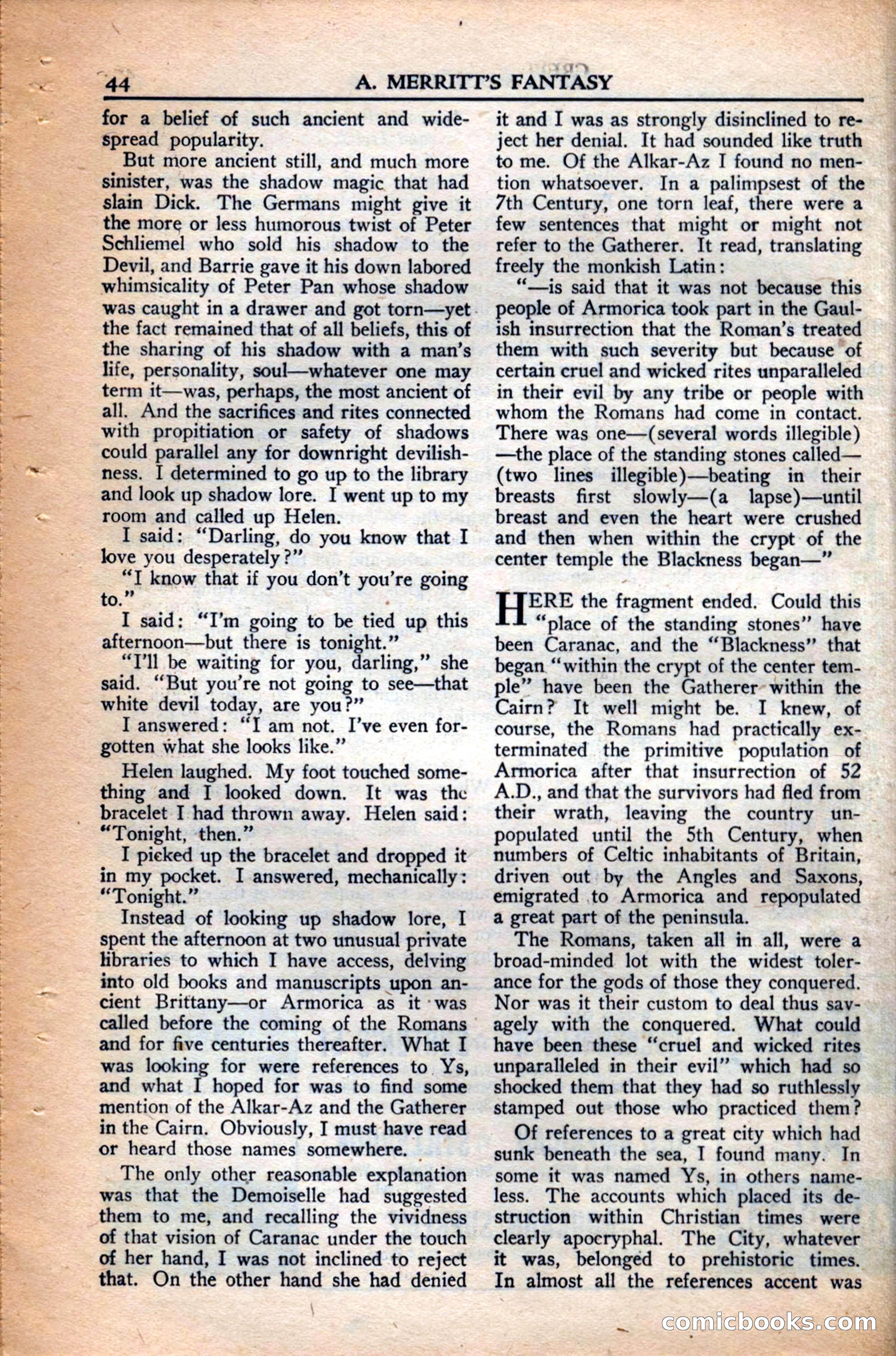
A restored page from Pulp Fiction, 1949. Page through the whole issue in the reader above.
📄 Transcribed text from this page (OCR, searchable)
Machine-transcribed from the original scan — historical spelling and the odd misread are preserved.
A r= oa > a for a belief of such ancient and wide- ~~? a oy Maye hy T. ra E re 3 at 9 pS rons . n r¢ Pe ©. +4 By ae A P é : « rey) Fy, ‘a . ; ag a ae Way ; LAY ho ih AMT : ‘ reas, } 5 Ue, A! , seme ee ey MELE OAL ¥ by. vee % tA oy Stat, Die tps dy Ae th hog ’ i ly ap te ialhes ; ‘f tS ig fa) ' *\. op + Ande 5 f. : Ly » ev ity 7 yy > nae rae [) ay Pea) ? P ‘SET. ». i aA 7 “ nay P a mi 4, "y r evee . ' iv ‘ f ‘ ? : Ve 1. ee , ’ ’ a” , * , +. / , : é o - A by ceili 5 <0 § A se Spread popularity. But more ancient still, and much more sinister, was the shadow magic that had slain Dick. The Germans might give it the more or less humorous twist of Peter Schliemel who sold his shadow to the Devil, and Barrie gave it his down labored whimsicality of Peter Pan whose shadow was caught in a drawer and got torn—yet. the fact remained that of all beliefs, this of the sharing of his shadow with a man’s life, personality, soul—whatever one may term it—was, perhaps, the most ancient of all. And the sacrifices and rites connected with propitiation or safety of shadows could parallel any for downright devilish- ness. I determined to go up to the library and look up shadow lore. I went up to my room and called up Helen. I said: “Darling, do you know that I love you desperately ?” =a know that if you don’t you’re going I said: “I’m going to be tied up this afternoon—but there is tonight.” “T’ll be waiting for you, darling,” she said. “But you’re not going to see—that white devil today, are you?” I answered: “I am not. I’ve even for- gotten what she looks like.” Helen laughed. My foot touched some- thing and I looked down. It was the bracelet I had thrown away. Helen said: “Tonight, then.” I picked up the bracelet and dropped it in my pocket. I answered, mechanically: “Tonight.” Instead of looking up shadow lore, I spent the afternoon at two unusual private libraries to which I have access, delving into old books and manuscripts upon an- cient Brittany—or Armorica as it ‘was to called before the coming of the Romans and for five centuries thereafter. What I was looking for were references to Ys, and what I hoped for was to find some mention of the Alkar-Az and the Gatherer in the Cairn. Obviously, I must have read or heard those names somewhere. — The only other reasonable explanation was that the Demoiselle had suggested them to me, and recalling the vividness of that vision of Caranac under the touch of her hand, I was not inclined to reject that. On the other hand she had denied A. MERRITT’S FANTASY it and I was as strongly disinclined to re- ject her denial. It had sounded like truth to me. Of the Alkar-Az I found no men- tion whatsoever. In a palimpsest of the 7th Century, one torn leaf, there were a few sentences that might or might not refer to the Gatherer. It read, translating freely the monkish Latin: “is said that it was not because this people of Armorica took part in the Gaul- ish insurrection that the Roman’s treated them with such severity but because of certain cruel and wicked rites unparalleled in their evil by any tribe or people with whom the Romans had come in contact. There was one—(several words illegible) —the place of the standing stones called— (two lines illegible)—beating in their breasts first slowly—(a lapse)—until breast and even the heart were crushed and then when within the crypt of the center temple the Blackness began—” ERE the fragment ended. Could this “place of the standing stones’’ have been Caranac, and the “Blackness” that began. “within the crypt of the center tem- ple” have been the Gatherer~ within the Cairn? It well might be. I knew, of course, the Romans had practically ex- terminated the primitive population of Armorica after that insurrection of 52 A.D., and that the survivors had fled from their wrath, leaving the country un- | populated until the 5th Century, when numbers of Celtic inhabitants of Britain, driven out by the Angles and Saxons, emigrated to Armorica and repopulated a great part of the peninsula. The Romans, taken all in all, were a broad-minded lot with the widest toler- ance for the gods of those they conquered. Nor was it their custom to deal thus say- agely with the conquered. What could have been these “cruel and wicked rites unparalleled in their evil” which had so shocked them that they had so ruthlessly stamped out those who practiced them? Of references to a great city which had sunk beneath the sea, I found many. In some it was named Ys, in others name- less. The accounts which placed its de- struction within Christian times were clearly apocryphal. The City, whatever it was, belonged to prehistoric times. — In almost all the references accent was oO == comicbooks.com