
Pulp Fiction, 1949 · page 31 of 132
A. Merritt's Fantasy Magazine, December 1949 — page 31: what you’re looking at
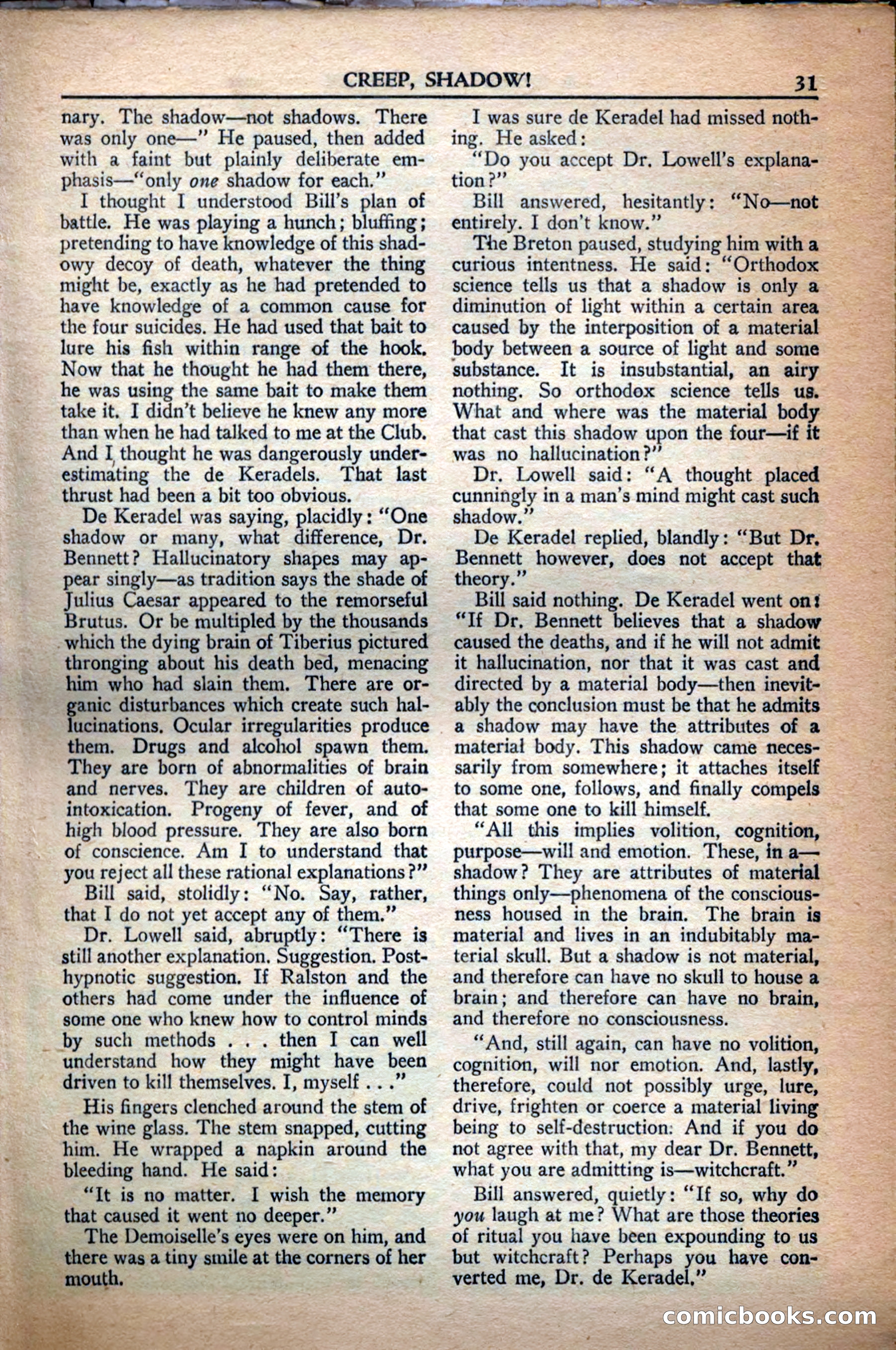
A restored page from Pulp Fiction, 1949. Page through the whole issue in the reader above.
📄 Transcribed text from this page (OCR, searchable)
Machine-transcribed from the original scan — historical spelling and the odd misread are preserved.
ber | CREEP, SHADOW! . nary. The shadow—not shadows. There was only one—” He paused, then added with a faint but plainly deliberate em- phasis—“only one shadow for each.” I thought I understood Bill’s plan of battle. He was playing a hunch; bluffing; pretending to have knowledge of this shad- owy decoy of death, whatever the thing might be, exactly as he had pretended to have knowledge of a common cause for the four suicides. He had used that bait to lure his fish within range of the hook, Now that he thought he had them there, he was using the same bait to make them take it. I didn’t believe he knew any more than when he had talked to me at the Club. And I thought he was dangerously under- estimating the de Keradels. That last thrust had been a bit too obvious. De Keradel was saying, placidly: “One shadow or many, what difference, Dr. | Bennett? Hallucinatory shapes may ap- __- pear singly—as tradition says the shade of | Julius Caesar appeared to the remorseful _ Brutus. Or be multipled by the thousands which the dying brain of Tiberius pictured we _ thronging about his death bed, menacing oS —him who had slain them. There are or- ganic disturbances which create such hal- ie ucinations, Ocular irregularities produce _ them. Drugs and alcohol spawn them. _ They are born of abnormalities of brain and nerves. They are children of auto- intoxication. Progeny of fever, and of high blood pressure. They are also born of conscience. Am I to understand that you reject all these rational explanations ?” Bill said, stolidly: “No. Say, rather, that I do not yet accept any of them.” Dr. Lowell said, abruptly: “There is still another explanation. Suggestion. Post- hypnotic suggestion. If Ralston and the others had come under the influence of some one who knew how to control minds _ by such methods .. . then I can well understand how they ‘might have been driven to kill themselves. I, myself . . His fingers clenched around the ie of __ the wine glass. The stem snapped, cutting him. He wrapped a napkin around the bleeding hand. He said: “ZT ig no matter. I wish the memory that caused it went no deeper.” -____ The Demoiselle’s eyes were on him, and . ase there eee snails at ee corners Eat her - | : \ | —_ - - | Ge ~ - om | ‘ \ NS z : - bes sane —, — - . < .< - A — ‘ > I was sure de Keradel had missed noth= ss ing. He asked: “Do you accept Dr, Lowell’s explana tion ?”’ Bill answered, hesitantly : entirely. I don’t know.” The Breton paused, studying him willia- See curious intentness. He said: “Orthodox science tells us that a shadow is. only ee diminution of light within a certain area =~ caused by the interposition of a material — body between a source of light and some as substance. It is insubstantial, an airy nothing. So orthodex science tells us, — What and where was the material body Se that cast this shadow upon the four—if it was no hallucination?” ee Dr, Lowell said: “A thought placed = cunningly in a man’s mind might cast such ee shadow.” De Keradel replied, blandly: “But Dr, 2S Bennett. however, does not accept that oa Se theory.” Se Bill said nothing. De Keradel went ont ars “If Dr, Bennett believes that a shadow = = caused the deaths, and if he will not admit it hallucination, nor that it was cast and — directed by a material body—then inevit- ably the conclusion must be that he admits a shadow may have the attributes of a material body. This shadow came neces- — sarily from somewhere; it attaches itself to some one, follows, and finally compels — = that some one to kill himself. = “All this implies volition, cognition, — purpose—will and emotion. These, in a— shadow? They are attributes of material — things only—phenomena of the conscious- _ > gk Se “No—not © on can Ve My, f eile aks y ie ; ff by ri A Xa ‘ ae ‘ ness housed in the brain. The brain is 3 material and lives in an indubitably ma- terial skull, But a shadow is not material, =e 4! Al and therefore can have no skull to house a brain; and therefore can have no brain, — &; Ary "| 4h << and therefore no consciousness. oa “And, still again, can have no voliticne so _ cognition, will nor emotion. And, lastly, = therefore, could not possibly urge, lure, = drive, frighten or coerce a material living a ae being to self-destruction: And if you do. ae not agree with that, my dear Dr. Bennett, what you are admitting is—witchcraft. ” Bill answered, quietly: “If so, why do you laugh at me? What are those theories of ritual you have been expounding tous but witchcraft? Perhaps you have con- : = verted me, Dr. de Kerad ral” ee ' 4 a_i o es os at mi Se ee