
Pulp Fiction, 1949 · page 13 of 132
A. Merritt's Fantasy Magazine, December 1949 — page 13: what you’re looking at
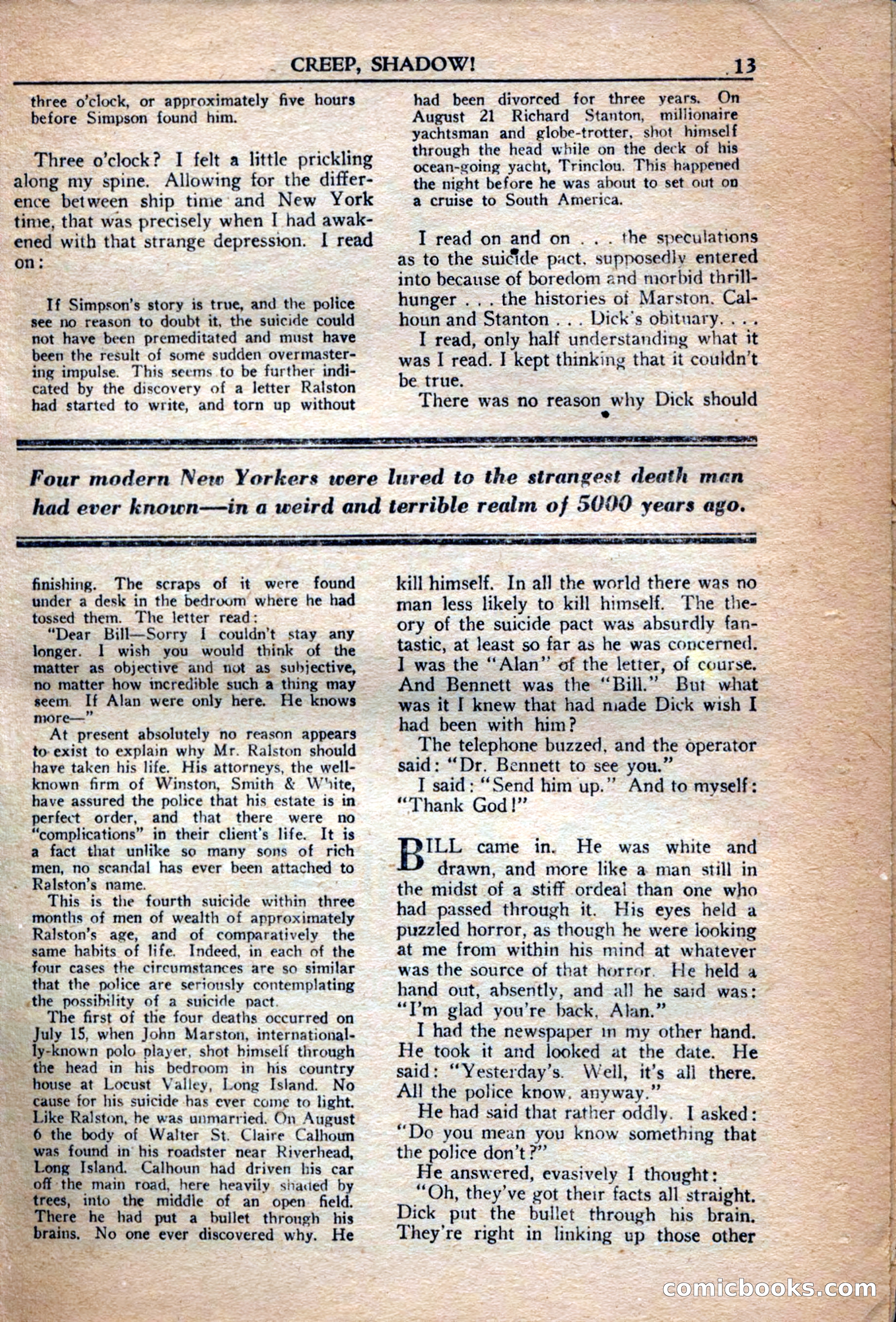
A restored page from Pulp Fiction, 1949. Page through the whole issue in the reader above.
📄 Transcribed text from this page (OCR, searchable)
Machine-transcribed from the original scan — historical spelling and the odd misread are preserved.
three o’clock, or approximately five hours before Simpson found him. Three o’clock? I felt a little prickling along my spine. Allowing for the differ- ence between ship time and New York time, that was precisely when I had awak- ened with that strange depression. I read on: : If Simpson’s story is true, and the police see no reason to doubt it, the suicide could not have been premeditated and must have been the result of some sudden overmaster- ing impulse. This seems to be further indi- cated by the discovery of a letter Ralston had started to write, and torn up without _ CREEP, SHADOW! = ae Ae ee need — t LMM ALAR LLL LLL LLL A a 7 — . ~ = had been divorced for three years. Om © August 21 Richard Stanton, millionaire yachtsman and globe-trotter, shot himself =a through the head while on the deck of his ocean-going yacht, Trinclou. This happened 2 <e the night before he was about to set out om a cruise to South America. = I read on and on .. . the speculations | as to the suidide pact, supposedly entered . into because of boredom and morbid thrill-— hunger . . . the histories of Marston. Cal- houn and Stanton... Dick's obituary. ..._ I read, only half understanding what it was I read. I kept thinking that it couldn’t be true. There was no reason why Dick should ie) ey id & th y Fe Four modern New Yorkers were lured to the strangest death man had ever known—in a weird and terrible realm of 5000 years ago. finishing. The scraps of it were found under a desk in the bedroom where he had tossed them. The letter read: “Dear Bill—Sorry I couldn’t stay any longer. I wish you would think of the - matter as objective and not as subjective, “no matter how incredible such a thing may geem. If Alan were only here. He knows more—” At present absolutely no reason appears to exist to explain why Mr. Ralston should have taken his life. His attorneys, the well- known firm of Winston, Smith & White, have assured the police that his estate is in perfect order, and that there were no “complications” in their client’s life. It is a fact that unlike so many sons of rich men, no scandal has ever been attached to Ralston’s name. This is the fourth suicide within three months of men of wealth of approximately Ralston’s age, and of comparatively the same habits of life. Indeed, in each of the . four cases the circumstances are so similar that the police are seriously contemplating _ «the possibility of a suicide pact. The first of the four deaths occurred on = july 15, when John Marston, international- kill himself. In all the world there was no — man less likely to kill himself. The the-- ory of the suicide pact was absurdly fan- tastic, at least so far as he was concerned. I was the “‘Alan”’ of the letter, of course. And Bennett was the “Bill.” But what— was it I knew that had made Dick wish I had been with him? -. The telephone buzzed, and the operator said: “Dr. Bennett to see you.” I said: “Send him up.” And to myself: “Thank God!” ILL came in. He was white and = drawn, and more like a man still in the midst of a stiff ordeal than one who had passed through it. His eyes held a puzzled horror, as though he were looking at me from within his mind at whatever was the source of that horror. He held a hand out, absently, and all he said was: “Tm glad you’re back, Alan.” I had the newspaper in my other hand. He took it and looked at the date. He 4 Se ly-known polo player, shot himself through the head in his bedroom in his country house at Locust Valley, Long Island. No cause for his suicide has ever come to light. _ Like Ralston, he was unmarried. On August 6 the body of Walter St. Claire Calhoun _ was found in his roadster near Riverhead, Long Island. Calhoun had driven his car off the main road, here heavily shaded by trees, into the middie of an open field. There he had put a builet through his brains. No one ever ee . « discovered why. He said: “Yesterday’s. Well, it’s all there. All the police know. anyway.” He had said that rather oddly. I asked: “Do you mean you know something that the police don’t ?” He answered, evasively I thought: “Oh, they’ve got their facts all straight. Dick put the bullet through his brain, They're right in linking up those other com “Se ee — aoa wd hey se ut BR ta Wb fig te : ak > s 4 7 4 ‘ ‘ Wi Ne ‘ Avy ay : / Wi)! fveet be) a yA 2 Pavey L fF uf f a 44 Aa ¥; 4 : ‘ ae Ry rahe 0 iis te 1 4). Per VAN $0 ior ebook: