
Pulp Fiction, 1949 · page 120 of 132
A. Merritt's Fantasy Magazine, December 1949 — page 120: what you’re looking at
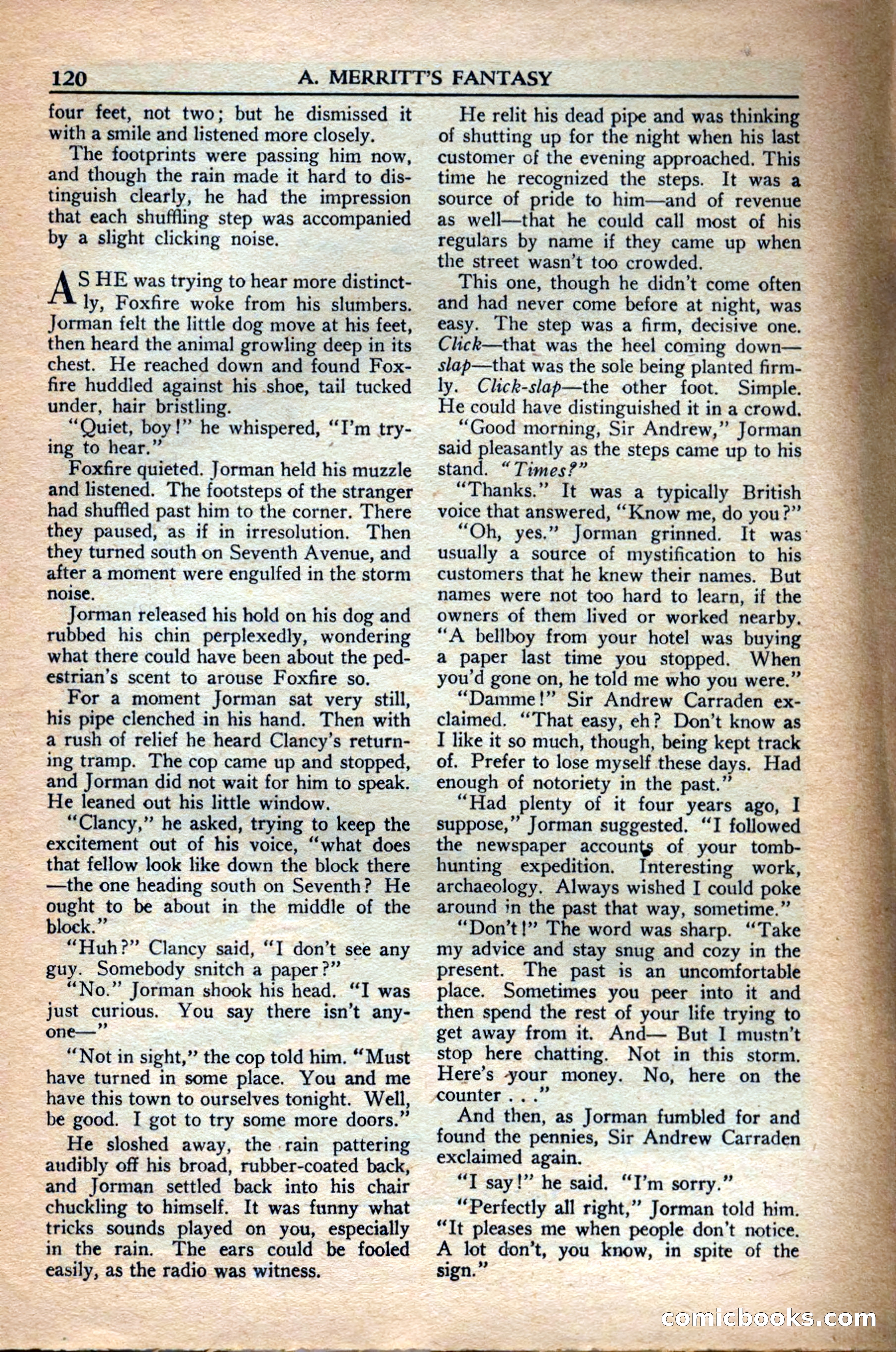
A restored page from Pulp Fiction, 1949. Page through the whole issue in the reader above.
📄 Transcribed text from this page (OCR, searchable)
Machine-transcribed from the original scan — historical spelling and the odd misread are preserved.
120 four feet, not two; but he dismissed it with a smile and listened more closely. The footprints were passing him now, _and though the rain made it hard to dis- tinguish clearly, he had the impression that each shuffling step was accompanied by a slight clicking noise. AS HE was trying to hear more distinct- _ +4 ly, Foxfire woke from his slumbers. Jorman felt the little dog move at his feet, then heard the animal growling deep in its chest. He reached down and found Fox- fire huddled against his shoe, tail tucked under, hair bristling. “Quiet, boy!” he whispered, “I’m try- ing to hear.” : Foxfire quieted. Jorman held his muzzle and listened. The footsteps of the stranger had shuffled past him to the corner. There they paused, as if in irresolution. Then they turned south on Seventh Avenue, and after a moment were engulfed in the storm noise. | Jorman released his hold on his dog and rubbed his chin perplexedly, wondering what there could have been about the ped- estrian’s scent to arouse Foxfire so. For a moment Jorman sat very still, his pipe clenched in his hand. Then with a rush of relief he heard Clancy’s return- ing tramp. The cop came up and stopped, and Jorman did not wait for him to speak. He leaned out his little window. “Clancy,” he asked, trying to keep the excitement out of his voice, ““what does that fellow look like down the block there —the one heading south on Seventh? He ought to be about in the middle of the block.” “Huh?” Clancy said, “I don’t see any guy. Somebody snitch a paper?” “No.” Jorman shook his head. “I was just curious. You say there isn’t any- one—” “Not in sight,” the cop told him. “Must have turned in some place. You and me have this town to ourselves tonight. Well, be good. I got to try some more doors.” He sloshed away, the rain pattering audibly off his broad, rubber-coated back, and Jorman settled back into his chair chuckling to himself. It was funny what tricks sounds played on you, especially in the rain. The ears could be fooled easily, as the radio was witness. A. MERRITT’S FANTASY counter...” He relit his dead pipe and was thinking of shutting up for the night when his last customer of the evening approached. This time he recognized the steps. It was a source of pride to him—and of revenue as well—that he could call most of his regulars by name if they came up when the street wasn’t too crowded. S This one, though he didn’t come often and had never come before at night, was easy. The step was a firm, decisive one. Click—that was the heel coming down— slap—that was the sole being planted firm- ly. Click-slap—the other foot. Simple. He could have distinguished it ina crowd, “Good morning, Sir Andrew,” Jorman said pleasantly as the steps came up to his stand. “Times?” “Thanks.” It was a typically British voice that answered, “Know me, do you?” “Oh, yes.” Jorman grinned. It was’ usually a source of mystification to his customers that he knew their names. But names were not too hard to learn, if the = owners of them lived or worked nearby, “A bellboy from your hotel was buying a paper last time you stopped. When you'd gone on, he told me who you were.” “Damme!” Sir Andrew Carraden ex- claimed. “That easy, eh? Don’t know as I like it so much, though, being kept track of. Prefer to lose myself these days. Had — enough of notoriety in the past.” ae “Had plenty of it four years ago, I suppose,” Jorman suggested. “I followed the newspaper accounts of your tomb- | hunting expedition. Interesting work, archaeology. Always wished I could poke around in the past that way, sometime.” “Don’t!” The word was sharp. “Take my advice and stay snug and cozy in the present. The past is an uncomfortable place. Sometimes you peer into it and then spend the rest of your life trying to get away from it. And— But I mustn't stop here chatting. Not in this storm. Here’s -rour money. No, here on the And then, as Jorman fumbled for and found the pennies, Sir Andrew Carraden exclaimed again. “T say!” he said. “I’m sorry.” “Perfectly all right,” Jorman told him. “It pleases me when people don’t notice. A lot don’t, you know, in spite of the sign.” ; oO Comicbooks.com