
Pulp Fiction, 1950 · page 97 of 132
A. Merritt's Fantasy Magazine, February 1950 — page 97: what you’re looking at
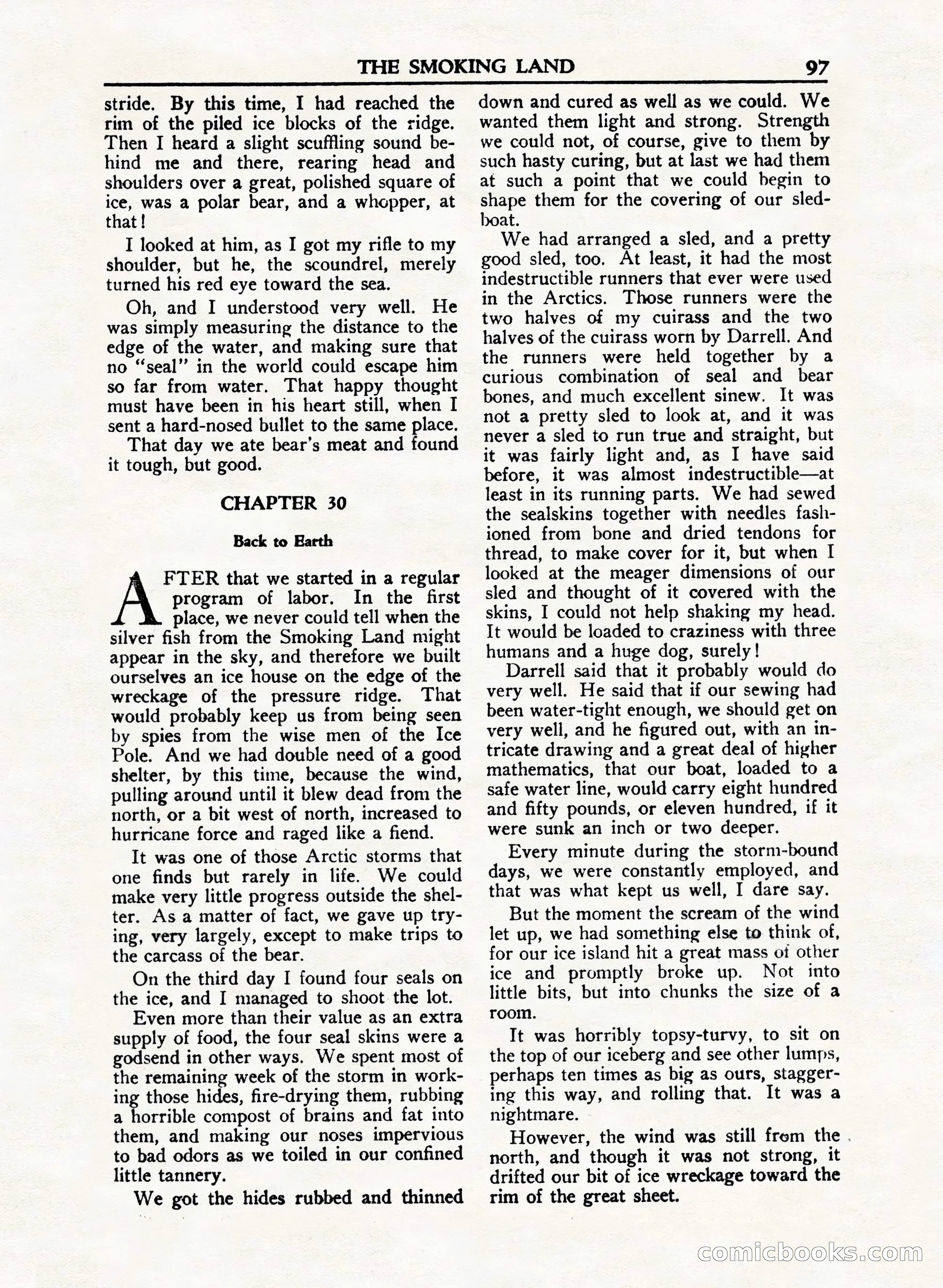
A restored page from Pulp Fiction, 1950. Page through the whole issue in the reader above.
📄 Transcribed text from this page (OCR, searchable)
Machine-transcribed from the original scan — historical spelling and the odd misread are preserved.
THE SMOKING LAND 97 stride. By this time, I had reached the rim of the piled ice blocks of the ridge. Then I heard a slight scuffling sound be- hind me and there, rearing head and shoulders over a great, polished square of we) was a polar bear, and a whopper, at that! I looked at him, as I got my rifle to my shoulder, but he, the scoundrel, merely turned his red eye toward the sea. Oh, and I understood very well. He was simply measuring the distance to the edge of the water, and making sure that no “seal” in the world could escape him so far from water. That happy thought must have been in his heart still, when I sent a hard-nosed bullet to the same place. That day we ate bear’s meat and found it tough, but good. CHAPTER 30 Back to Earth FTER that we started in a regular program of labor. In the first place, we never could tell when the silver fish from the Smoking Land might appear in the sky, and therefore we built ourselves an ice house on the edge of the wreckage of the pressure ridge. That would probably keep us from being seen by spies from the wise men of the Ice Pole. And we had double need of a good shelter, by this time, because the wind, pulling around until it blew dead from the north, or a bit west of north, increased to hurricane force and raged like a fiend. It was one of those Arctic storms that one finds but rarely in life. We could make very little progress outside the shel- ter. As a matter of fact, we gave up try- ing, very largely, except to make trips to the carcass of the bear. On the third day I found four seals on the ice, and I managed to shoot. the lot. Even more than their value as an extra supply of food, the four seal skins were a godsend in other ways. We spent most of the remaining week of the storm in work- ing those hides, fire-drying them, rubbing a harible compost of brains and fat into them, and making our noses impervious to bad odors as we toiled in our confined little tannery. We got the hides rubbed and thinned down and cured as well as we could. We wanted them light and strong. Strength we could not, of course, give to them by such hasty curing, but at last we had them at such a point that we could begin to shape them for the covering of our sled- boat. We had arranged a sled, and a pretty good sled, too. At least, it had the most indestructible runners that ever were used in the Arctics. Those runners were the two halves of my cuirass and the two halves of the cuirass worn by Darrell. And the runners were held together by a curious combination of seal and bear bones, and much excellent sinew. It was not a pretty sled to look at, and it was never a sled to run true and straight, but it was fairly light and, as I have said before, it was almost indestructible—at least in its running parts. We had sewed the sealskins together with needles fash- ioned from bone and dried tendons for thread, to make cover for it, but when I looked at the meager dimensions of our sled and thought of it covered with the skins, I could not help shaking my head. It would be loaded to craziness with three humans and a huge dog, surely! Darrell said that it probably would do very well. He said that if our sewing had been water-tight enough, we should get on very well, and he figured out, with an in- tricate drawing and a great deal of higher mathematics, that our boat, loaded to a safe water line, would carry eight hundred and fifty pounds, or eleven hundred, if it were sunk an inch or two deeper. Every minute during the storm-bound days, we were constantly employed, and that was what kept us well, I dare say. But the moment the scream of the wind let up, we had something else to think of, for our ice island hit a great mass of other ice and promptly broke up. Not into little bits, but into chunks the size of a room. It was horribly topsy-turvy, to sit on the top of our iceberg and see other lumps, perhaps ten times as big as ours, stagger- ing this way, and rolling that. It was a nightmare. However, the wind was still from the . north, and though it was not strong, it drifted our bit of ice wreckage toward the rim of the great sheet. COMmic aoa S C@ inn