
Pulp Fiction, 1950 · page 42 of 132
A. Merritt's Fantasy Magazine, February 1950 — page 42: what you’re looking at
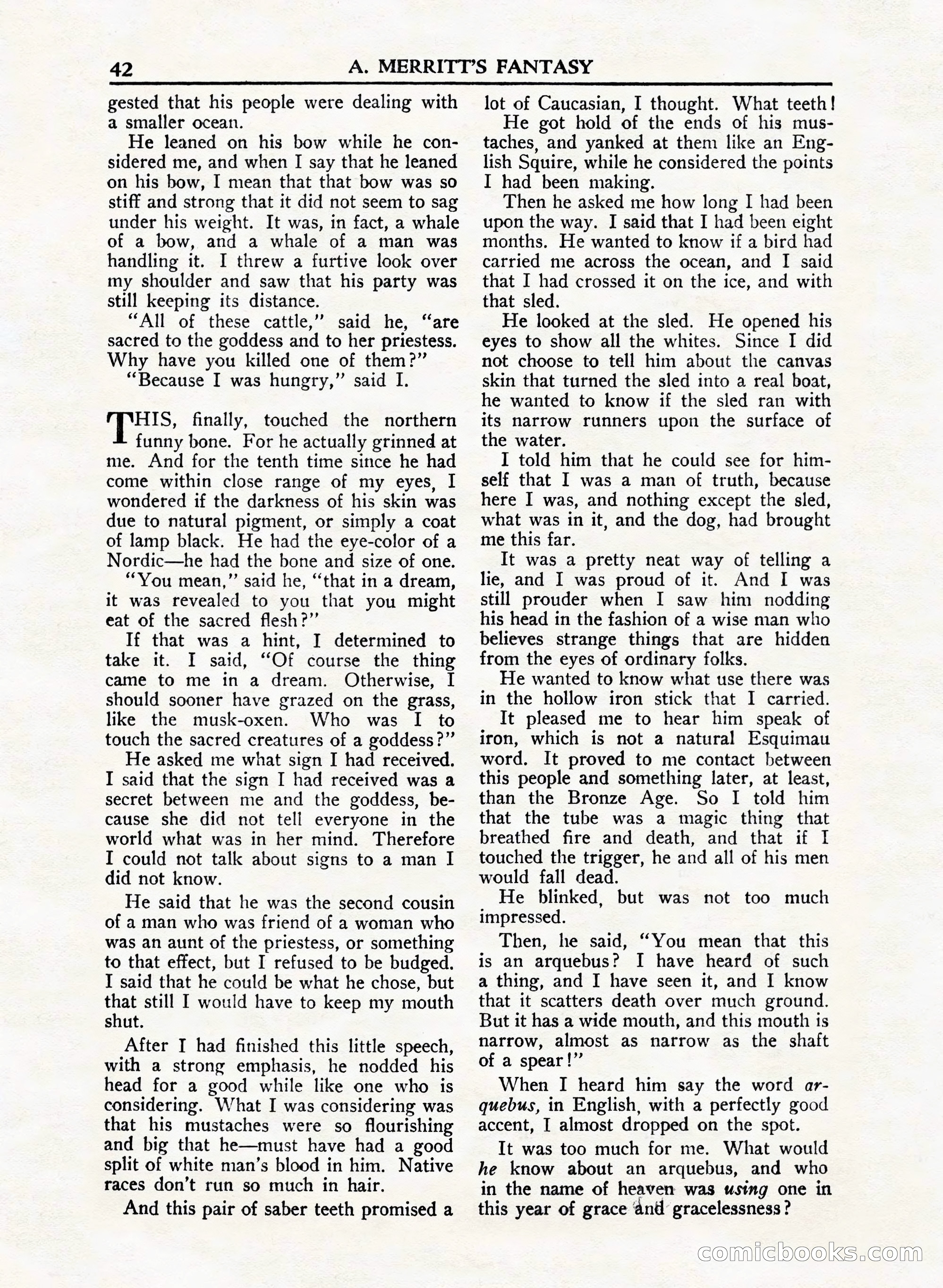
A restored page from Pulp Fiction, 1950. Page through the whole issue in the reader above.
📄 Transcribed text from this page (OCR, searchable)
Machine-transcribed from the original scan — historical spelling and the odd misread are preserved.
42 A. MERRITT’S FANTASY gested that his people were dealing with a smaller ocean. He leaned on his bow while he con- sidered me, and when I say that he leaned on his bow, I mean that that bow was so stiff and strong that it did not seem to sag under his weight. It was, in fact, a whale of a bow, and a whale of a man was handling it. I threw a furtive look over my shoulder and saw that his party was still keeping its distance. “All of these cattle,” said he, “are sacred to the goddess and to her priestess. Why have you killed one of them?” “Because I was hungry,” said I. fu finally, touched the northern funny bone. For he actually grinned at me. And for the tenth time since he had come within close range of my eyes, I wondered if the darkness of his skin was due to natural pigment, or simply a coat of lamp black. He had the eye-color of a Nordic—he had the bone and size of one. “You mean,” said he, “that in a dream, it was revealed to you that you might eat of the sacred flesh ?”’ If that was a hint, I determined to take it. I said, “Of course the thing came to me in a dream. Otherwise, I should sooner have grazed on the grass, like the musk-oxen. Who was I to touch the sacred creatures of a goddess?” He asked me what sign I had received. I said that the sign I had received was a secret between me and the goddess, be- cause she did not tell everyone in the world what was in her mind. Therefore I could not talk about signs to a man I did not know. He said that he was the second cousin of a man who was friend of a woman who was an aunt of the priestess, or something to that effect, but I refused to be budged. I said that he could be what he chose, but that still I would have to keep my mouth shut. After I had finished this little speech, with a strong emphasis, he nodded his head for a good while like one who is considering. What I was considering was that his mustaches were so flourishing and big that he—must have had a good split of white man’s blood in him. Native races don’t run so much in hair. And this pair of saber teeth promised a lot of Caucasian, I thought. What teeth! He got hold of the ends of his mus- taches, and yanked at them like an Eng- lish Squire, while he considered the points I had been making. Then he asked me how long I had been upon the way. I said that I had been eight months. He wanted to know if a bird had carried me across the ocean, and I said that I had crossed it on the ice, and with that sled. He looked at the sled. He opened his eyes to show all the whites. Since I did not choose to tell him about the canvas skin that turned the sled into a real boat, he wanted to know if the sled ran with its narrow runners upon the surface of the water. I told him that he could see for him- self that I was a man of truth, because here I was, and nothing except the sled, what was in it, and the dog, had brought me this far. It was a pretty neat way of telling a lie, and I was proud of it. And I was still prouder when I saw him nodding his head in the fashion of a wise man who believes strange things that are hidden from the eyes of ordinary folks. He wanted to know what use there was in the hollow iron stick that I carried. It pleased me to hear him speak of iron, which is not a natural Esquimau word. It proved to me contact between this people and something later, at least, than the Bronze Age. So I told him that the tube was a magic thing that breathed fire and death, and that if I touched the trigger, he and all of his men would fall dead. He blinked, but was not too much impressed. Then, he said, “You mean that this is an arquebus? I have heard of such a thing, and I have seen it, and I know that it scatters death over much ground. But it has a wide mouth, and this mouth is narrow, almost as narrow as the shaft of a spear!” When I heard him say the word ar- quebus, in English, with a perfectly good accent, I almost dropped on the spot. It was too much for me. What would he know about an arquebus, and who in the name of heaven was using one in this year of grace and gracelessness? GOMIIGooOO (©