
Pulp Fiction, 1950 · page 120 of 132
A. Merritt's Fantasy Magazine, February 1950 — page 120: what you’re looking at
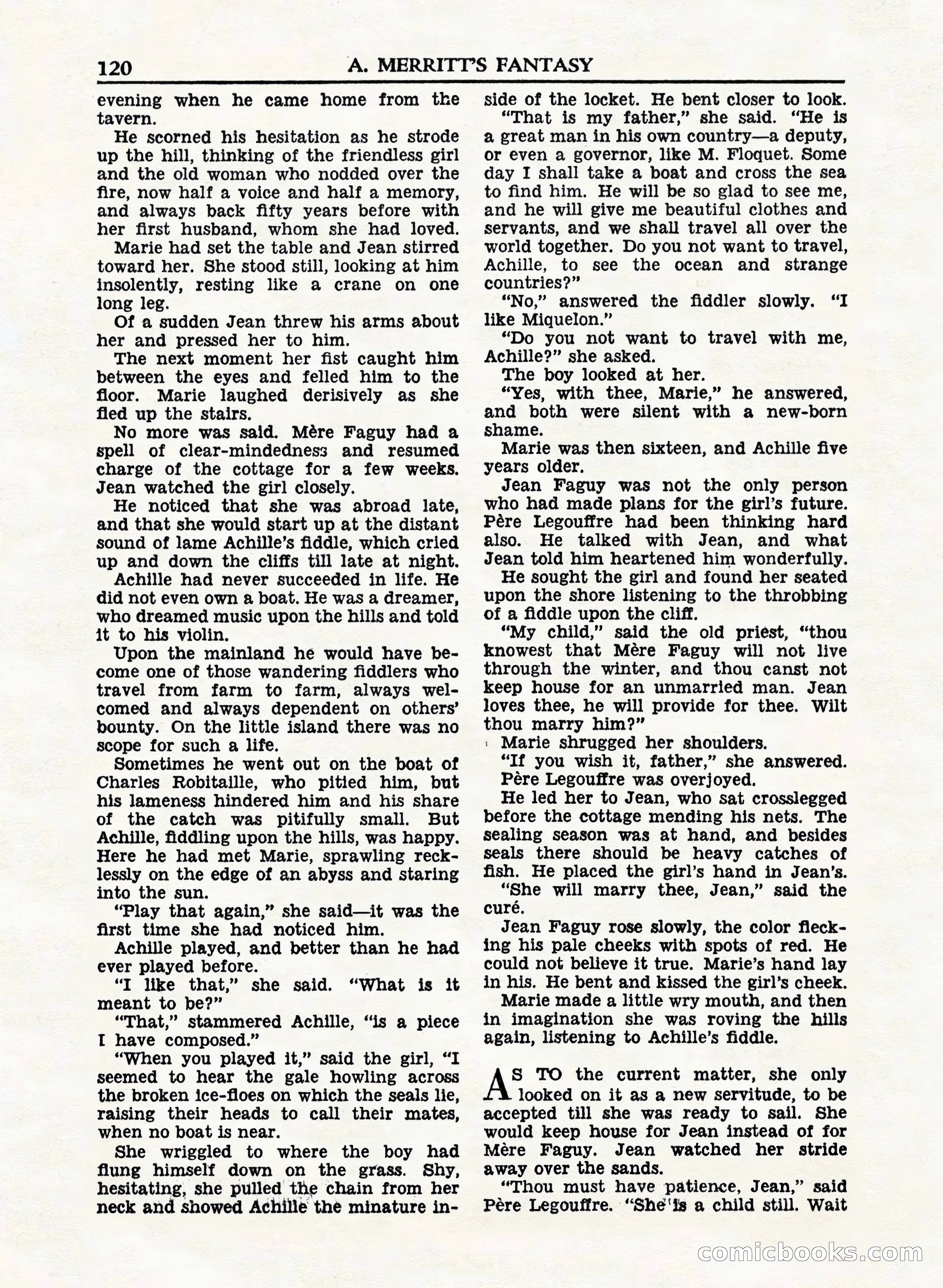
A restored page from Pulp Fiction, 1950. Page through the whole issue in the reader above.
📄 Transcribed text from this page (OCR, searchable)
Machine-transcribed from the original scan — historical spelling and the odd misread are preserved.
120 A. MERRITT’S FANTASY evening when he came home from the tavern. He scorned his hesitation as he strode up the hill, thinking of the friendless girl and the old woman who nodded over the fire, now half a voice and half a memory, and always back fifty years before with her first husband, whom she had loved. Marie had set the table and Jean Stirred toward her. She stood still, looking at him insolently, resting like a crane on one long leg. Of a sudden Jean threw his arms about her and pressed her to him. The next moment her fist caught him between the eyes and felled him to the floor. Marie laughed derisively as she fled up the stairs. No more was said. Mére Faguy had a spell of clear-mindedness and resumed charge of the cottage for a few weeks. Jean watched the girl closely. He noticed that she was abroad late, and that she would start up at the distant sound of lame Achille’s fiddle, which cried up and down the cliffs till late at night. Achille had never succeeded in life. He did not even own a boat. He was a dreamer, who dreamed music upon the hills and told it to his violin. Upon the mainland he would have be- come one of those wandering fiddlers who travel from farm to farm, always wel- comed and always dependent on others’ bounty. On the little island there was no scope for such a life. Sometimes he went out on the boat of Charles Robitaille, who pitied him, but his Jameness hindered him and his share of the catch was pitifully small. But Achille, fiddling upon the hills, was happy. Here he had met Marie, sprawling reck- lessly on the edge of an abyss and staring into the sun. “Play that again,” she said—it was the first time she had noticed him. Achille played, and better than he had ever played before. “I like that,” she said. meant to be?” “That,” stammered Achille, “is a piece I have composed.” “When you played it,” said the girl, “I seemed to hear the gale howling across the broken ice-floes on which the seals lie, raising their heads to call their mates, when no boat is near. She wriggled to where the boy had flung himself down on the grass. Shy, hesitating, she pulled the chain from her neck and showed Achille the minature in- “What is it side of the locket. He bent closer to look. “That is my father,” she said. “He is a great man in his own country—a deputy, or even a governor, like M. Floquet. Some day I shall take a boat and cross the sea to find him. He will be so glad to see me, and he will give me beautiful clothes and servants, and we shall travel all over the world together. Do you not want to travel, Achille, to see the ocean and strange countries?” “No,” answered the fiddler slowly. like Miquelon.” “Do you not want to travel with me, Achille?” she asked. The boy looked at her. “Yes, with thee, Marie,” he answered, and both were silent with a new-born shame. Marie was then sixteen, and Achille five years older. Jean Faguy was not the only person who had made plans for the girl’s future. Pére Legouffre had been thinking hard also. He talked with Jean, and what Jean told him heartened him wonderfully. He sought the girl and found her seated upon the shore listening to the throbbing of a fiddle upon the cliff. “My child,” said the old priest, “thou knowest that Mére Faguy will not live through the winter, and thou canst not keep house for an unmarried man. Jean loves thee, he will provide for thee. Wilt thou marry him?” : Marie shrugged her shoulders. “If you wish it, father,” she answered. Pére Legouffre was overjoyed. He led her to Jean, who Sat crosslegged before the cottage mending his nets. The sealing season was at hand, and besides seals there should be heavy catches of fish. He placed the girl’s hand in Jean’s. “She will marry thee, Jean,” said the curé. Jean Faguy rose slowly, the color fleck- ing his pale cheeks with spots of red. He could not believe it true. Marie’s hand lay in his. He bent and kissed the girl’s cheek. Marie made a little wry mouth, and then in imagination she was roving the hills again, listening to Achille’s fiddle. “uy S TO the current matter, she only looked on it as a new servitude, to be accepted till she was ready to sail. She would keep house for Jean instead of for Mere Faguy. Jean watched her stride away over the sands. “Thou must have patience, Jean,” said Pére Legouffre. “She'is a child still. Wait COIN IGDOOKS C@ in