
Pulp Fiction, 1953 · page 82 of 132
5 Detective Novels Magazine Cover — page 82: what you’re looking at
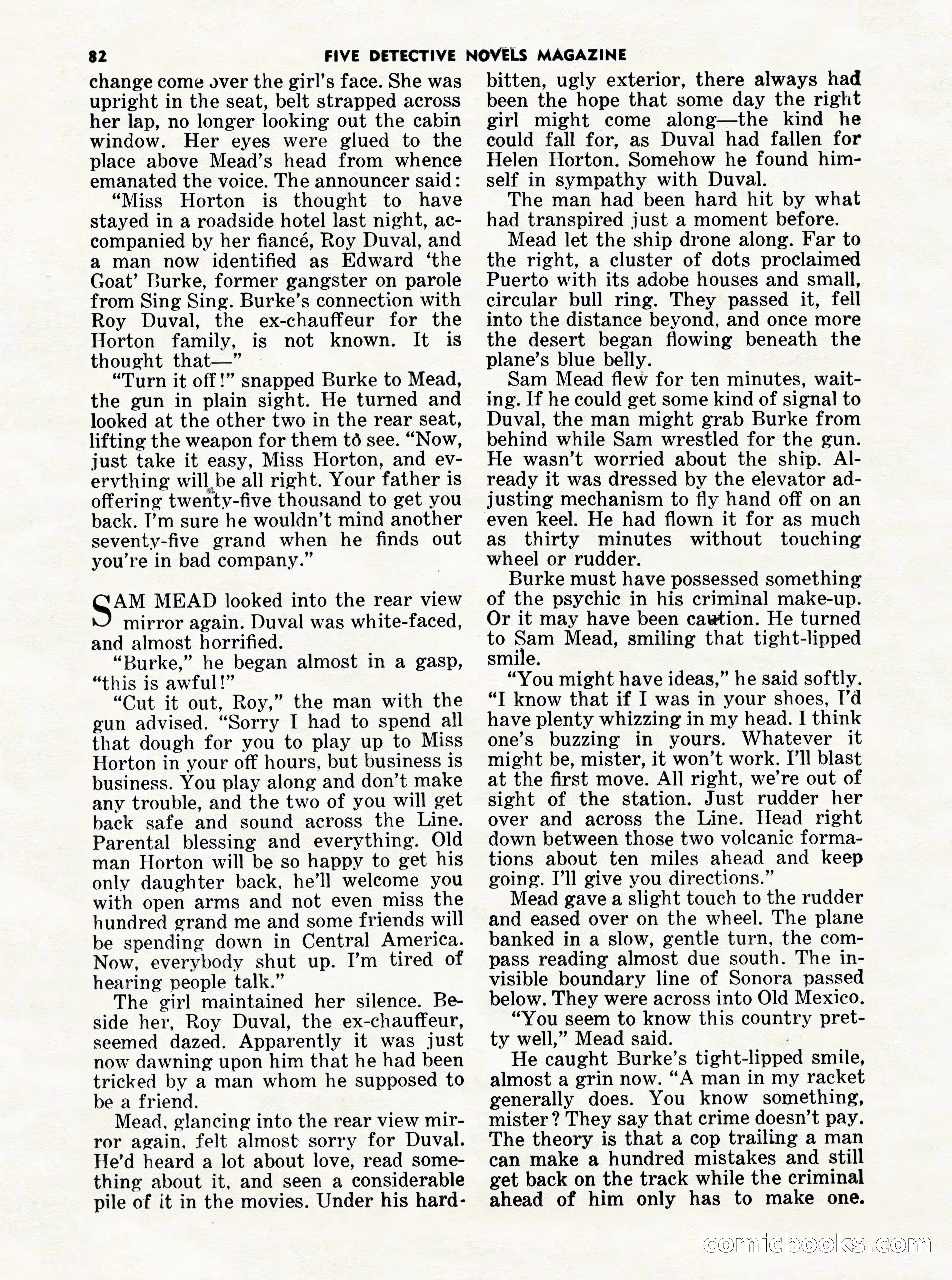
A restored page from Pulp Fiction, 1953. Page through the whole issue in the reader above.
📄 Transcribed text from this page (OCR, searchable)
Machine-transcribed from the original scan — historical spelling and the odd misread are preserved.
82 change come over the girl’s face. She was upright in the seat, belt strapped across her lap, no longer looking out the cabin window. Her eyes were glued to the place above Mead’s head from whence emanated the voice. The announcer said: “Miss Horton is thought to have stayed in a roadside hotel last night, ac- companied by her fiancé, Roy Duval, and a man now identified as Edward ‘the Goat’ Burke, former gangster on parole from Sing Sing. Burke’s connection with Roy Duval, the ex-chauffeur for the Horton family, is not known. It is thought that—” “Turn it off!” snapped Burke to Mead, the gun in plain sight. He turned and looked at the other two in the rear seat, lifting the weapon for them t6 see. “Now, just take it easy, Miss Horton, and ev- ervthing will be all right. Your father is offering twenty-five thousand to get you back. I’m sure he wouldn’t mind another seventy-five grand when he finds out you’re in bad company.” AM MEAD looked into the rear view mirror again. Duval was white-faced, and almost horrified. “Burke,” he began almost in a gasp, “this is awful!” : “Cut it out, Roy,” the man with the gun advised. “Sorry I had to spend all that dough for you to play up to Miss Horton in your off hours, but business is business. You play along and don’t make any trouble, and the two of you will get back safe and sound across the Line. Parental blessing and everything. Old man Horton will be so happy to get his only daughter back, he’ll welcome you with open arms and not even miss the hundred grand me and some friends will be spending down in Central America. Now, everybody shut up. I’m tired of hearing people talk.” The girl maintained her silence. Be- side her, Roy Duval, the ex-chauffeur, seemed dazed. Apparently it was just now dawning upon him that he had been tricked by a man whom he supposed to be a friend. Mead, glancing into the rear view mir- ror again, felt almost sorry for Duval. He’d heard a lot about love, read some- thing about it, and seen a considerable pile of it in the movies. Under his hard- FIVE DETECTIVE NOVELS MAGAZINE bitten, ugly exterior, there always had been the hope that some day the right girl might come along—the kind he could fall for, as Duval had fallen for Helen Horton. Somehow he found him- self in sympathy with Duval. The man had been hard hit by what had transpired just a moment before. Mead let the ship drone along. Far to the right, a cluster of dots proclaimed Puerto with its adobe houses and small, circular bull ring. They passed it, fell into the distance beyond, and once more the desert began flowing beneath the plane’s blue belly. Sam Mead flew for ten minutes, wait- ing. If he could get some kind of signal to Duval, the man might grab Burke from behind while Sam wrestled for the gun. He wasn’t worried about the ship. Al- ready it was dressed by the elevator ad- justing mechanism to fly hand off on an even keel. He had flown it for as much as thirty minutes without touching wheel or rudder. Burke must have possessed something of the psychic in his criminal make-up. Or it may have been caution. He turned to Sam Mead, smiling that tight-lipped smile. “You might have ideas,” he said softly. “IT know that if I was in your shoes, I’d have plenty whizzing in my head. I think one’s buzzing in yours. Whatever it might be, mister, it won’t work. I’ll blast at the first move. All right, we’re out of sight of the station. Just rudder her over and across the Line. Head right down between those two volcanic forma- tions about ten miles ahead and keep going. I’ll give you directions.” Mead gave a slight touch to the rudder and eased over on the wheel. The plane banked in a slow, gentle turn, the com- pass reading almost due south. The in- visible boundary line of Sonora passed below. They were across into Old Mexico. “You seem to know this country pret- ty well,” Mead said. : He caught Burke’s tight-lipped smile, almost a grin now. “A man in my racket generally does. You know something, mister? They say that crime doesn’t pay. The theory is that a cop trailing a man can make a hundred mistakes and still get back on the track while the criminal ahead of him only has to make one. ECoOMmicloo S (C(O)