
Pulp Fiction, 1953 · page 57 of 132
5 Detective Novels Magazine Cover — page 57: what you’re looking at
A restored page from Pulp Fiction, 1953. Page through the whole issue in the reader above.
📄 Transcribed text from this page (OCR, searchable)
Machine-transcribed from the original scan — historical spelling and the odd misread are preserved.
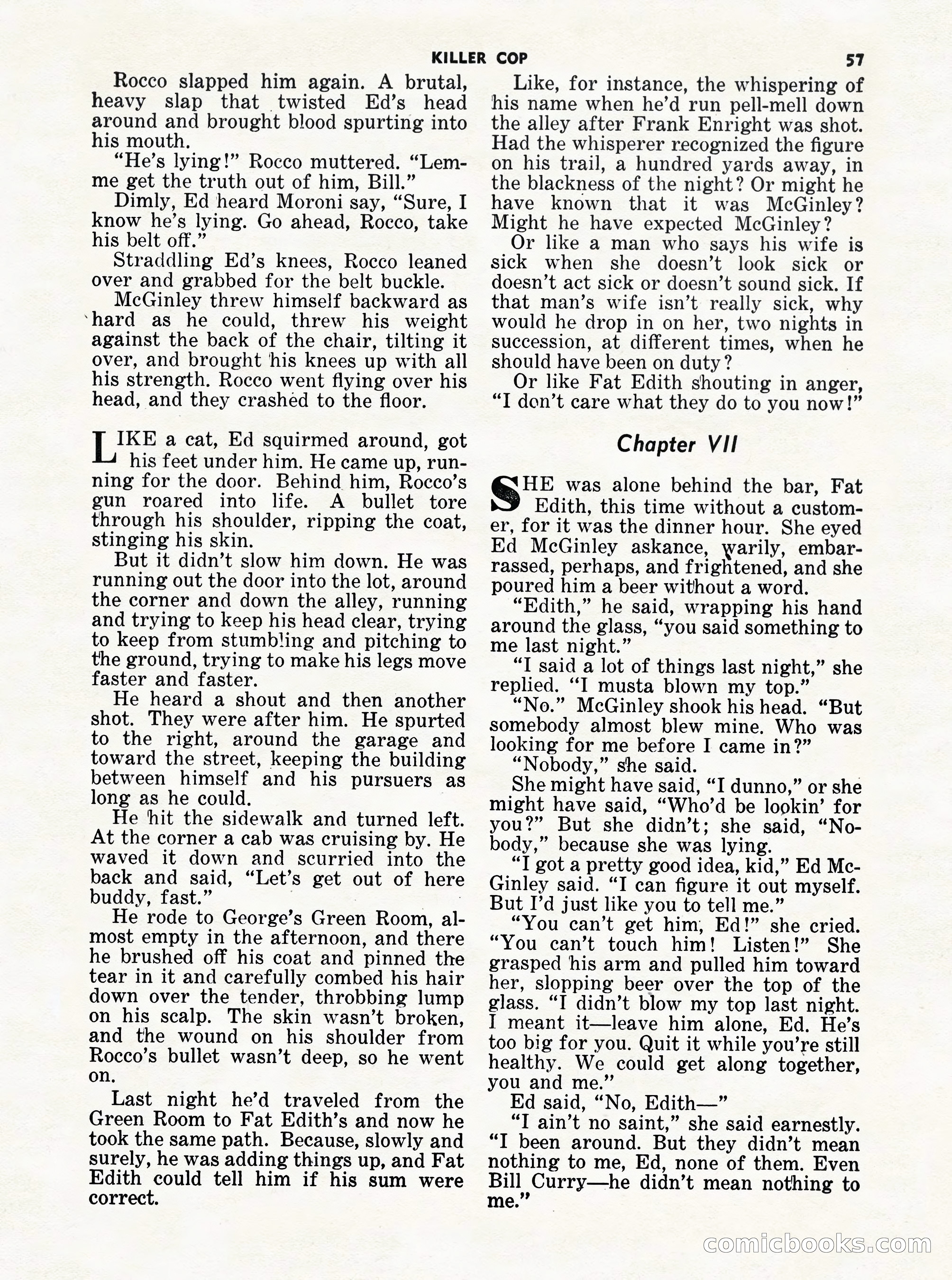
KILLER COP Rocco slapped him again. A brutal, heavy slap that twisted Ed’s head around and brought blood spurting into his mouth. “He’s lying!” Rocco muttered. “Lem- me get the truth out of him, Bill.” Dimly, Ed heard Moroni say, “Sure, I know he’s lying. Go ahead, Rocco, take his belt off.” Straddling Ed’s knees, Rocco leaned over and grabbed for the belt buckle. McGinley threw himself backward as ‘hard as he could, threw his weight against the back of the chair, tilting it over, and brought his knees up with all his strength. Rocco went flying over his head, and they crashed to the floor. [ a cat, Ed squirmed around, got his feet under him. He came up, run- ning for the door. Behind him, Rocco’s gun roared into life. A bullet tore through his shoulder, ripping the coat, stinging his skin. But it didn’t slow him down. He was running out the door into the lot, around the corner and down the alley, running and trying to keep his head clear, trying to keep from stumbling and pitching to the ground, trying to make his legs move faster and faster. He heard a shout and then another shot. They were after him. He spurted to the right, around the garage and toward the street, keeping the building between himself and his pursuers as long as he could. He hit the sidewalk and turned left. At the corner a cab was cruising by. He waved it down and scurried into the back and said, buddy, fast.” 7 He rode to George’s Green Room, al- most empty in the afternoon, and there he brushed off his coat and pinned the tear in it and carefully combed his hair down over the tender, throbbing lump on his scalp. The skin wasn’t broken, and the wound on his shoulder from Rocco’s bullet wasn’t deep, so he went on. Last night he’d traveled from the Green Room to Fat Edith’s and now he took the same path. Because, slowly and surely, he was adding things up, and Fat Edith could tell him if his sum were correct. “Let’s get out of here 57 Like, for instance, the whispering of his name when he’d run pell-mell down the alley after Frank Enright was shot. Had the whisperer recognized the figure on his trail, a hundred yards away, in the blackness of the night? Or might he have known that it was McGinley? Might he have expected McGinley? Or like a man who gays his wife is sick when she doesn’t look sick or doesn’t act sick or doesn’t sound sick. If that man’s wife isn’t really sick, why would he drop in on her, two nights in succession, at different times, when he should have been on duty? Or like Fat Edith shouting in anger, “I don’t care what they do to you now!” Chapter VII HE was alone behind the bar, Fat Edith, this time without a custom- er, for it was the dinner hour. She eyed Ed McGinley askance, warily, embar- rassed, perhaps, and frightened, and she poured him a beer without a word. “Edith,” he said, wrapping his hand around the glass, “you said something to me last night.” “I said a lot of things last night,” she replied. ‘I musta blown my top.” “No.” McGinley shook his head. “But Somebody almost blew mine. Who was looking for me before I came in?” “Nobody,” she said. | She might have said, “I dunno,” or she might have said, “Who’d be lookin’ for you?” But she didn’t; she said, “No- body,” because she was lying. “I got a pretty good idea, kid,” Ed Mc- Ginley said. “I can figure it out myself. But I’d just like you to tell me.” “You can’t get him, Ed!” she cried. “You can’t touch him! Listen!” She grasped his arm and pulled him toward her, slopping beer over the top of the glass. “I didn’t blow my top last night. I meant it—leave him alone, Ed. He’s too big for you. Quit it while you’re still healthy. We could get along together, you and me.” Ed said, “No, Edith—” “I ain’t no saint,” she said earnestly. “IT been around. But they didn’t mean nothing to me, Ed, none of them. Even Bill Curry—he didn’t mean nothing to me.’ CoOmicloookks (C@)