
Pulp Fiction, 1953 · page 46 of 132
5 Detective Novels Magazine Cover — page 46: what you’re looking at
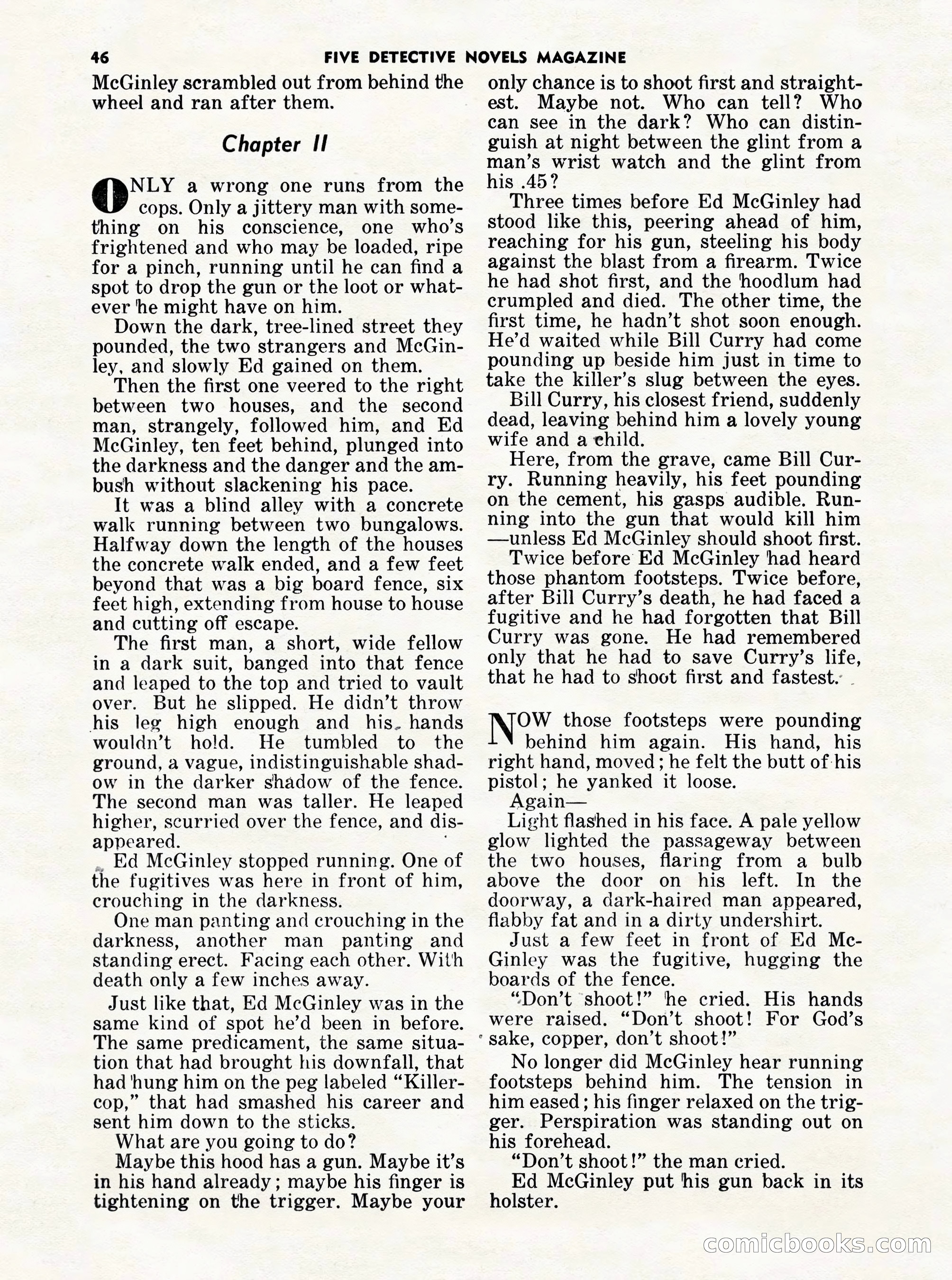
A restored page from Pulp Fiction, 1953. Page through the whole issue in the reader above.
📄 Transcribed text from this page (OCR, searchable)
Machine-transcribed from the original scan — historical spelling and the odd misread are preserved.
46 McGinley scrambled out from behind the wheel and ran after them. Chapter II NLY a wrong one runs from the cops. Only a jittery man with some- thing on his conscience, one who’s frightened and who may be loaded, ripe for a pinch, running until he can find a spot to drop the gun or the loot or what- ever he might have on him. Down the dark, tree-lined street they pounded, the two ‘strangers and McGin- ley, and slowly Ed gained on them. Then the first one veered to the right between two houses, and the second man, strangely, followed him, and Ed McGinley, ten feet behind, plunged into the darkness and the danger and the am- bush without slackening his pace. It was a blind alley with a concrete walk running between two bungalows. Halfway down the length of the houses the concrete walk ended, and a few feet beyond that was a big board fence, six feet high, extending from house to house and cutting off escape. The first man, a short, wide fellow in a dark suit, banged into that fence and leaped to the top and tried to vault over. But he slipped. He didn’t throw his leg high enough and his. hands wouldn’t hold. He tumbled to the ground, a vague, indistinguishable shad- ow in the darker shadow of the fence. The second man was taller. He leaped higher, scurried over the fence, and dis- appeared. Ed McGinley stopped running. One of the fugitives was here in front of him, crouching in the darkness. One man panting and crouching in the darkness, another man panting and standing erect. Facing each other. With death only a few inches away. Just like that, Ed McGinley was in the same kind of spot he’d been in before. The same predicament, the same situa- tion that had brought his downfall, that had ‘hung him on the peg labeled “Killer- cop,” that had smashed his career and sent him down to the sticks. What are you going to do? Maybe this hood has a gun. Maybe it’s in his hand already ; maybe his finger is tightening on the trigger. Maybe your FIVE DETECTIVE NOVELS MAGAZINE only chance is to shoot first and straight- est. Maybe not. Who can tell? Who can see in the dark? Who can distin- guish at night between the glint from a man’s wrist watch and the glint from his .45? Three times before Ed McGinley had stood like this, peering ahead of him, reaching for his gun, steeling his body against the blast from a firearm. Twice he had shot first, and the hoodlum had crumpled and died. The other time, the first time, he hadn’t shot soon enough. He’d waited while Bill Curry had come pounding up beside him just in time to take the killer’s slug between the eyes. Bill Curry, his closest friend, suddenly dead, leaving behind him a lovely young wife and a ehild. Here, from the grave, came Bill Cur- ry. Running heavily, his feet pounding on the cement, his gasps audible. Run- ning into the gun that would kill him —unless Ed McGinley should shoot first. Twice before Ed McGinley ‘had heard those phantom footsteps. Twice before, after Bill Curry’s death, he had faced a fugitive and he had forgotten that Bill Curry was gone. He had remembered only that he had to save Curry’s life, that he had to shoot first and fastest. . No those footsteps were pounding behind him again. His hand, his right hand, moved; he felt the butt of:his pistol; he yanked it loose. Again— Light flashed in his face. A pale yellow glow lighted the passageway between the two houses, flaring from a bulb above the door on his left. In the doorway, a dark-haired man appeared, flabby fat and in a dirty undershirt. Just a few feet in front of Ed Mc- Ginley was the fugitive, hugging the boards of the fence. “Don’t shoot!” ‘he cried. His hands were raised. “Don’t shoot! For God’s "sake, copper, don’t shoot!” No longer did McGinley hear running footsteps behind him. The tension in him eased; his finger relaxed on the trig- ger. Perspiration was standing out on his forehead. “Don’t shoot!” the man cried. Ed McGinley put his gun back in its holster. MICLOO @) (CO) S (C(O)