
Pulp Fiction, 1953 · page 120 of 132
5 Detective Novels Magazine Cover — page 120: what you’re looking at
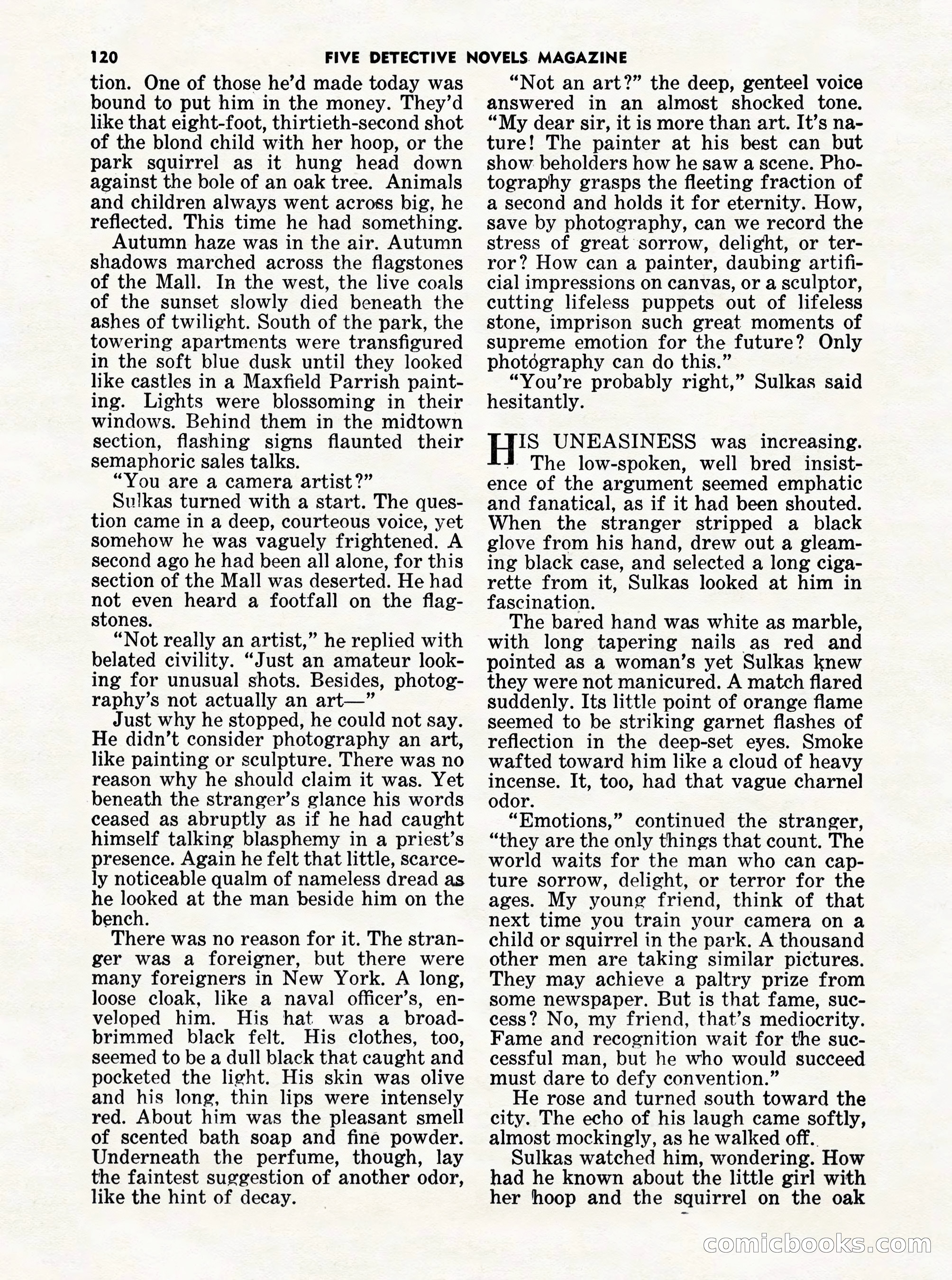
A restored page from Pulp Fiction, 1953. Page through the whole issue in the reader above.
📄 Transcribed text from this page (OCR, searchable)
Machine-transcribed from the original scan — historical spelling and the odd misread are preserved.
120 tion. One of those he’d made today was bound to put him in the money. They’d like that eight-foot, thirtieth-second shot of the blond child with her hoop, or the park squirrel as it hung head down against the bole of an oak tree. Animals and children always went across big, he reflected. This time he had something. Autumn haze was in the air. Autumn shadows marched across the flagstones of the Mall. In the west, the live coals of the sunset slowly died beneath the ashes of twilight. South of the park, the towering apartments were transfigured in the soft blue dusk until they looked like castles in a Maxfield Parrish paint- ing. Lights were blossoming in their windows. Behind them in the midtown section, flashing signs flaunted their semaphoric sales talks. “You are a camera artist?” Sulkas turned with a start. The ques- tion came in a deep, courteous voice, yet somehow he was vaguely frightened. A second ago he had been all alone, for this section of the Mall was deserted. He had not even heard a footfall on the flag- stones. “Not really an artist,” he replied with belated civility. “Just an amateur look- ing for unusual shots. Besides, photog- raphy’s not actually an art—” Just why he stopped, he could not say. He didn’t consider photography an art, like painting or sculpture. There was no reason why he should claim it was. Yet beneath the stranger’s glance his words ceased as abruptly as if he had caught himself talking blasphemy in a priest’s presence. Again he felt that little, scarce- ly noticeable qualm of nameless dread as he looked at the man beside him on the bench. There was no reason for it. The stran- ger was a foreigner, but there were many foreigners in New York. A long, loose cloak, like a naval officer’s, en- veloped him. His hat was a _ broad- brimmed black felt. His clothes, too, seemed to be a dull black that caught and pocketed the light. His skin was olive and his long, thin lips were intensely red. About him was the pleasant smell of scented bath soap and fine powder. Underneath the perfume, though, lay the faintest suggestion of another odor, like the hint of decay. FIVE DETECTIVE NOVELS. MAGAZINE “Not an art?” the deep, genteel voice answered in an almost shocked tone. “My dear sir, it is more than art. It’s na- ture! The painter at his best can but show beholders how he saw a scene. Pho- tography grasps the fleeting fraction of a second and holds it for eternity. How, save by photography, can we record the stress of great sorrow, delight, or ter- ror? How can a painter, daubing artifi- cial impressions on canvas, or a sculptor, cutting lifeless puppets out of lifeless stone, imprison such great moments of supreme emotion for the future? Only photography can do this.” “You’re probably right,” Sulkas said hesitantly. IS UNEASINESS was increasing. “ The low-spoken, well bred insist- ence of the argument seemed emphatic and fanatical, as if it had been shouted. When the stranger stripped a black glove from his hand, drew out a gleam- ing black case, and selected a long ciga- rette from it, Sulkas looked at him in fascination. The bared hand was white as marble, with long tapering nails as red and pointed as a woman’s yet Sulkas knew they were not manicured. A match flared suddenly. Its little point of orange flame seemed to be striking garnet flashes of reflection in the deep-set eyes. Smoke wafted toward him like a cloud of heavy incense. It, too, had that vague charnel odor. “Emotions,” continued the stranger, “they are the only things that count. The world waits for the man who can cap- ture sorrow, delight, or terror for the ages. My young friend, think of that next time you train your camera on a child or squirrel in the park. A thousand other men are taking similar pictures. They may achieve a paltry prize from some newspaper. But is that fame, suc- cess? No, my friend, that’s mediocrity. Fame and recognition wait for the suc- cessful man, but he who would succeed must dare to defy convention.” He rose and turned south toward the city. The echo of his laugh came softly, almost mockingly, as he walked off.. Sulkas watched him, wondering. How had he known about the little girl with her hoop and the squirrel on the oak AMNCLOOO SS (C@) (C@)