
Pulp Fiction, 1952 · page 82 of 132
5 Detective Novels Magazine Cover — page 82: what you’re looking at
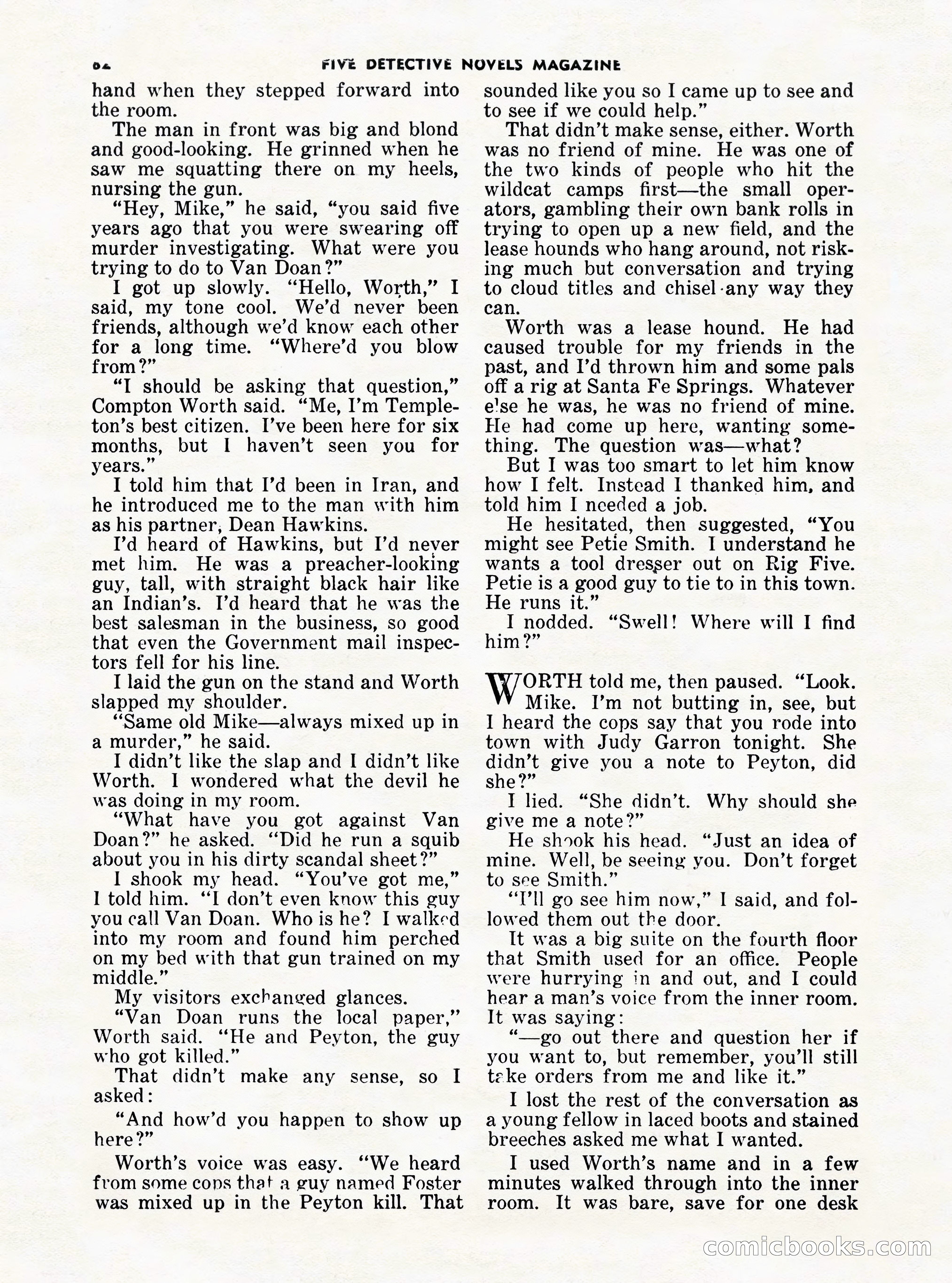
A restored page from Pulp Fiction, 1952. Page through the whole issue in the reader above.
📄 Transcribed text from this page (OCR, searchable)
Machine-transcribed from the original scan — historical spelling and the odd misread are preserved.
Os hand when they stepped forward into the room. The man in front was big and blond and good-looking. He grinned when he saw me squatting there on my heels, nursing the gun. “Hey, Mike,” he said, “you said five years ago that you were swearing off murder investigating. What were you trying to do to Van Doan?” I got up slowly. “Hello, Worth,” I said, my tone cool. We’d never been friends, although we’d know each other for a long time. “Where’d you blow from?” “IT should be asking that question,” Compton Worth said. “Me, I’m Temple- ton’s best citizen. I’ve been here for six months, but I haven’t seen you for years.” I told him that I’d been in Iran, and he introduced me to the man with him as his partner, Dean Hawkins. I’d heard of Hawkins, but I’d never met him. He was a preacher-looking guy, tall, with straight black hair like an Indian’s. I’d heard that he was the best salesman in the business, so good that even the Government mail inspec- tors fell for his line. I laid the gun on the stand and Worth slapped my shoulder. ‘Same old Mike—always mixed up in a murder,” he said. I didn’t like the slap and I didn’t like Worth. I wondered what the devil he was doing in my room. “What have you got against Van Doan?” he asked. ‘Did he run a squib about you in his dirty scandal sheet?” I shook my head. “You’ve got me,” I told him. “I don’t even know this guy you call Van Doan. Who is he? I walked into my room and found him perched on my bed with that gun trained on my middle.” My visitors exchanged glances. “Van Doan runs the local paper,” Worth said. “He and Peyton, the guy who got killed.” That didn’t make any sense, so I asked: “And how’d you happen to show up here?” Worth’s voice was easy. “We heard from some cons that a guy named Foster was mixed up in the Peyton kill. That FIVe DETECTIVE NOVELS MAGAZINE sounded like you so I came up to see and to see if we could help.” That didn’t make sense, either. Worth was no friend of mine. He was one of the two kinds of people who hit the wildcat camps first—the small oper- ators, gambling their own bank rolls in trying to open up a new field, and the lease hounds who hang around, not risk- ing much but conversation and trying to cloud titles and chisel-any way they can. Worth was a lease hound. He had caused trouble for my friends in the past, and I’d thrown him and some pals off a rig at Santa Fe Springs. Whatever e'se he was, he was no friend of mine. He had come up here, wanting’ some- thing. The question was—what? But I was too smart to let him know how I felt. Instead I thanked him, and told him I nceded a job. He hesitated, then suggested, “You might see Petie Smith. I understand he wants a tool dresser out on Rig Five. Petie is a good guy to tie to in this town. He runs it.” I nodded. him?” “Swell! Where will I find ORTH told me, then paused. “Look. Mike. I’m not butting in, see, but I heard the cops say that you rode into town with Judy Garron tonight. She didn’t give you a note to Peyton, did she?” I lied. “She didn’t. Why should she give me a note?” He shook his head. “Just an idea of mine. Well, be seeiny you. Don’t forget to see Smith.” “Ill go see him now,” I said, and fol- lowed them out the door. It was a big suite on the fourth floor that Smith used for an office. People were hurrying in and out, and I could hear a man’s voice from the inner room. It was saying: “—_go out there and question her if you want to, but remember, you’ll still teke orders from me and like it.” I lost the rest of the conversation as a young fellow in laced boots and stained breeches asked me what I wanted. I used Worth’s name and in a few minutes walked through into the inner room. It was bare, save for one desk CoOnniclooo S (C(O) mM