
Pulp Fiction, 1952 · page 76 of 132
5 Detective Novels Magazine Cover — page 76: what you’re looking at
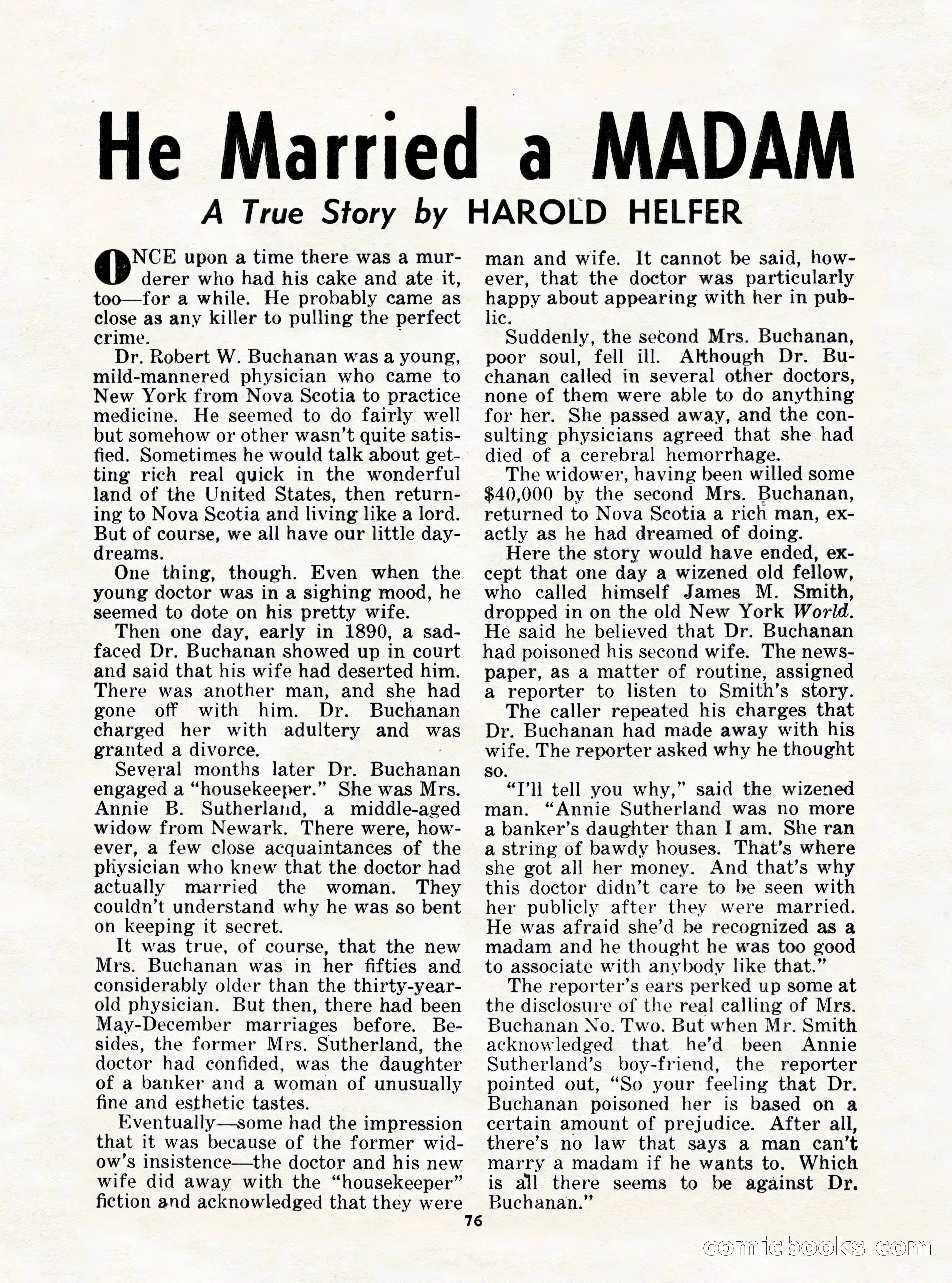
A restored page from Pulp Fiction, 1952. Page through the whole issue in the reader above.
📄 Transcribed text from this page (OCR, searchable)
Machine-transcribed from the original scan — historical spelling and the odd misread are preserved.
He Married a MADAM A True Story by HAROLD HELFER NCE upon a time there was a mur- derer who had his cake and ate it, too—for a while. He probably came as close as any killer to pulling the perfect crime. Dr. Robert W. Buchanan was a young, mild-mannered physician who came to New York from Nova Scotia to practice medicine. He seemed to do fairly well but somehow or other wasn’t quite satis- fied. Sometimes he would talk about get- ting rich real quick in the wonderful land of the United States, then return- ing to Nova Scotia and living like a lord. But of course, we all have our little day- dreams. One thing, though. Even when the young doctor was in a sighing mood, he seemed to dote on his pretty wife. Then one day, early in 1890, a sad- faced Dr. Buchanan showed up in court and said that his wife had deserted him. There was another man, and she had gone off with him. Dr. Buchanan charged her with adultery and was granted a divorce. Several months later Dr. Buchanan engaged a “housekeeper.” She was Mrs. Annie B. Sutherland, a middle-aged widow from Newark. There were, how- ever, a few close acquaintances of the physician who knew that the doctor had actually married the woman. They couldn’t understand why he was so bent on keeping it secret. It was true, of course, that the new Mrs. Buchanan was in her fifties and considerably older than the thirty-year- old physician. But then, there had been May-December marriages before. Be- sides, the former Mrs. Sutherland, the doctor had confided, was the daughter of a banker and a woman of unusually fine and esthetic tastes. Eventually—some had the impression that it was because of the former wid- ow’s insistence—the doctor and his new wife did away with the “housekeeper” fiction and acknowledged that they were 76 man and wife. It cannot be said, how- ever, that the doctor was particularly happy about appearing with her in pub- lic. Suddenly, the second Mrs. Buchanan, poor soul, fell ill. Although Dr. Bu- chanan called in several other doctors, none of them were able to do anything for her. She passed away, and the con- sulting physicians agreed that she had died of a cerebral hemorrhage. The widower, having been willed some $40,000 by the second Mrs. Buchanan, returned to Nova Scotia a rich man, ex- actly as he had dreamed of doing. Here the story would have ended, ex- cept that one day a wizened old fellow, who called himself James M. Smith, dropped in on the old New York World. He said he believed that Dr. Buchanan had poisoned his second wife. The news- paper, as a matter of routine, assigned a reporter to listen to Smith’s story. The caller repeated his charges that Dr. Buchanan had made away with his wife. The reporter asked why he thought O. “T’ll tell you why,” said the wizened man. “Annie Sutherland was no more a banker’s daughter than I am. She ran a string of bawdy houses. That’s where she got all her money. And that’s why this doctor didn’t care to be seen with her publicly after they were married. He was afraid she’d be recognized as a madam and he thought he was too good to associate with anybody like that.” The reporter’s ears perked up some at the disclosure of the real calling of Mrs. Buchanan No. Two. But when Mr. Smith acknowledged that he’d been Annie Sutherland’s boy-friend, the reporter pointed out, “So your feeling that Dr. Buchanan poisoned her is based on a certain amount of prejudice. After all, there’s no law that says a man can’t marry a madam if he wants to. Which is all there seems to be against Dr. Buchanan.” AMICLOOO@ CO) Ss (C(O)