
Pulp Fiction, 1952 · page 70 of 132
5 Detective Novels Magazine Cover — page 70: what you’re looking at
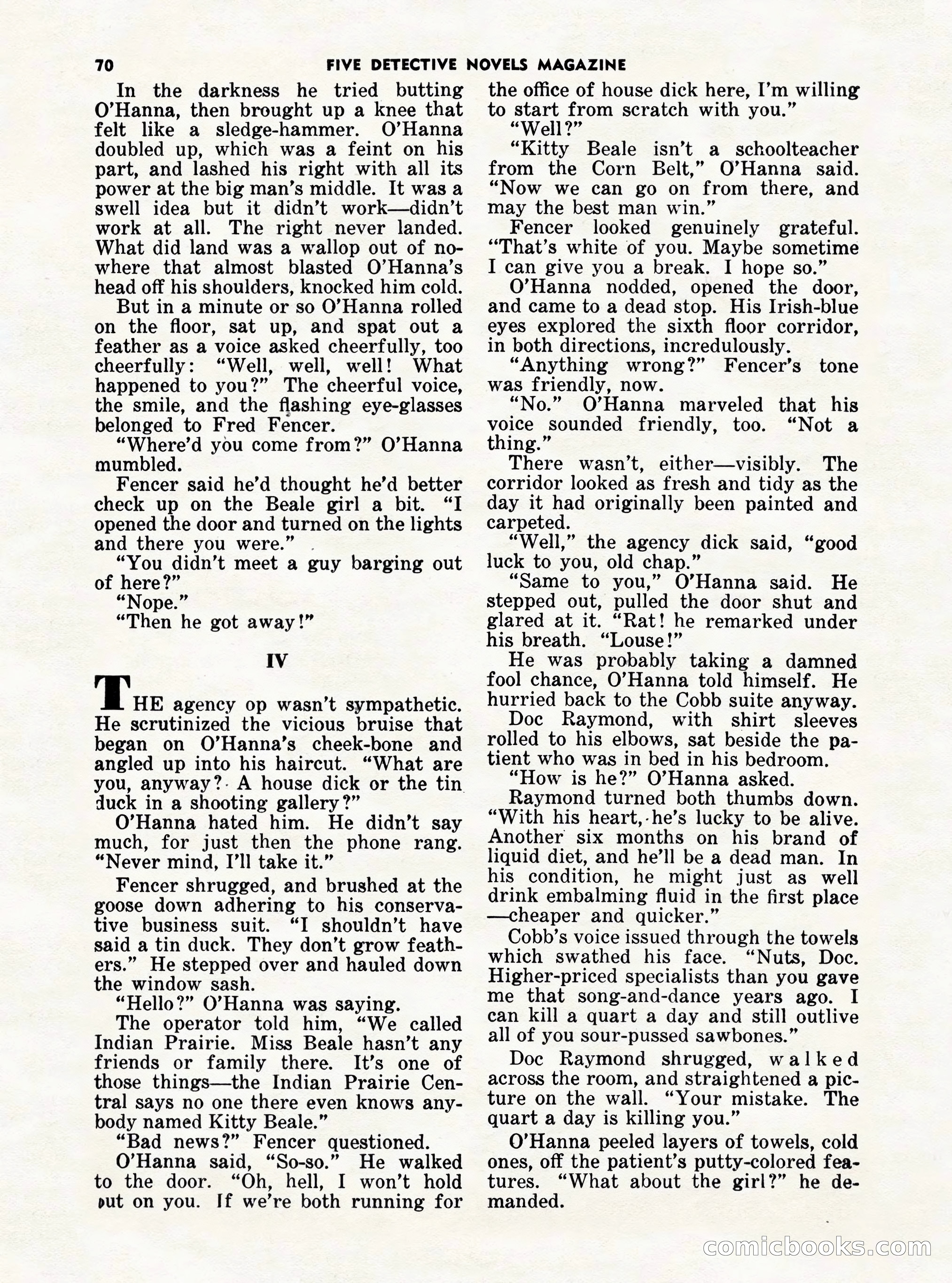
A restored page from Pulp Fiction, 1952. Page through the whole issue in the reader above.
📄 Transcribed text from this page (OCR, searchable)
Machine-transcribed from the original scan — historical spelling and the odd misread are preserved.
70 In the darkness he tried butting O’Hanna, then brought up a knee that felt like a sledge-hammer. O’Hanna doubled up, which was a feint on his part, and lashed his right with all its power at the big man’s middle. It was a swell idea but it didn’t work—didn’t work at all. The right never landed. What did land was a wallop out of no- where that almost blasted O’Hanna’s head off his shoulders, knocked him cold. But in a minute or so O’Hanna rolled on the floor, sat up, and spat out a feather as a voice asked cheerfully, too cheerfully: “Well, well, well! What happened to you?” The cheerful voice, the smile, and the flashing eye-glasses belonged to Fred Fencer. “Where'd you come from?” O’Hanna mumbled. Fencer said he’d thought he’d better check up on the Beale girl a bit. “I opened the door and turned on the lights and there you were.” . “You didn’t meet a guy barging out of here?” “Nope.” “Then he got away!” IV | lee agency op wasn’t sympathetic. He scrutinized the vicious bruise that began on O’Hanna’s cheek-bone and angled up into his haircut. “What are you, anyway?- A house dick or the tin duck in a shooting gallery?” O’Hanna hated him. He didn’t say much, for just then the phone rang. “Never mind, I’ll take it.” Fencer shrugged, and brushed at the goose down adhering to his conserva- tive business suit. “I shouldn’t have said a tin duck. They don’t grow feath- ers.” He stepped over and hauled down the window sash. “Hello?” O’Hanna was saying. The operator told him, “We called Indian Prairie. Miss Beale hasn’t any friends or family there. It’s one of those things—the Indian Prairie Cen- tral says no one there even knows any- body named Kitty Beale.” “Bad news?” Fencer questioned. O’Hanna said, “So-so.” He walked to the door. “Oh, hell, I won’t hold put on you. If we’re both running for FIVE DETECTIVE NOVELS MAGAZINE the office of house dick here, I’m willing to start from scratch with you.” “Well?” “Kitty Beale isn’t a schoolteacher from the Corn Belt,” O’Hanna said. “Now we can go on from there, and may the best man win.” Fencer looked genuinely grateful. “That’s white of you. Maybe sometime I can give you a break. I hope so.” O’Hanna nodded, opened the door, and came to a dead stop. His Irish-blue eyes explored the sixth floor corridor, in both directions, incredulously. “Anything wrong?” Fencer’s tone was friendly, now. o.” O’Hanna marveled that his voice sounded friendly, too. “Not a thing.” There wasn’t, either—visibly. The corridor looked as fresh and tidy as the day it had originally been painted and carpeted. “Well,” the agency dick said, “good luck to you, old chap.” “Same to you,” O’Hanna said. He stepped out, pulled the door shut and glared at it. “Rat! he remarked under his breath. “Louse!” He was probably taking a damned fool chance, O’Hanna told himself. He hurried back to the Cobb suite anyway. Doc Raymond, with shirt sleeves rolled to his elbows, sat beside the pa- tient who was in bed in his bedroom. “How is he?” O’Hanna asked. Raymond turned both thumbs down. “With his heart,-he’s lucky to be alive. Another six months on his brand of liquid diet, and he’ll be a dead man. In his condition, he might just as well drink embalming fluid in the first place —cheaper and quicker.” Cobb’s voice issued through the towels which swathed his face. “Nuts, Doc. Higher-priced specialists than you gave me that song-and-dance years ago. I can kill a quart a day and still outlive all of you sour-pussed sawbones.” Doc Raymond shrugged, walked across the room, and straightened a pic- ture on the wall. “Your mistake. The quart a day is killing you.” O’Hanna peeled layers of towels, cold ones, off the patient’s putty-colored fea- tures. “What about the girl?” he de- manded. JOO COIN @ S (C(O) mM