
Pulp Fiction, 1952 · page 25 of 132
5 Detective Novels Magazine Cover — page 25: what you’re looking at
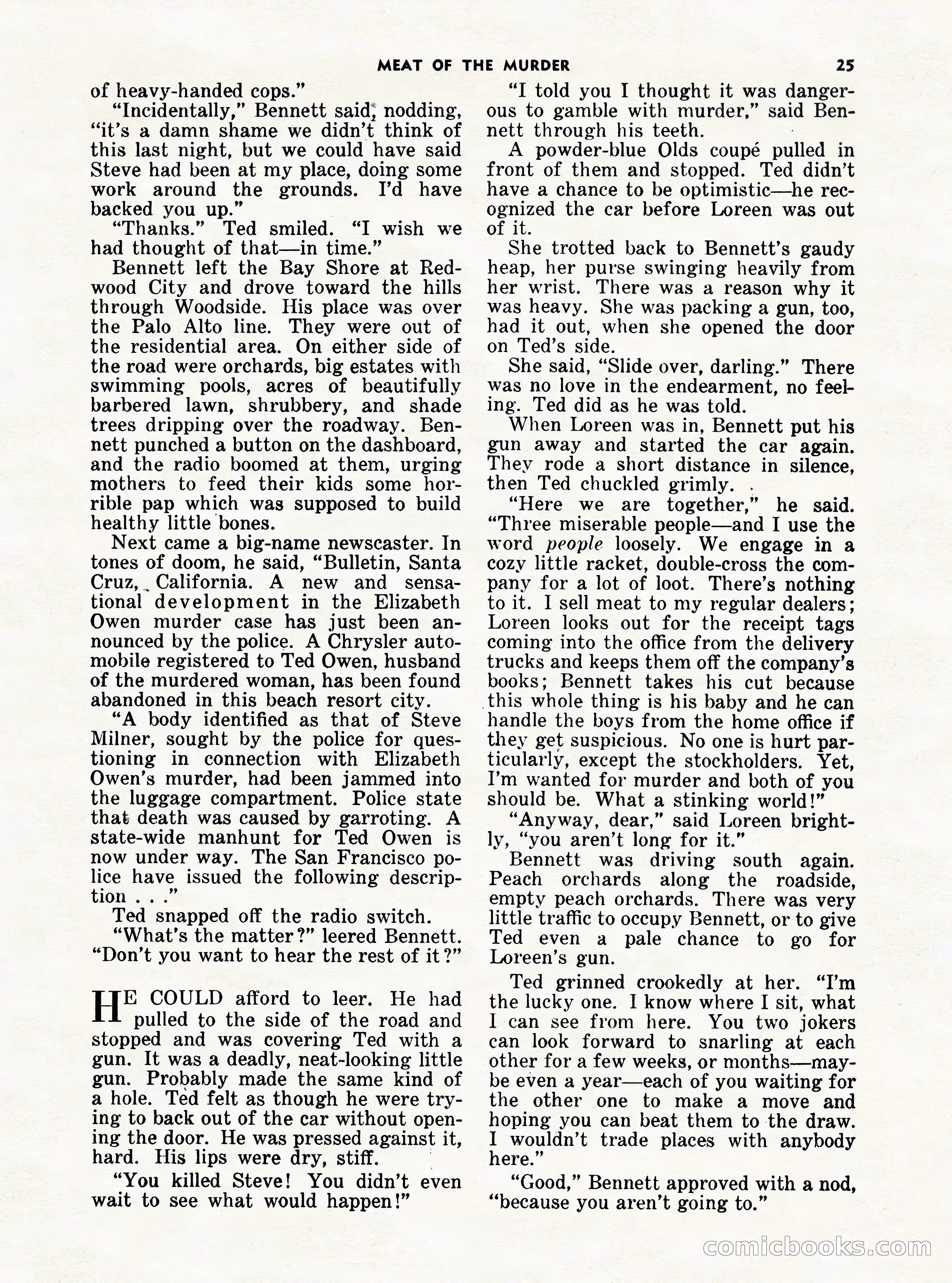
A restored page from Pulp Fiction, 1952. Page through the whole issue in the reader above.
📄 Transcribed text from this page (OCR, searchable)
Machine-transcribed from the original scan — historical spelling and the odd misread are preserved.
MEAT OF THE MURDER of heavy-handed cops.” “Incidentally,” Bennett said; nodding, ‘it’s a damn shame we didn’t think of this last night, but we could have said Steve had been at my place, doing some work around the grounds. I’d have backed you up.” “Thanks.” Ted smiled. “I wish we had thought of that—in time.” Bennett left the Bay Shore at Red- wood City and drove toward the hills through Woodside. His place was over the Palo Alto line. They were out of the residential area. On either side of the road were orchards, big estates with swimming pools, acres of beautifully barbered lawn, shrubbery, and shade trees dripping over the roadway. Ben- nett punched a button on the dashboard, and the radio boomed at them, urging mothers to feed their kids some hor- rible pap which was supposed to build healthy little bones. Next came a big-name newscaster. In tones of doom, he said, “Bulletin, Santa Cruz, California. A new and _ sensa- tional development in the Elizabeth Owen murder case has just been an- nounced by the police. A Chrysler auto- mobile registered to Ted Owen, husband of the murdered woman, has been found abandoned in this beach resort city. “A body identified as that of Steve Milner, sought by the police for ques- tioning in connection with Elizabeth Owen’s murder, had been jammed into the luggage compartment. Police state that death was caused by garroting. A state-wide manhunt for Ted Owen is now under way. The San Francisco po- lice have issued the following descrip- t1ON 22°. - Ted snapped off the radio switch. “What’s the matter?” leered Bennett. “Don’t you want to hear the rest of it?” L EK COULD afford to leer. He had pulled to the side of the road and stopped and was covering Ted with a gun. It was a deadly, neat-looking little gun. Probably made the same kind of a hole. Ted felt as though he were try- ing to back out of the car without open- ing the door. He was pressed against it, hard. His lips were dry, stiff. “You killed Steve! You didn’t even wait to see what would happen!” 2° “T told you I thought it was danger- ous to gamble with murder,” said Ben- nett through his teeth. A powder-blue Olds coupe pulled in front of them and stopped. Ted didn’t have a chance to be optimistic—he rec- ognized the car before Loreen was out of it. She trotted back to Bennett’s gaudy heap, her purse swinging heavily from her wrist. There was a reason why it was heavy. She was packing a gun, too, had it out, when she opened the door on Ted’s side. She said, “Slide over, darling.” There was no love in the endearment, no feel- ing. Ted did as he was told. When Loreen was in, Bennett put his gun away and started the car again. They rode a short distance in silence, then Ted chuckled grimly. “Here we are together,” he said. “Three miserable people—and I use the word people loosely. We engage in a cozy little racket, double-cross the com- pany for a lot of loot. There’s nothing to it. I sell meat to my regular dealers; Loreen looks out for the receipt tags coming into the office from the delivery trucks and keeps them off the company’s books; Bennett takes his cut because this whole thing is his baby and he can handle the boys from the home office if they get suspicious. No one is hurt par- ticularly, except the stockholders. Yet, I’m wanted for murder and both of you should be. What a stinking world!” “Anyway, dear,” said Loreen bright- “vou aren’t long for it.” Bennett was driving south again. Peach orchards along the _ roadside, empty peach orchards. There was very little traffic to occupy Bennett, or to give Ted even a pale chance to go for Loreen’s gun. Ted grinned crookedly at her. “I’m the lucky one. I know where I sit, what I can see from here. You two jokers can look forward to snarling at each other for a few weeks, or months—may- be even a year—each of you waiting for the other one to make a move and hoping you can beat them to the draw. I wouldn't trade places with anybody here.” “Good,” Bennett approved with a nod, “because you aren’t going to.” ly, Conniclooo S (C(O) mM