
Pulp Fiction, 1952 · page 97 of 132
5 Detective Novels Magazine — page 97: what you’re looking at
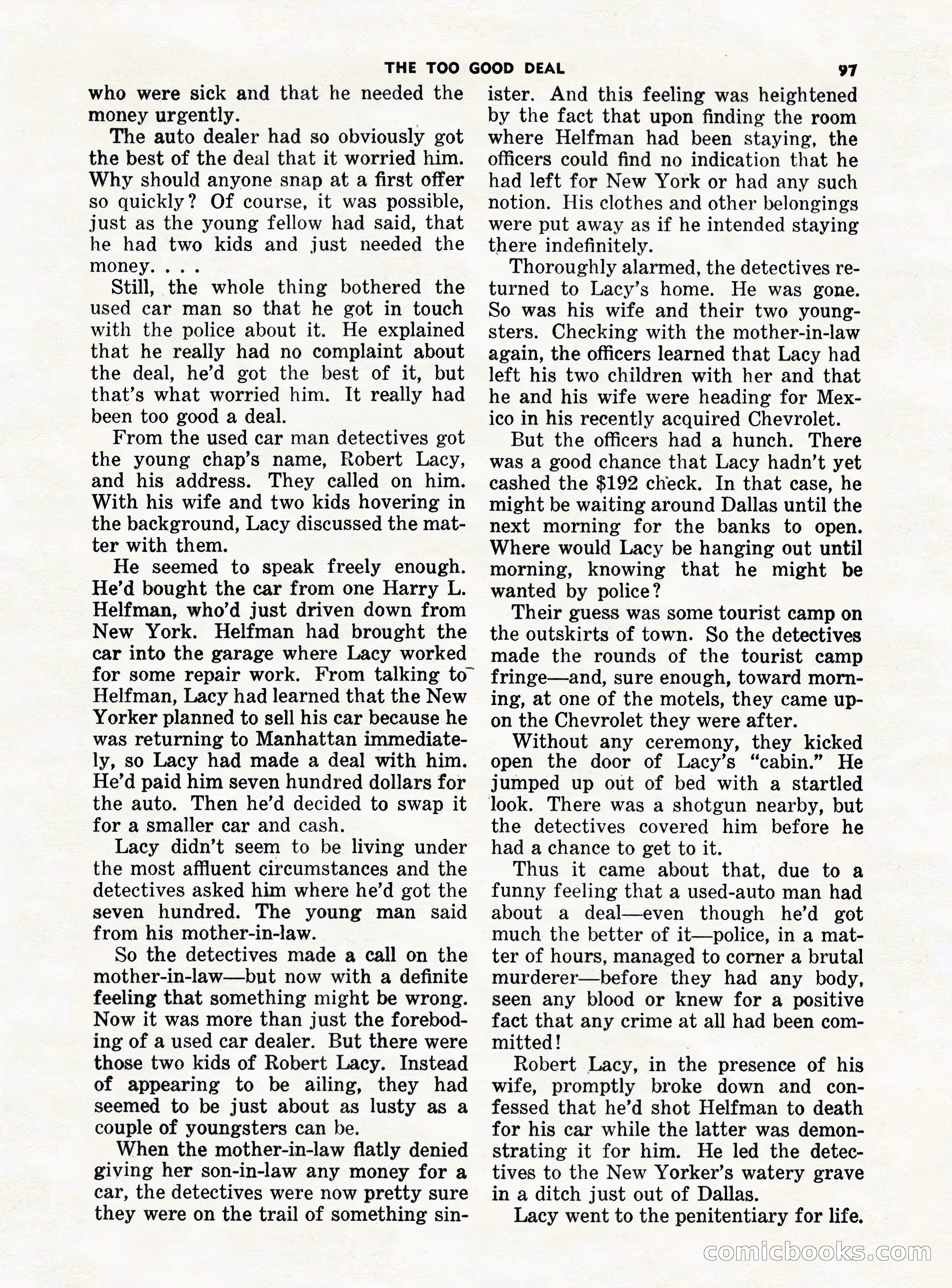
A restored page from Pulp Fiction, 1952. Page through the whole issue in the reader above.
📄 Transcribed text from this page (OCR, searchable)
Machine-transcribed from the original scan — historical spelling and the odd misread are preserved.
THE TOO GOOD DEAL who were sick and that he needed the money urgently. The auto dealer had so obviously got the best of the deal that it worried him. Why should anyone snap at a first offer so quickly? Of course, it was possible, just as the young fellow had said, that he had two kids and just needed the money. ... Still, the whole thing bothered the used car man so that he got in touch with the police about it. He explained that he really had no complaint about the deal, he’d got the best of it, but that’s what worried him. It really had been too good a deal. From the used car man detectives got the young chap’s name, Robert Lacy, and his address. They called on him. With his wife and two kids hovering in the background, Lacy discussed the mat- ter with them. He seemed to speak freely enough. He’d bought the car from one Harry L. Helfman, who’d just driven down from New York. Helfman had brought the car into the garage where Lacy worked for some repair work. From talking to— Helfman, Lacy had learned that the New Yorker planned to sell his car because he was returning to Manhattan immediate- ly, so Lacy had made a deal with him. He’d paid him seven hundred dollars for the auto. Then he’d decided to swap it for a smaller car and cash. Lacy didn’t seem to be living under the most affluent circumstances and the detectives asked him where he’d got the seven hundred. The young man said from his mother-in-law. So the detectives made a call on the mother-in-law—but now with a definite feeling that something might be wrong. Now it was more than just the forebod- ing of a used car dealer. But there were those two kids of Robert Lacy. Instead of appearing to be ailing, they had seemed to be just about as lusty as a couple of youngsters can be. When the mother-in-law flatly denied giving her son-in-law any money for a car, the detectives were now pretty sure they were on the trail of something sin- 97 ister. And this feeling was heightened by the fact that upon finding the room where Helfman had been staying, the officers could find no indication that he had left for New York or had any such notion. His clothes and other belongings were put away as if he intended staying there indefinitely. Thoroughly alarmed, the detectives re- turned to Lacy’s home. He was gone. So was his wife and their two young- sters. Checking with the mother-in-law again, the officers learned that Lacy had left his two children with her and that he and his wife were heading for Mex- ico in his recently acquired Chevrolet. But the officers had a hunch. There was a good chance that Lacy hadn’t yet cashed the $192 check. In that case, he might be waiting around Dallas until the next morning for the banks to open. Where would Lacy be hanging out until morning, knowing that he might be wanted by police? Their guess was some tourist camp on the outskirts of town. So the detectives made the rounds of the tourist camp fringe—and, sure enough, toward morn- ing, at one of the motels, they came up- on the Chevrolet they were after. Without any ceremony, they kicked open the door of Lacy’s “cabin.” He jumped up out of bed with a startled look. There was a shotgun nearby, but the detectives covered him before he had a chance to get to it. Thus it came about that, due to a funny feeling that a used-auto man had about a deal—even though he’d got much the better of it—police, in a mat- ter of hours, managed to corner a brutal murderer—before they had any body, seen any blood or knew for a positive fact that any crime at all had been com- mitted! i Robert Lacy, in the presence of his wife, promptly broke down and con- fessed that he’d shot Helfman to death for his car while the latter was demon- strating it for him. He led the detec- tives to the New Yorker’s watery grave in a ditch just out of Dallas. Lacy went to the penitentiary for life. MICLOOOKS COMNMIC