
Pulp Fiction, 1952 · page 70 of 132
5 Detective Novels Magazine — page 70: what you’re looking at
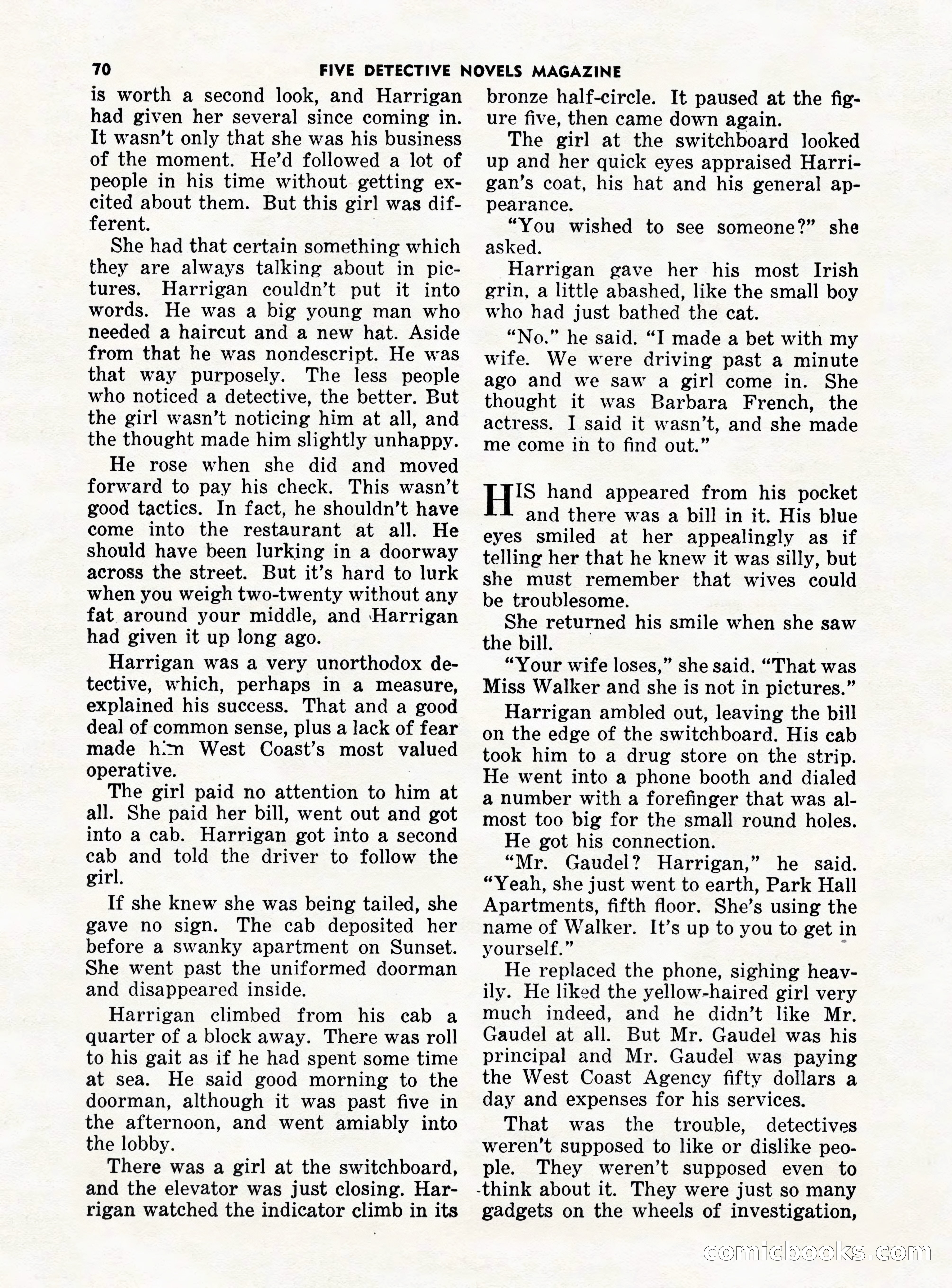
A restored page from Pulp Fiction, 1952. Page through the whole issue in the reader above.
📄 Transcribed text from this page (OCR, searchable)
Machine-transcribed from the original scan — historical spelling and the odd misread are preserved.
70 is worth a second look, and Harrigan had given her several since coming in. It wasn’t only that she was his business of the moment. He’d followed a lot of people in his time without getting ex- cited about them. But this girl was dif- ferent. She had that certain something which they are always talking about in pic- tures. Harrigan couldn’t put it into words. He was a big young man who needed a haircut and a new hat. Aside from that he was nondescript. He was that way purposely. The less people who noticed a detective, the better. But the girl wasn’t noticing him at all, and the thought made him slightly unhappy. He rose when she did and moved forward to pay his check. This wasn’t good tactics. In fact, he shouldn’t have come into the restaurant at all. He should have been lurking in a doorway across the street. But it’s hard to lurk when you weigh two-twenty without any fat around your middle, and Harrigan had given it up long ago. Harrigan was a very unorthodox de- tective, which, perhaps in a measure, explained his success. That and a good deal of common sense, plus a lack of fear made h:m West Coast’s most valued operative. The girl paid no attention to him at all. She paid her bill, went out and got into a cab. Harrigan got into a second cab and told the driver to follow the girl. If she knew she was being tailed, she gave no sign. The cab deposited her before a swanky apartment on Sunset. She went past the uniformed doorman and disappeared inside. Harrigan climbed from his cab a quarter of a block away. There was roll to his gait as if he had spent some time at sea. He said good morning to the doorman, although it was past five in the afternoon, and went amiably into the lobby. There was a girl at the switchboard, and the elevator was just closing. Har- rigan watched the indicator climb in its FIVE DETECTIVE NOVELS MAGAZINE bronze half-circle. It paused at the fig- ure five, then came down again. The girl at the switchboard looked up and her quick eyes appraised Harri- gan’s coat, his hat and his general ap- pearance. “You wished to see someone?” she asked. Harrigan gave her his most Irish grin, a little abashed, like the small boy who had just bathed the cat. “No.” he said. “I made a bet with my wife. We were driving past a minute ago and we saw a girl come in. She thought it was Barbara French, the actress. I said it wasn’t, and she made me come in to find out.” H's hand appeared from his pocket and there was a bill in it. His blue eyes smiled at her appealingly as if telling her that he knew it was silly, but she must remember that wives could be troublesome. She returned his smile when she saw the bill. : | “Your wife loses,” she said. “That was Miss Walker and she is not in pictures.” Harrigan ambled out, leaving the bill on the edge of the switchboard. His cab took him to a drug store on the strip. He went into a phone booth and dialed a number with a forefinger that was al- most too big for the small round holes. He got his connection. “Mr. Gaudel? Harrigan,” he said. “Yeah, she just went to earth, Park Hall Apartments, fifth floor. She’s using the name of Walker. It’s up to you to get in yourself.” : He replaced the phone, sighing heav- ily. He liked the yellow-haired girl very much indeed, and he didn’t like Mr. Gaudel at all. But Mr. Gaudel was his principal and Mr. Gaudel was paying the West Coast Agency fifty dollars a day and expenses for his services. That was the trouble, detectives weren’t supposed to like or dislike peo- ple. They weren’t supposed even to -think about it. They were just so many gadgets on the wheels of investigation, CoOMmiclooo €=)