
Pulp Fiction, 1952 · page 6 of 132
5 Detective Novels Magazine — page 6: what you’re looking at
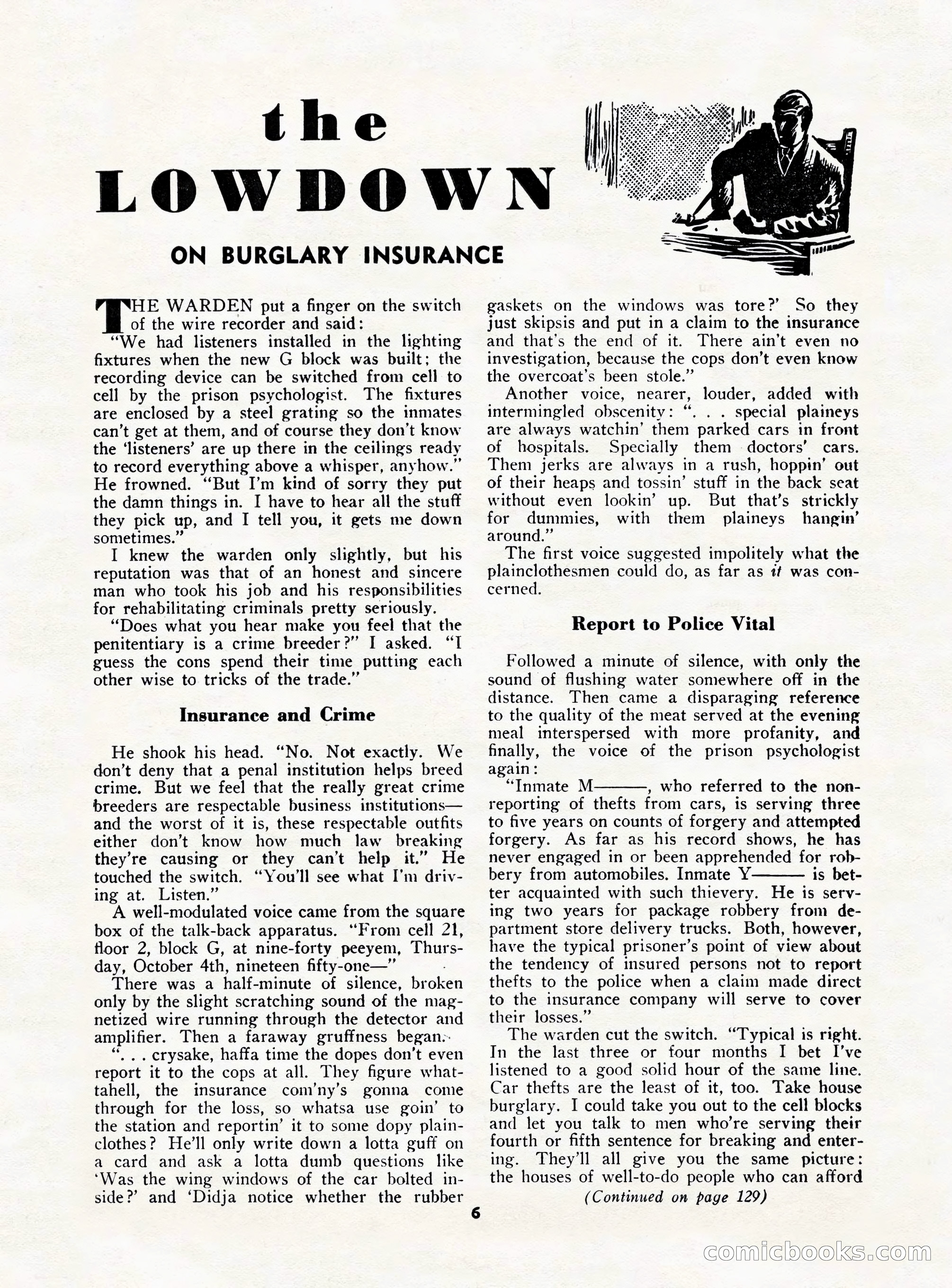
A restored page from Pulp Fiction, 1952. Page through the whole issue in the reader above.
📄 Transcribed text from this page (OCR, searchable)
Machine-transcribed from the original scan — historical spelling and the odd misread are preserved.
the HE WARDEN put a finger on the switch of the wire recorder and said: “We had listeners installed in the lighting fixtures when the new G block was built; the recording device can be switched from cell to cell by the prison psychologist. The fixtures are enclosed by a steel grating so the inmates can’t get at them, and of course they don’t know the ‘listeners’ are up there in the ceilings ready to record everything above a whisper, anyhow.” He frowned. “But I’m kind of sorry they put the damn things in. I have to hear all the stuff they pick up, and I tell you, it gets me down sometimes.” I knew the warden only slightly, but his reputation was that of an honest and sincere man who took his job and his responsibilities for rehabilitating criminals pretty seriously. “Does what you hear make you feel that the penitentiary is a crime breeder?” I asked. “I guess the cons spend their time putting each other wise to tricks of the trade.” Insurance and Crime He shook his head. “No. Not exactly. We don’t deny that a penal institution helps breed crime. But we feel that the really great crime breeders are respectable business institutions— and the worst of it is, these respectable outfits either don’t know how much law breaking they’re causing or they can't help it.” He touched the switch. “You'll see what I’m driv- ing at. Listen.” A well-modulated voice came from the square box of the talk-back apparatus. ‘‘From cell 21, floor 2, block G, at nine-forty peeyem, Thurs- day, October 4th, nineteen fifty-one—” There was a half-minute of silence, br oken only by the slight scratching sound of the mag- netized wire running through the detector and amplifier. Then a faraway gruffness began:- '...crysake, haffa time the dopes don’t even report it to the cops at all. They figure what- tahell, the insurance com’ny’s gonna come through for the loss, so whatsa use goin’ to the station and reportin’ it to some dopy plain- clothes? He’ll only write down a lotta guff on a card and ask a lotta dumb questions like ‘Was the wing windows of the car bolted in- side?’ and ‘Didja notice whether the rubber LOWDOWN. ON BURGLARY INSURANCE So they just skipsis and put in a claim to the insurance gaskets on the windows was tore?’ and that’s the end of it. There ain’t even no investigation, because the cops don’t even know the overcoat’s been stole.” Another voice, nearer, louder, added with intermingled obscenitv: “. . . special plaineys are always watchin’ them parked cars in front of hospitals. Specially them -doctors’ cars. Them jerks are always in a rush, hoppin’ out of their heaps and tossin’ stuff in the back seat without even lookin’ up. But that’s strickly for dummies, with them plaineys hangin’ around.” The first voice suggested impolitely what the plainclothesmen could do, as far as tt was con- cerned. Report to Police Vital Followed a minute of silence, with only the sound of flushing water somewhere off in the distance. Then came a disparaging reference to the quality of the meat served at the evening meal interspersed with more profanity, and finally, the voice of the prison psychologist again: “Inmate M , who referred to the non- reporting of thefts from cars, is serving three to five years on counts of forgery and attempted forgery. As far as his record shows, he has never engaged in or been apprehended for rob- bery from automobiles. Inmate Y is bet- ter acquainted with such thievery. He is serv- ing two years for package robbery from de- partment store delivery trucks. Both, however, have the typical prisoner’s point of view about the tendency of insured persons not to report thefts to the police when a claim made direct to the insurance company will serve to cover their losses.” The warden cut the switch. “Typical is right. In the last three or four months I bet I’ve listened to a good solid hour of the same line. Car thefts are the least of it, too. Take house burglary. I could take you out to the cell blocks and let you talk to men who're serving their fourth or fifth sentence for breaking and enter- ing. They'll all give you the same picture: the houses of well-to-do people who can afford (Continued on page 129) MICLOO (CO@