
Pulp Fiction, 1952 · page 43 of 132
5 Detective Novels Magazine — page 43: what you’re looking at
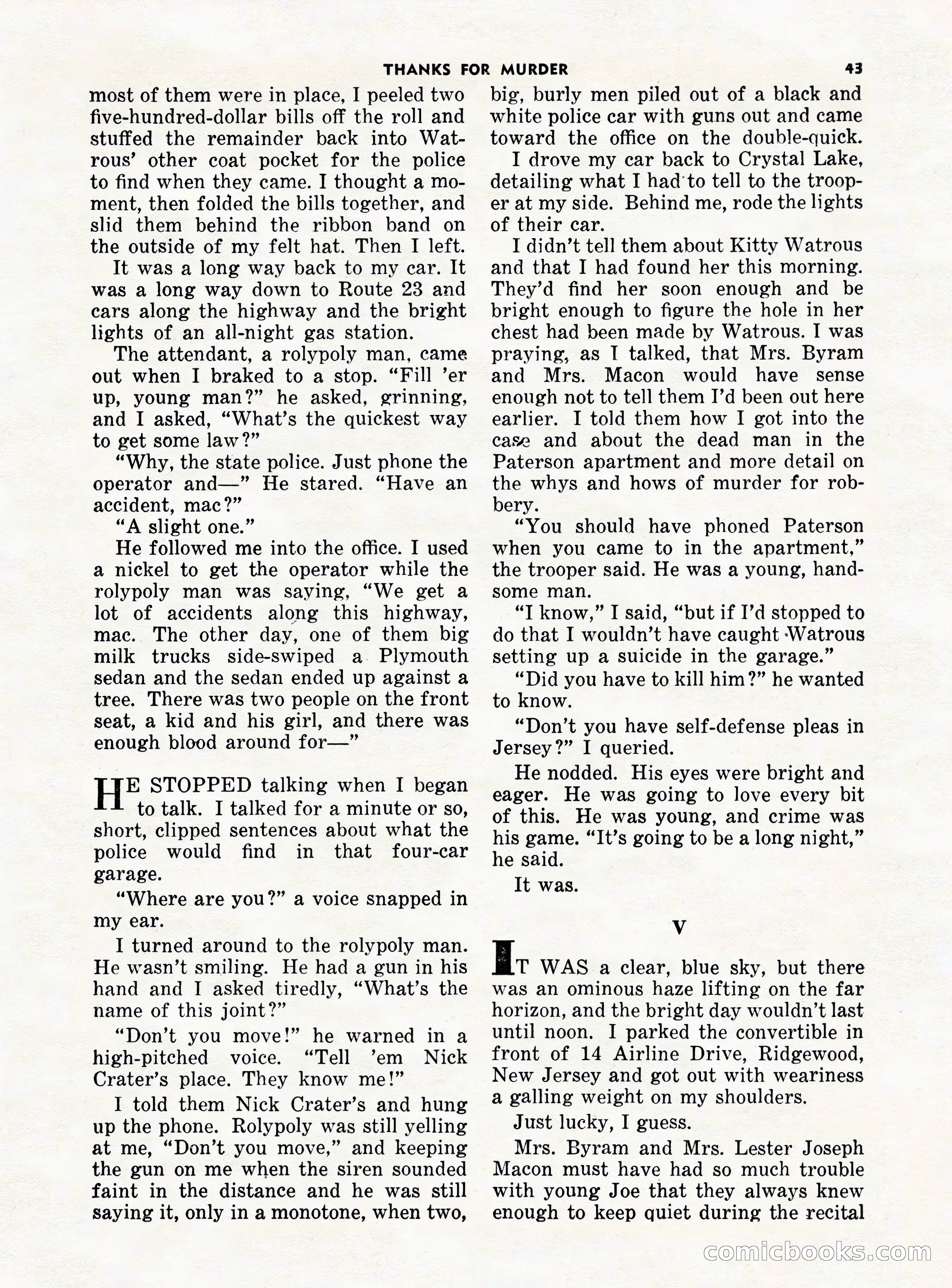
A restored page from Pulp Fiction, 1952. Page through the whole issue in the reader above.
📄 Transcribed text from this page (OCR, searchable)
Machine-transcribed from the original scan — historical spelling and the odd misread are preserved.
THANKS FOR MURDER most of them were in place, I peeled two five-hundred-dollar bills off the roll and stuffed the remainder back into Wat- rous’ other coat pocket for the police to find when they came. I thought a mo- ment, then folded the bills together, and slid them behind the ribbon band on the outside of my felt hat. Then I left. It was a long way back to my car. It was a long way down to Route 23 and cars along the highway and the bright lights of an all-night gas station. The attendant, a rolypoly man, came out when I braked to a stop. “Fill ’er up, young man?” he asked, grinning, and I asked, “What’s the quickest way to get some law?” “Why, the state police. Just phone the operator and—” He stared. “Have an accident, mac?” “A slight one.” He followed me into the office. I used a nickel to get the operator while the rolypoly man was saying, “We get a lot of accidents along this highway, mac. The other day, one of them big milk trucks side-swiped a. Plymouth sedan and the sedan ended up against a tree. There was two people on the front seat, a kid and his girl, and there was enough blood around for—” H* STOPPED talking when I began to talk. I talked for a minute or so, short, clipped sentences about what the police would find in that four-car garage. “Where are you?” a voice snapped in my ear. I turned around to the rolypoly man. He wasn’t smiling. He had a gun in his hand and I asked tiredly, “What’s the name of this joint?” “Don’t you move!” he warned in a high-pitched voice. “Tell ’em Nick Crater’s place. They know me!” I told them Nick Crater’s and hung up the phone. Rolypoly was still yelling at me, “Don’t you move,” and keeping the gun on me when the siren sounded faint in the distance and he was still saying it, only in a monotone, when two, 43 big, burly men piled out of a black and white police car with guns out and came toward the office on the double-quick. I drove my car back to Crystal Lake, detailing what I had'to tell to the troop- er at my side. Behind me, rode the lights of their car. I didn’t tell them about Kitty Watrous and that I had found her this morning. They’d find her soon enough and be bright enough to figure the hole in her chest had been made by Watrous. I was praying, as I talked, that Mrs. Byram and Mrs. Macon would have _ sense enough not to tell them I’d been out here earlier. I told them how I got into the case and about the dead man in the Paterson apartment and more detail on the whys and hows of murder for rob- bery. “You should have phoned Paterson when you came to in the apartment,” the trooper said. He was a young, hand- some man. “T know,” I said, “but if I’d stopped to do that I wouldn’t have caught -Watrous setting up a suicide in the garage.” “Did you have to kill him?” he wanted to know. “Don’t you have self-defense pleas in Jersey?” I queried. He nodded. His eyes were bright and eager. He was going to love every bit of this. He was young, and crime was his game. “It’s going to be a long night,” he said. It was. Vv i WAS a clear, blue sky, but there was an ominous haze lifting on the far horizon, and the bright day wouldn’t last until noon. I parked the convertible in front of 14 Airline Drive, Ridgewood, New Jersey and got out with weariness a galling weight on my shoulders. Just lucky, I guess. Mrs. Byram and Mrs. Lester Joseph Macon must have had so much trouble with young Joe that they always knew enough to keep quiet during the recital MICLOO C@ S