
Pulp Fiction, 1952 · page 13 of 132
5 Detective Novels Magazine — page 13: what you’re looking at
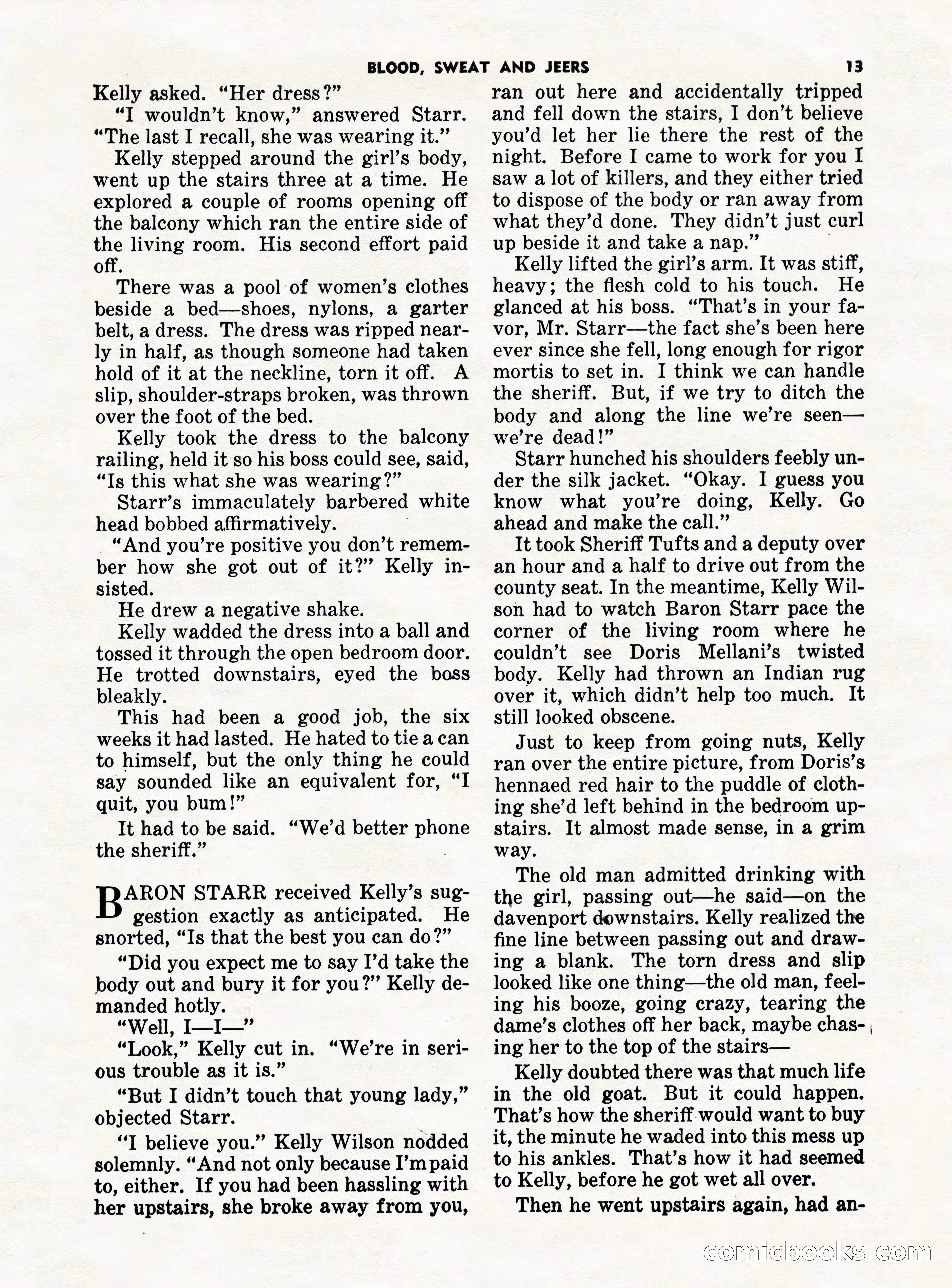
A restored page from Pulp Fiction, 1952. Page through the whole issue in the reader above.
📄 Transcribed text from this page (OCR, searchable)
Machine-transcribed from the original scan — historical spelling and the odd misread are preserved.
BLOOD, SWEAT AND JEERS Kelly asked. “Her dress?” “I wouldn’t know,” answered Starr. “The last I recall, she was wearing it.” Kelly stepped around the girl’s body, went up the stairs three at a time. He explored a couple of rooms opening off the balcony which ran the entire side of the living room. His second effort paid off. There was a pool of women’s clothes beside a bed—shoes, nylons, a garter belt, a dress. The dress was ripped near- ly in half, as though someone had taken hold of it at the neckline, torn it off. A slip, shoulder-straps broken, was thrown over the foot of the bed. Kelly took the dress to the balcony railing, held it so his boss could see, said, “Is this what she was wearing?” Starr’s immaculately barbered white head bobbed affirmatively. : _ “And you’re positive you don’t remem- ber how she got out of it?” Kelly in- sisted. He drew a negative shake. Kelly wadded the dress into a ball and tossed it through the open bedroom door. He trotted downstairs, eyed the boss bleakly. This had been a good job, the six weeks it had lasted. He hated to tie a can to himself, but the only thing he could say sounded like an equivalent for, “I quit, you bum!” It had to be said. “We’d better phone the sheriff.” Bates STARR received Kelly’s sug- gestion exactly as anticipated. He snorted, “Is that the best you can do?” “Did you expect me to say I’d take the body out and bury it for you?” Kelly de- manded hotly. “Well, I—I—” “Look,” Kelly cut in. “We’re in seri- ous trouble as it is.” “But I didn’t touch that young lady,” objected Starr. “I believe you.” Kelly Wilson nodded solemnly. “And not only because I’m paid to, either. If you had been hassling with her upstairs, she broke away from you, ran out here and accidentally tripped and fell down the stairs, I don’t believe you’d let her lie there the rest of the night. Before I came to work for you I saw a lot of killers, and they either tried to dispose of the body or ran away from what they’d done. They didn’t just curl up beside it and take a nap.” : Kelly lifted the girl’s arm. It was stiff, heavy; the flesh cold to his touch. He glanced at his boss. “That’s in your fa- vor, Mr. Starr—the fact she’s been here ever since she fell, long enough for rigor mortis to set in. I think we can handle the sheriff. But, if we try to ditch the body and along the line we’re seen— we're dead!” Starr hunched his shoulders feebly un- der the silk jacket. “Okay. I guess you know what you’re doing, Kelly. Go ahead and make the call.” It took Sheriff Tufts and a deputy over an hour and a half to drive out from the county seat. In the meantime, Kelly Wil- son had to watch Baron Starr pace the corner of the living room where he couldn’t see Doris Mellani’s twisted body. Kelly had thrown an Indian rug over it, which didn’t help too much. It still looked obscene. Just to keep from going nuts, Kelly ran over the entire picture, from Doris’s hennaed red hair to the puddle of cloth- ing she’d left behind in the bedroom up- stairs. It almost made sense, in a grim way. The old man admitted drinking with the girl, passing out—he said—on the davenport downstairs. Kelly realized the fine line between passing out and draw- ing a blank. The torn dress and slip looked like one thing—the old man, feel- ing his booze, going crazy, tearing the dame’s clothes off her back, maybe chas-, ing her to the top of the stairs— Kelly doubted there was that much life in the old goat. But it could happen. That’s how the sheriff would want to buy it, the minute he waded into this mess up to his ankles. That’s how it had seemed to Kelly, before he got wet all over. Then he went upstairs again, had an- MICLOO COMNMIC S