
Pulp Fiction, 1952 · page 116 of 132
5 Detective Novels Magazine — page 116: what you’re looking at
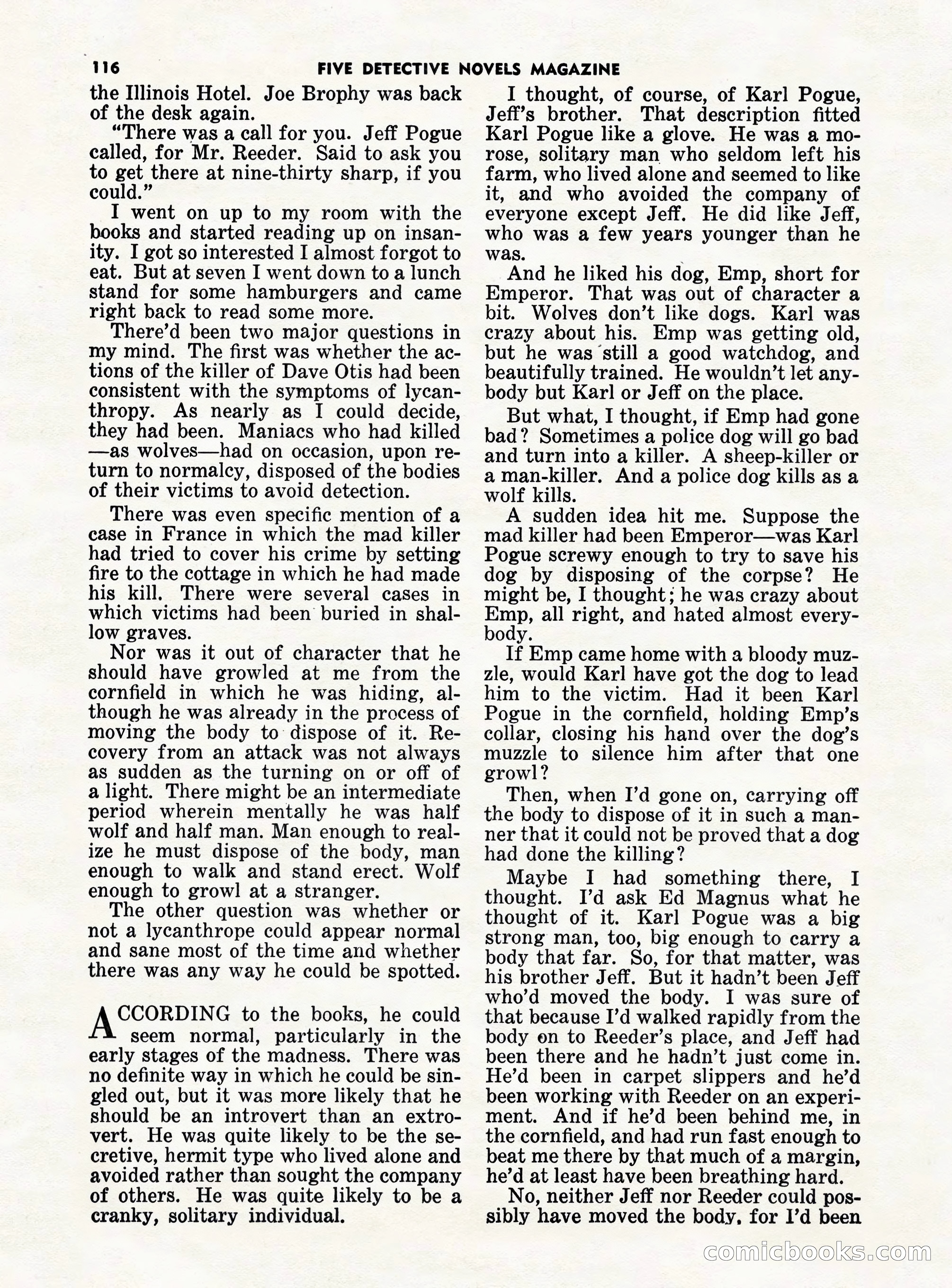
A restored page from Pulp Fiction, 1952. Page through the whole issue in the reader above.
📄 Transcribed text from this page (OCR, searchable)
Machine-transcribed from the original scan — historical spelling and the odd misread are preserved.
“116 the Illinois Hotel. Joe Brophy was back of the desk again. “There was a call for you. Jeff Pogue called, for Mr. Reeder. Said to ask you to get there at nine-thirty sharp, if you could.” I went on up to my room with the books and started reading up on insan- ity. I got so interested I almost forgot to eat. But at seven I went down to a lunch stand for some hamburgers and came right back to read some more. There’d been two major questions in my mind. The first was whether the ac- tions of the killer of Dave Otis had been consistent with the symptoms of lycan- thropy. As nearly as I could decide, they had been. Maniacs who had killed —as wolves—had on occasion, upon re- turn to normalcy, disposed of the bodies of their victims to avoid detection. There was even specific mention of a case in France in which the mad killer had tried to cover his crime by setting fire to the cottage in which he had made his kill, There were several cases in which victims had been buried in shal- low graves. Nor was it out of character that he should have growled at me from the cornfield in which he was hiding, al- though he was already in the process of moving the body to dispose of it. Re- covery from an attack was not always as sudden as the turning on or off of a light. There might be an intermediate period wherein mentally he was half wolf and half man. Man enough to real- ize he must dispose of the body, man enough to walk and stand erect. Wolf enough to growl at a stranger. The other question was whether or not a lycanthrope could appear normal and sane most of the time and whether there was any way he could be spotted. AP CORDS to the books, he could seem normal, particularly in the early stages of the madness. There was no definite way in which he could be sin- gled out, but it was more likely that he should be an introvert than an extro- vert. He was quite likely to be the se- cretive, hermit type who lived alone and avoided rather than sought the company of others. He was quite likely to be a cranky, solitary individual. FIVE DETECTIVE NOVELS MAGAZINE I thought, of course, of Kar] Pogue, Jeff’s brother. That description fitted Karl Pogue like a glove. He was a mo- rose, solitary man who seldom left his farm, who lived alone and seemed to like it, and who avoided the company of everyone except Jeff. He did like Jeff, who was a few years younger than he was. And he liked his dog, Emp, short for Emperor. That was out of character a bit. Wolves don’t like dogs. Karl was crazy about his. Emp was getting old, but he was still a good watchdog, and beautifully trained. He wouldn’t let any- body but Karl or Jeff on the place. But what, I thought, if Emp had gone bad? Sometimes a police dog will go bad and turn into a killer. A sheep-killer or a man-killer. And a police dog kills as a wolf kills. A sudden idea hit me. Suppose the mad killer had been Emperor—was Karl Pogue screwy enough to try to save his dog by disposing of the corpse? He might be, I thought; he was crazy about Emp, all right, and hated almost every- body. If Emp came home with a bloody muz- zle, would Karl have got the dog to lead him to the victim. Had it been Karl Pogue in the cornfield, holding Emp’s collar, closing his hand over the dog’s muzzle to silence him after that one growl? Then, when I’d gone on, carrying off the body to dispose of it in such a man- ner that it could not be proved that a dog had done the killing? Maybe I had something there, I thought. I’d ask Ed Magnus what he thought of it. Karl Pogue was a big strong man, too, big enough to carry a body that far. So, for that matter, was his brother Jeff. But it hadn’t been Jeff who’d moved the body. I was sure of that because I’d walked rapidly from the body on to Reeder’s place, and Jeff had been there and he hadn’t just come in. He’d been in carpet slippers and he’d been working with Reeder on an experi- ment. And if he’d been behind me, in the cornfield, and had run fast enough to beat me there by that much of a margin, he’d at least have been breathing hard. No, neither Jeff nor Reeder could pos- sibly have moved the body, for I’d been MICLOOOKS (C eo