
Pulp Fiction, 1952 · page 110 of 132
5 Detective Novels Magazine — page 110: what you’re looking at
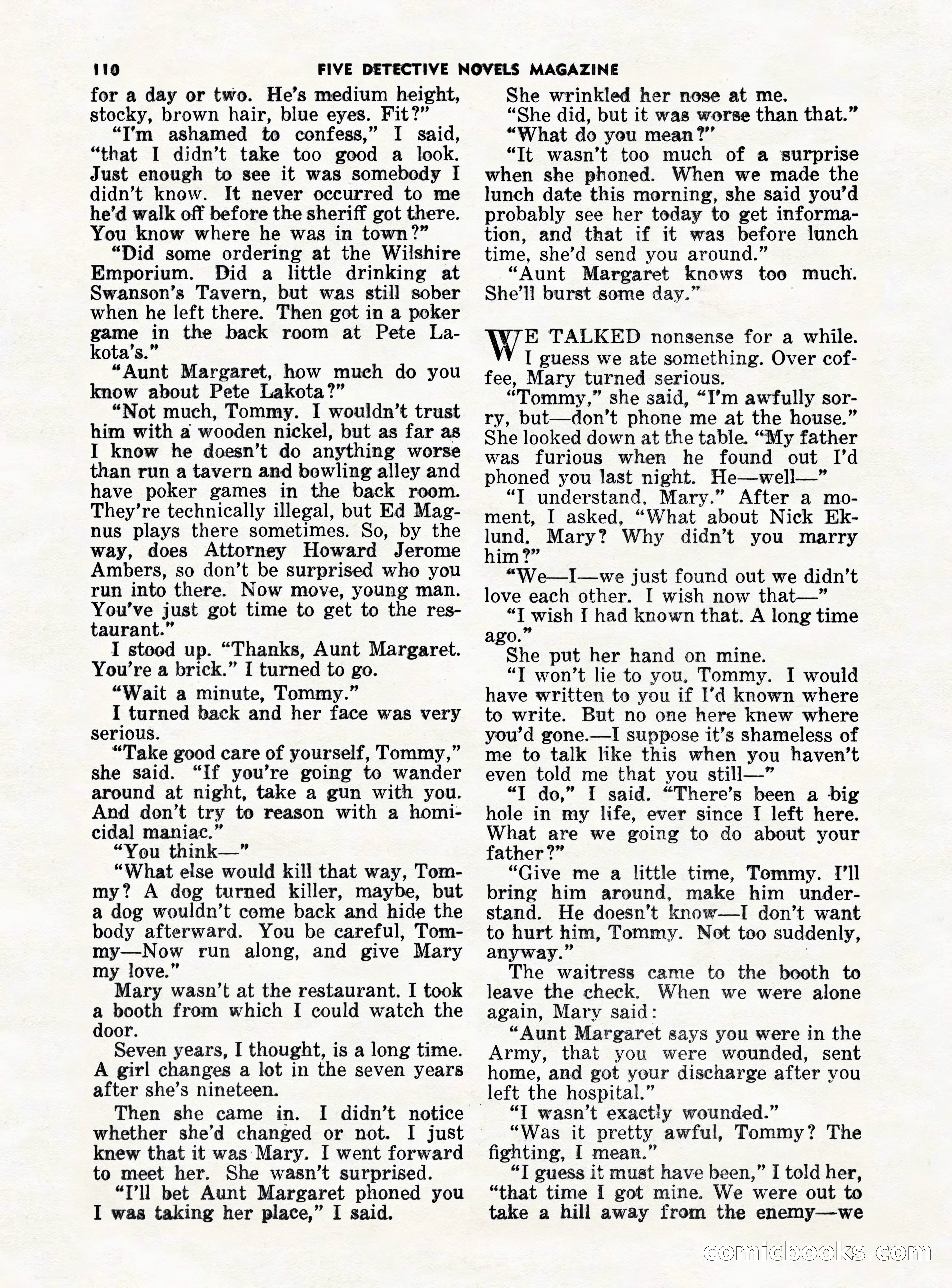
A restored page from Pulp Fiction, 1952. Page through the whole issue in the reader above.
📄 Transcribed text from this page (OCR, searchable)
Machine-transcribed from the original scan — historical spelling and the odd misread are preserved.
110 for a day or two. He’s medium height, stocky, brown hair, blue eyes. Fit?” “I’m ashamed to confess,” I said, “that I didn’t take too good a look. Just enough to see it was somebody I didn’t know. It never occurred to me he’d walk off before the sheriff got there. You know where he was in town?” “Did some ordering at the Wilshire Emporium. Did a little drinking at Swanson’s Tavern, but was still sober when he left there. Then got in a poker game in the back room at Pete La- kota’s.” “Aunt Margaret, how much do you know about Pete Lakota?” “Not much, Tommy. I wouldn’t trust him with a wooden nickel, but as far as I know he doesn’t do anything worse than run a tavern and bowling alley and have poker games in the back room. They’re technically illegal, but Ed Mag- nus plays there sometimes. So, by the way, does Attorney Howard Jerome Ambers, so don’t be surprised who you run into there. Now move, young man. You’ve just got time to get to the res- taurant.” I stood up. “Thanks, Aunt Margaret. You’re a brick.” I turned to go. “Wait a minute, Tommy.” I turned back and her face was very serious. “Take good care of yourself, Tommy,” she said. “If you’re going to wander around at night, take a gun with you. And don’t try to reason with a homi- cidal maniac.” “You think—” “What else would kill that way, Tom- my? A dog turned killer, maybe, but a dog wouldn’t come back and hide the body afterward. You be careful, Tom- my—Now run along, and give Mary my love.” Mary wasn’t at the restaurant. I took a booth from which I could watch the door. Seven years, I thought, is a long time. A girl changes a lot in the seven years after she’s nineteen. Then she came in. whether she’d changed or not. I just knew that it was Mary. I went forward to meet her. She wasn’t surprised. “T’ll bet Aunt Margaret phoned you I was taking her place,” I said. I didn’t notice © FIVE DETECTIVE NOVELS MAGAZINE She wrinkled her nose at me. “She did, but it was worse than that.” “What do you mean?” “It wasn’t too much of a surprise when she phoned. When we made the lunch date this morning, she said you’d probably see her teday to get informa- tion, and that if it was before lunch time, she’d send you around.” “Aunt Margaret knows too much. She’ll burst some day.” E TALKED nonsense for a while. I guess we ate something. Over cof- fee, Mary turned serious. “Tommy,” she said, “I’m awfully sor- ry, but—don’t phone me at the house.” She looked down at the table. “My father was furious when he found out I’d phoned you last night. He—well—” “TI understand, Mary.” After a mo- ment, I asked, “What about Nick Ek- lund, Mary? Why didn’t you marry him?” “W e—I—we just found out we didn’t love each other. I wish now that—” “I wish I had known that. A long time ago.” She put her hand on mine. “TI won’t lie to you, Tommy. I would have written to you if I’d known where to write. But no one here knew where you’d gone.—I suppose it’s shameless of me to talk like this when you haven’t even told me that you still—” “I do,” I said. “There’s been a big hole in my life, ever since I left here. What are we going to do about your father ?” “Give me a little time, Tommy. [’ll bring him around, make him under- stand. He doesn’t know—I don’t want to hurt him, Tommy. Not too suddenly, anyway.” The waitress came to the booth to leave the check. When we were alone again, Mary said: “Aunt Margaret says you were in the Army, that you were wounded, sent home, and got your discharge after vou left the hospital.” “I wasn’t exactly wounded.” “Was it pretty awful, Tommy? The fighting, [ mean.” “IT guess it must have been,” I told her, “that time I got mine. We were out to take a hill away from the enemy—we MICLOO (CO) SH (C(O)