
Pulp Fiction, 1951 · page 6 of 132
5 Detective Novels Magazine Cover — page 6: what you’re looking at
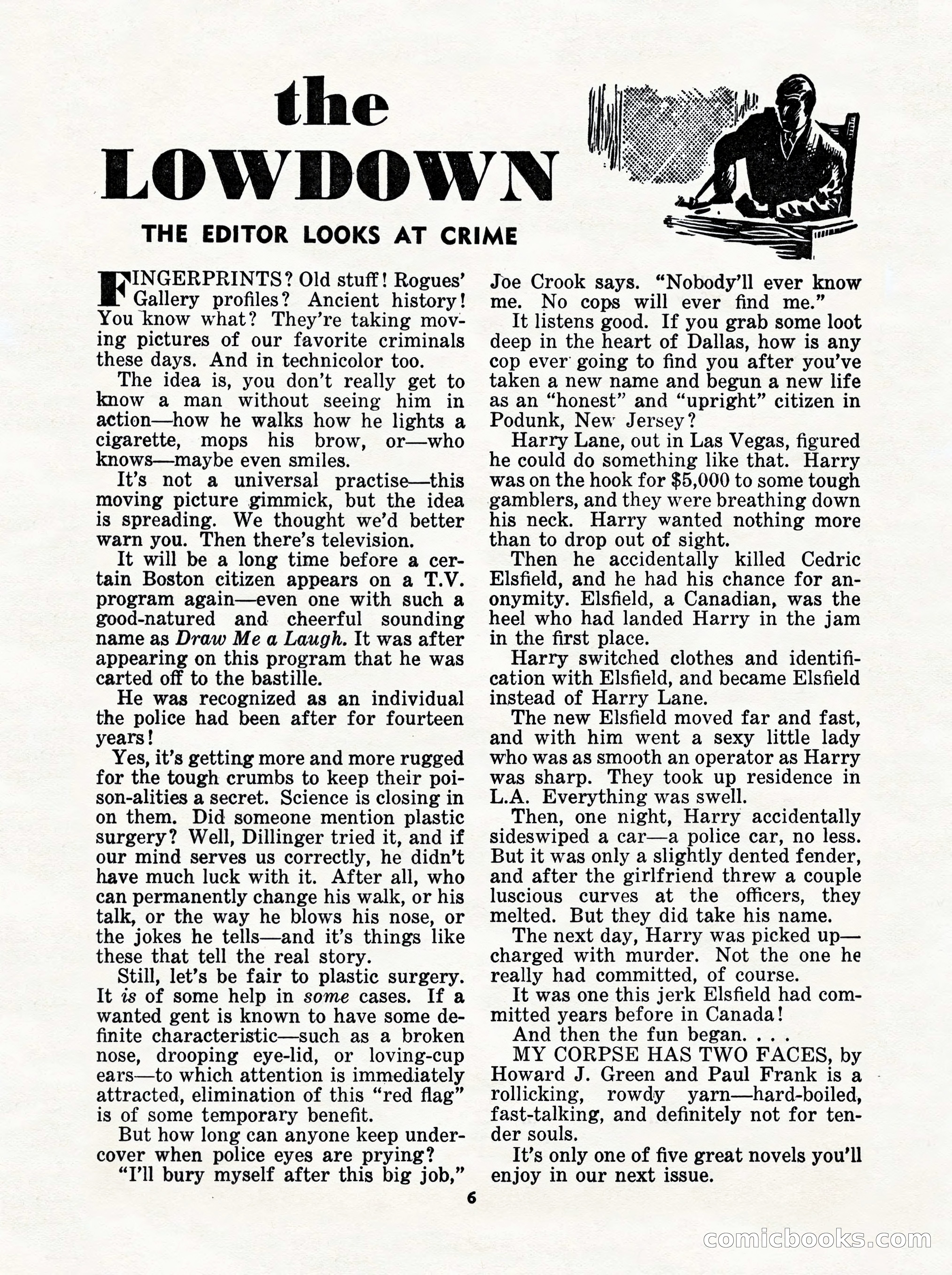
A restored page from Pulp Fiction, 1951. Page through the whole issue in the reader above.
📄 Transcribed text from this page (OCR, searchable)
Machine-transcribed from the original scan — historical spelling and the odd misread are preserved.
LOWDOWN | THE EDITOR LOOKS AT CRIME INGERPRINTS? Old stuff! Rogues’ Gallery profiles? Ancient history! You know what? They’re taking mov- ing pictures of our favorite criminals these days. And in technicolor too. The idea is, you don’t really get to know a man without seeing him in action—how he walks how he lights a cigarette, mops his brow, or—who knows—maybe even smiles. It’s not a universal practise—this moving picture gimmick, but the idea is spreading. We thought we’d better warn you. Then there’s television. It will be a long time before a cer- tain Boston citizen appears on a T.V. program again—even one with such a good-natured and cheerful sounding name as Draw Me a Laugh. It was after appearing on this program that he was carted off to the bastille. He was recognized as an individual the police had been after for fourteen years! : Yes, it’s getting more and more rugged for the tough crumbs to keep their poi- son-alities a secret. Science is closing in on them. Did someone mention plastic surgery? Well, Dillinger tried it, and if our mind serves us correctly, he didn’t have much luck with it. After all, who can permanently change his walk, or his talk, or the way he blows his nose, or the jokes he tells—and it’s things like these that tell the real story. Still, let’s be fair to plastic surgery. It 2s of some help in some cases. If a wanted gent is known to have some de- finite characteristic—such as a broken nose, drooping eye-lid, or loving-cup ears—to which attention is immediately attracted, elimination of this “red flag” is of some temporary benefit. But how long can anyone keep under- cover when police eyes are prying? “T’ll bury myself after this big job,” 6 . it, ry . +, KEE + tae, ee eee ' o.e,°, I PAS ‘ mt) ’ O36. Mee OR) Porore's recone Cs & " ON OOOO ’ OO staey? ' torent ooste! om poses Se ae? OR SO me. No cops will ever find me.” It listens good. If you grab some loot deep in the heart of Dallas, how is any cop ever’ going to find you after you’ve taken a new name and begun a new life as an “honest” and “upright” citizen in Podunk, New Jersey? Harry Lane, out in Las Vegas, figured he could do something like that. Harry was on the hook for $5,000 to some tough gamblers, and they were breathing down his neck. Harry wanted nothing more than to drop out of sight. Then he accidentally killed Cedric Elsfield, and he had his chance for an- onymity. Elsfield, a Canadian, was the heel who had landed Harry in the jam in the first place. Harry switched clothes and identifi- cation with Elsfield, and became Elsfield instead of Harry Lane. The new Elsfield moved far and fast, and with him went a sexy little lady who was as smooth an operator as Harry was sharp. They took up residence in L.A. Everything was swell. Then, one night, Harry accidentally sideswiped a car—a police car, no less. But it was only a slightly dented fender, and after the girlfriend threw a couple luscious curves at the officers, they melted. But they did take his name. The next day, Harry was picked up— charged with murder. Not the one he really had committed, of course. It was one this jerk Elsfield had com- mitted years before in Canada! And then the fun began.... MY CORPSE HAS TWO FACES, by Howard J. Green and Paul Frank isa - rollicking, rowdy yarn—hard-boiled, fast-talking, and definitely not for ten- der souls. It’s only one of five great novels you'll enjoy in our next issue. LAOO = A (C(O) (C(O)