
Pulp Fiction, 1955 · page 45 of 99
2-Gun Western, November 1955 — page 45: what you’re looking at
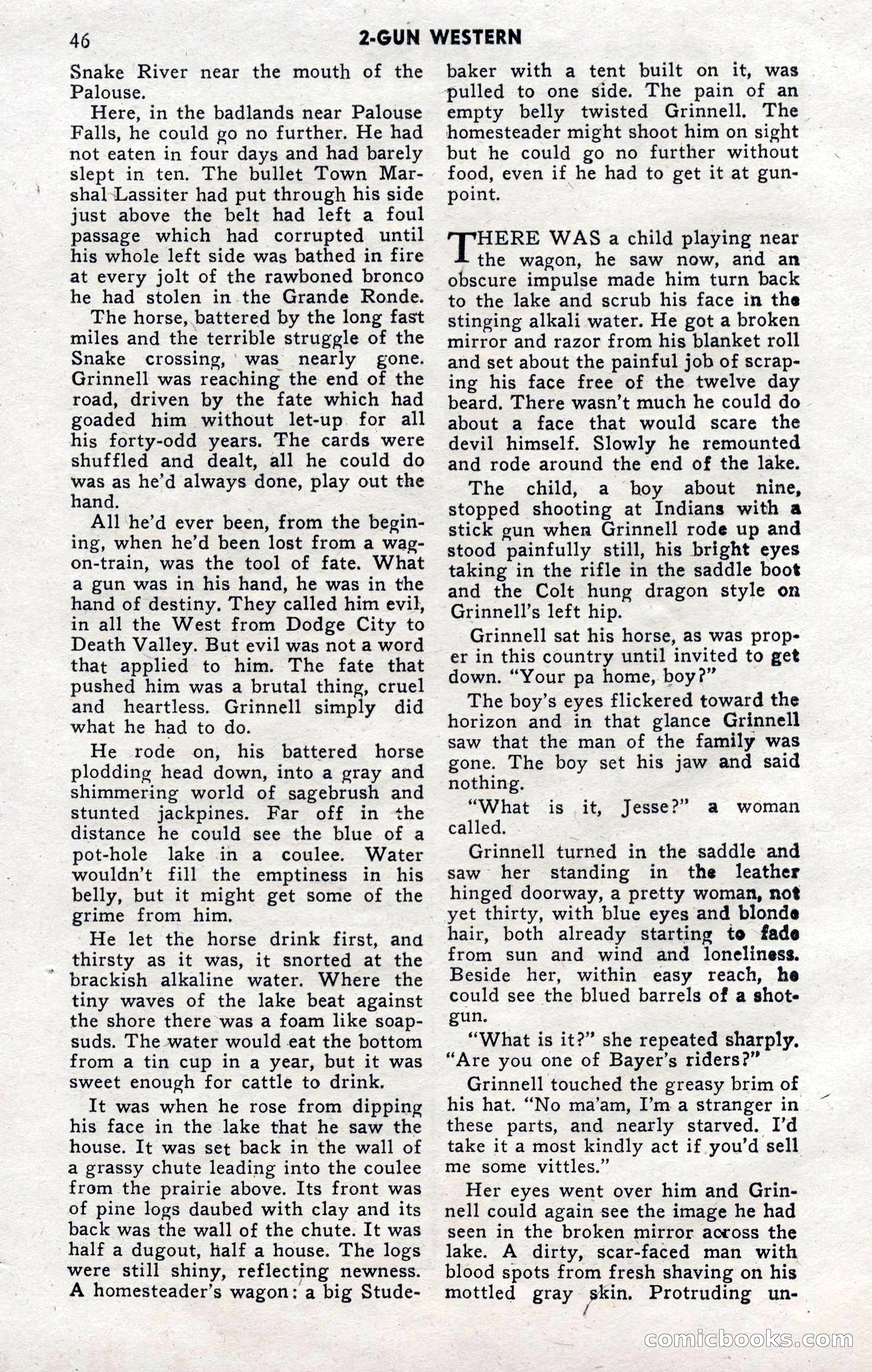
A restored page from Pulp Fiction, 1955. Page through the whole issue in the reader above.
📄 Transcribed text from this page (OCR, searchable)
Machine-transcribed from the original scan — historical spelling and the odd misread are preserved.
46 Snake River near the mouth of the Palouse. Here, in the badlands near Palouse Falls, he could go no further. He had not eaten in four days and had barely slept in ten. The bullet Town Mar- shal-Lassiter had put through his side just above the belt had left a foul passage which had corrupted until his whole left side was bathed in fire at every jolt of the rawboned bronco he had stolen in the Grande Ronde. The horse, battered by the long fast miles and the terrible struggle of the Snake crossing, was nearly gone. Grinnell was reaching the end of the road, driven by the fate which had goaded him without let-up for all his forty-odd years. The cards were shuffled and dealt, all he could do was as he’d always done, play out the hand. All he’d ever been, from the begin- ing, when he’d been lost from a wag- on-train, was the tool of fate. What a gun was in his hand, he was in the hand of destiny. They called him evil, in all the West from Dodge City to Death Valley. But evil was not a word that applied to him. The fate that pushed him was a brutal thing, cruel and heartless. Grinnell simply did what he had to do. He rode on, his battered horse plodding head down, into a gray and shimmering world of sagebrush and stunted jackpines. Far off in the distance he could see the blue of a pot-hole lake in a coulee. Water wouldn’t fill the emptiness in his belly, but it might get some of the grime from him. He let the horse drink first, and _ thirsty as it was, it snorted at the brackish alkaline water. Where the tiny waves of the lake beat against the shore there was a foam like soap- suds. The water would eat the bottom from a tin cup in a year, but it was sweet enough for cattle to drink. It was when he rose from dipping his face in the lake that he saw the house. It was set back in the wall of a grassy chute leading into the coulee from the prairie above. Its front was of pine logs daubed with clay and its back was the wall of the chute. It was half a dugout, half a house. The logs were still shiny, reflecting newness. A homesteader’s wagon: a big Stude- 2-GUN WESTERN baker with a tent built on it, was pulled to one side. The pain of an empty belly twisted Grinnell. The homesteader might shoot him on sight but he could go no further without food, even if he had to get it at gun- © point. pees WAS a child playing near the wagon, he saw now, and an obscure impulse made him turn back to the lake and scrub his face in the stinging alkali water. He got a broken mirror and razor from his blanket roll and set about the painful job of scrap- ing his face free of the twelve day beard. There wasn’t much he could do about a face that would scare the devil himself. Slowly he remounted and rode around the end of the lake. The child, a hoy about nine, stopped shooting at Indians with a stick gun when Grinnell rode up and stood painfully still, his bright eyes taking in the rifle in the saddle boot and the Colt hung dragon style on Grinnell’s left hip. Grinnell sat his horse, as was prop- er in this country until invited to get down. “Your pa home, boy?” The boy’s eyes flickered toward the horizon and in that glance Grinnell saw that the man of the family was gone. The boy set his jaw and said nothing. “What called. Grinnell turned in the saddle and saw her standing in the leather hinged doorway, a pretty woman, not yet thirty, with blue eyes and blonde hair, both already starting te fade from sun and wind and loneliness. Beside her, within easy reach, he could see the blued barrels of a shote gun. “What is it?” she repeated sharply. “Are you one of Bayer’s riders?” is it, Jesse?” a woman Grinnell touched the greasy brim of his hat. “No ma’am, I’m a stranger in these parts, and nearly starved. I’d take it a most kindly act if you’d sell me some vittles.” Her eyes went over him and Grin- nell could again see the image he had seen in the broken mirror across the lake. A dirty, scar-faced man with blood spots from fresh shaving on his mottled gray pain. Protruding un- oO COLMIcLoo S CO