
Pulp Fiction, 1955 · page 34 of 99
2-Gun Western, November 1955 — page 34: what you’re looking at
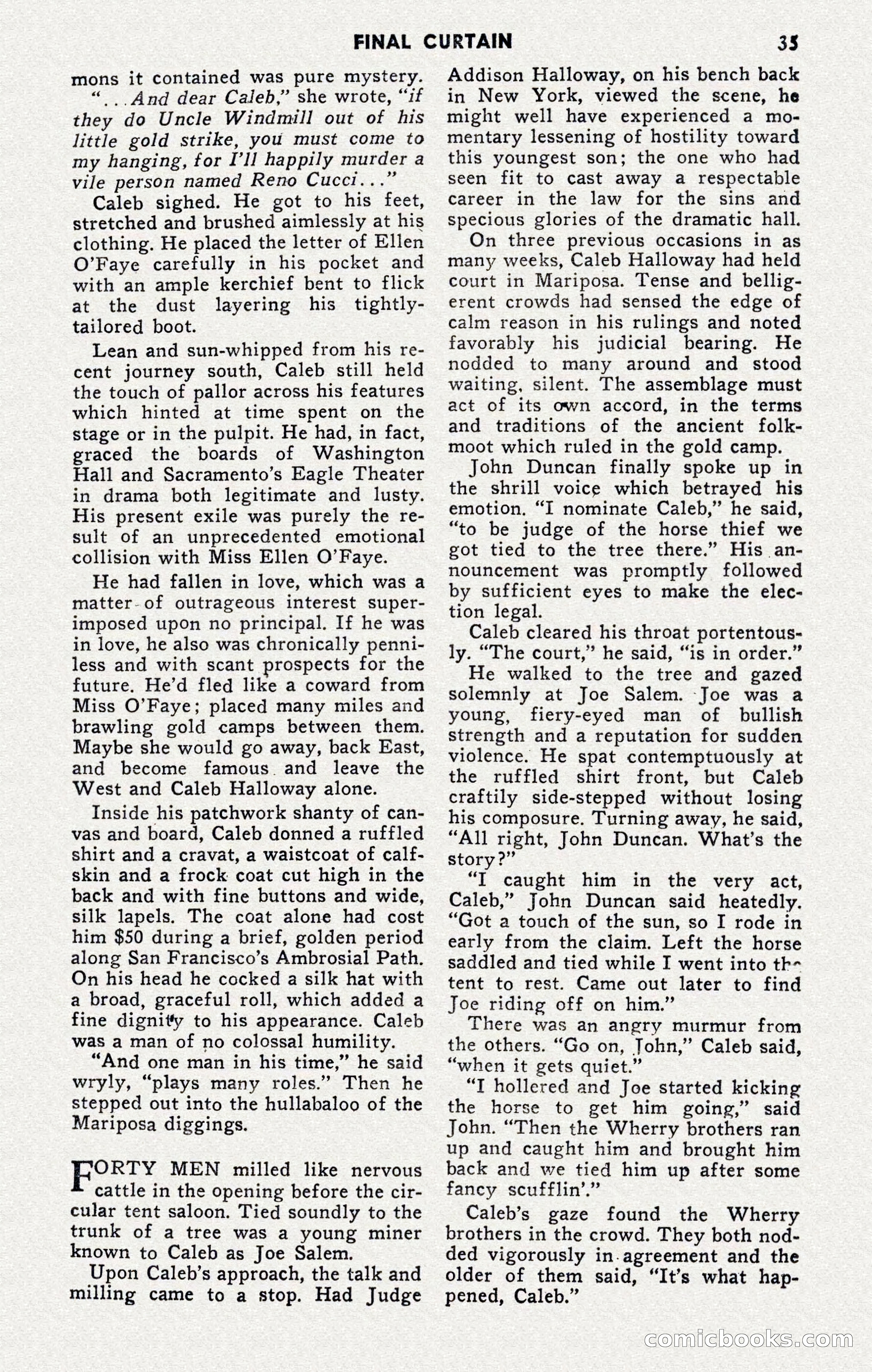
A restored page from Pulp Fiction, 1955. Page through the whole issue in the reader above.
📄 Transcribed text from this page (OCR, searchable)
Machine-transcribed from the original scan — historical spelling and the odd misread are preserved.
FINAL CURTAIN 33 mons it contained was pure mystery. “And dear Caleb,” she wrote, “if they do Uncle Windmill out of his little gold strike, you must come to my hanging, for I'll happily murder a vile person named Reno Cucci...” Caleb sighed. He got to his feet, stretched and brushed aimlessly at his clothing. He placed the letter of Ellen O’Faye carefully in his pocket and with an ample kerchief bent to flick at the dust layering his tightly- tailored boot. Lean and sun-whipped from his re- cent journey south, Caleb still held the touch of pallor across his features which hinted at time spent on the stage or in the pulpit. He had, in fact, graced the boards of Washington Hall and Sacramento’s Eagle Theater in drama both legitimate and lusty. His present exile was purely the re- sult of an unprecedented emotional collision with Miss Ellen O’Faye. He had fallen in love, which was a matter-of outrageous interest super- imposed upon no principal. If he was in love, he also was chronically penni- less and with scant prospects for the future. He’d fled like a coward from Miss O’Faye; placed many miles and brawling gold camps between them. Maybe she would go away, back East, and become famous. and leave the West and Caleb Halloway alone. Inside his patchwork shanty of can- vas and board, Caleb donned a ruffled shirt and a cravat, a waistcoat of calf- skin and a frock coat cut high in the back and with fine buttons and wide, silk lapels. The coat alone had cost him $50 during a brief, golden period along San Francisco’s Ambrosial Path. On his head he cocked a silk hat with a broad, graceful roll, which added a fine dignity to his appearance. Caleb was a man of no colossal humility. “And one man in his time,” he said wryly, “plays many roles.” Then he stepped out into the hullabaloo of the Mariposa diggings. ORTY MEN milled like nervous cattle in the opening before the cir- cular tent saloon. Tied soundly to the trunk of a tree was a young miner known to Caleb as Joe Salem. Upon Caleb’s approach, the talk and milling came to a stop. Had Judge Addison Halloway, on his bench back in New York, viewed the scene, he might well have experienced a mo- mentary lessening of hostility toward this youngest son; the one who had seen fit to cast away a respectable career in the law for the sins and specious glories of the dramatic hall. On three previous occasions in as many weeks, Caleb Halloway had held court in Mariposa. Tense and bellig- erent crowds had sensed the edge of calm reason in his rulings and noted favorably his judicial bearing. He nodded to many around and stood waiting, silent. The assemblage must act of its own accord, in the terms and traditions of the ancient folk- moot which ruled in the gold camp. John Duncan finally spoke up in the shrill voice which betrayed his emotion, “I nominate Caleb,” he said, “to be judge of the horse thief we got tied to the tree there.” His an- nouncement was promptly followed by sufficient eyes to make the elec- tion legal. Caleb cleared his throat portentous- ly. “The court,” he said, “is in order.” He walked to the tree and gazed solemnly at Joe Salem. Joe was a young, fiery-eyed man of bullish strength and a reputation for sudden violence. He spat contemptuously at the ruffled shirt front, but Caleb craftily side-stepped without losing his composure. Turning away, he said, “All right, John Duncan. What’s the story?” “I caught him in the very act, Caleb,” John Duncan said heatedly. “Got a touch of the sun, so I rode in early from the claim. Left the horse saddled and tied while I went into th- tent to rest. Came out later to find Joe riding off on him.” There was an angry murmur from the others. “Go on, John,” Caleb said, “when it gets quiet.” “T hollered and Joe started kicking the horse to get him going,” said John. “Then the Wherry brothers ran up and caught him and brought him back and we tied him up after some fancy scufflin’.” Caleb’s gaze found the Wherry brothers in the crowd. They both nod- ded vigorously in-agreement and the older of them said, “It’s what hap- pened, Caleb.” Oo conmmilclbooks C©