
Pulp Fiction, 1955 · page 50 of 100
2-Gun Western, November 1955 — page 50: what you’re looking at
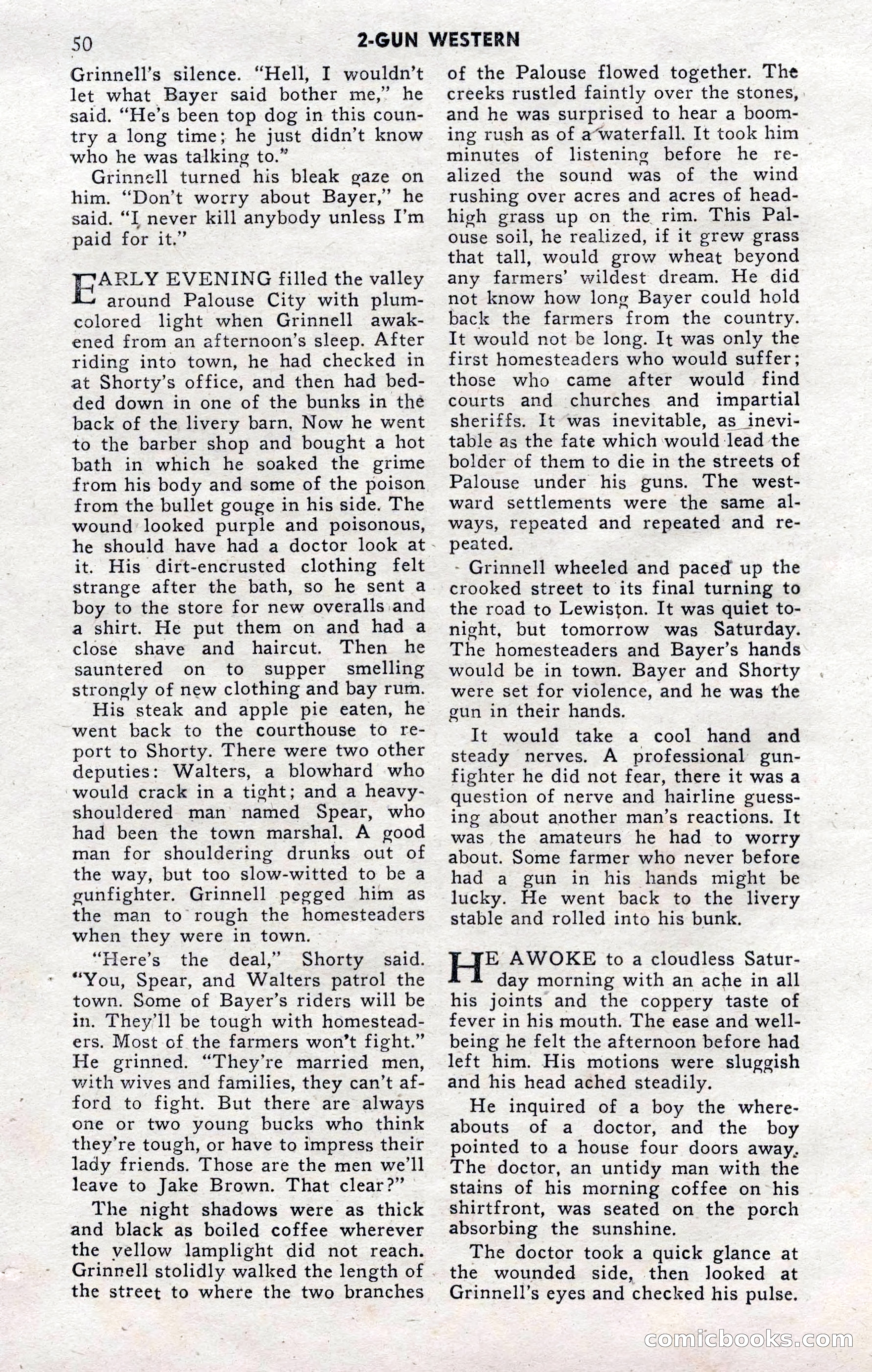
A restored page from Pulp Fiction, 1955. Page through the whole issue in the reader above.
📄 Transcribed text from this page (OCR, searchable)
Machine-transcribed from the original scan — historical spelling and the odd misread are preserved.
50 Grinnell’s silence. “Hell, I wouldn't let what Bayer said bother me.. “he said. “He’s been top dog in this coun- try a long time; he just didn’t know who he was talking to.” Grinnell turned his bleak gaze on him. “Don’t worry about Bayer,’ he said. “I never kill anybody unless I’m paid for it.” ARLY EVENING filled the valley around Palouse City with plum- colored light when Grinnell awak- ened from an afternoon’s sleep. After riding into town, he had checked in at Shorty’ s office, and then had bed- ded down in one of the bunks in the back of the livery barn, Now he went to the barber shop and bought a hot bath in which he soaked the grime from his body and some of the poison from the bullet gouge in his side. The wound looked purple and poisonous, he should have had a doctor look at- it. His dirt-encrusted clothing felt strange after the bath, so he sent a boy to the store for new overalls and a shirt. He put them on and had a _ close shave and haircut. Then he sauntered on to supper smelling strongly of new clothing and bay rum. His steak and apple pie eaten, he went back to the courthouse to re- port to Shorty. There were two other deputies: Walters, a blowhard who would crack in a tight; and a heavy- shouldered man named Spear, who had been the town marshal. A good man for shouldering drunks out of the way, but too slow-witted to be a gunfighter. Grinnell pegged him as the man to rough the homesteaders when they were in town. | ‘“Here’s the deal,” Shorty said. “You, Spear, and Walters patrol the town. Some of Bayer’s riders will be in. They'll be tough with homestead- ers. Most of the farmers won’t fight.” He grinned. “They’re married men, with wives and families, they can’t af- ford to fight. But there are always one or two young bucks who think they're tough, or have to impress their lady friends. Those are the men we'll leave to Jake Brown. That clear?” The night shadows were as thick and black as boiled coffee wherever the vellow lamplight did not reach. Grinnell stolidly walked the length of the street to where the two branches 2-GUN WESTERN of the Palouse flowed together. The creeks rustled faintly over the stones, and he was surprised to hear a boom- ing rush as of a“waterfall. It took him minutes of listening before he re- alized the sound was of the wind rushing over acres and acres of head- high grass up on the rim. This Pal- ouse soil, he realized, if it grew grass that tall, would grow wheat beyond any farmers’ wildest dream. He did not know how long Bayer could hold back the farmers from the country. It would not be long. It was only the first homesteaders who would suffer; those who came after would find courts and churches and impartial sheriffs. It was inevitable, as inevi- table as the fate which would lead the bolder of them to die in the streets of Palouse under his guns. The west- ward settlements were the same al- ways, repeated and repeated and re- peated. - Grinnell wheeled and paced up the crooked street to its final turning to the road to Lewiston. It was quiet to- night, but tomorrow was Saturday. The homesteaders and Bayer’s hands would be in town. Bayer and Shorty were set for violence, and he was the gun in their hands. It would take a cool hand and steady nerves. A professional gun- fighter he did not fear, there it was a question of nerve and hairline guess- ing about another man’s reactions. It was the amateurs he had to worry about. Some farmer who never before had a gun in his hands might be lucky. He went back to the livery stable and rolled into his bunk. E AWOKE to a cloudless Satur- day morning with an ache in all his joints and the coppery taste of fever in his mouth. The ease and well- being he felt the afternoon before had left him. His motions were sluggish and his head ached steadily. He inquired of a boy the where- abouts of a doctor, and the boy pointed to a house four doors away, The doctor, an untidy man with the stains of his morning coffee on his shirtfront, was seated on the porch absorbing the sunshine. The doctor took a quick glance at the wounded side, then looked at Grinnell’s eyes and ‘checked his pulse. Cconmmicloo S CO Ff)